


The minister of economic affairs has become the latest victim of the usual game of finger-pointing in Taiwan’s political scene following the gas leaks that caused a series of deadly explosions in Greater Kaohsiung last week.
In a written statement issued yesterday evening, Minister of Economic Affairs Chang Chia-juch (張家祝) said he had tendered his resignation to the Executive Yuan.
Chang said in the statement that he was resigning because of the “difficult political environment” as a result of the “persistent boycott by opposition parties” over several economic policies in the past one-and-a-half years.
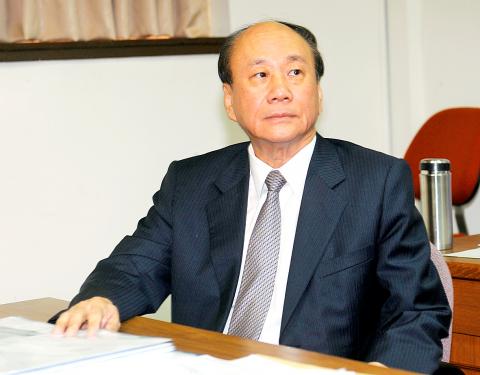
Photo: CNA
“As the ministry’s major policies are still facing difficulties moving forward, I am exhausted,” Chang said.
Executive Yuan spokesperson Sun Lih-chyun (孫立群) confirmed that Chang had offered to resign at 10am yesterday in a telephone call to Premier Jiang Yi-huah (江宜樺).
However, Sun said that in light of the efforts Chang had made to improve the nation’s economy, “Jiang would try to persuade Chang to stay on.”
President Ma Ying-jeou (馬英九) fully supported Jiang’s decision to retain Chang, Presidential Office spokesman Ma Wei-kuo (馬瑋國) said.
In the wake of Chang’s resignation, Deputy Minister of Economic Affairs Woody Duh (杜紫軍) said he would follow suit.
Duh’s resignation will be conditional on Chang’s.
Chang, who is in charge of the Central Disaster Response Center handling the aftermath of the explosions, said the ministry had made every effort in rescue and reconstruction work.
Earlier yesterday, Chang was criticized as “heartless” by legislators from the opposition party at a meeting of the legislature’s Economics Committee.
“How many times have you visited the explosion sites?” Democratic Progressive Party (DPP) Legislator Chen Chi-mai (陳其邁) asked Chang. “Why are you still sitting here when the public memorial service for victims of the explosions last week is to be held this afternoon?”
Chen said the ministry should not blame the Greater Kaohsiung Government for the accident, since the ministry is in charge of the petrochemical industry.
Before Chang announced his resignation, four officials at the Greater Kaohsiung Government, including Deputy Mayor Wu Hong-mo (吳宏謀), Water Resources Bureau Director Lee Hsien-yi (李賢義), Public Works Bureau Director Yang Ming-jou (楊明州) and Kaohsiung Mass Rapid Transit Bureau Director Chen Tsun-yung (陳存永), tendered their resignations to take responsibility for the blasts.
Their resignations came after Kaohsiung Mayor Chen Chu (陳菊) apologized for “poor horizontal coordination” among different bureaus following the revelation that the municipality’s Mass Rapid Transit Bureau had known about the existence of LCY Chemical Corp’s (李長榮化工) pipelines when it undertook a site investigation for a light rail system.
Chinese Nationalist Party (KMT) Legislator Lin Kuo-cheng (林國正) made public an official document showing that LCY Chemical was invited by the Mass Rapid Transit Bureau to attend a meeting about the pipelines before the construction of the light rail system.
However, Chen Chu denied that she had lied about not knowing about LCY Chemical’s pipeline, saying the lapse was due to serious lack of coordination between departments.
Yang said although the regulations require pipeline owners to upload location information to the local government’s database, LCY Chemical’s pipeline records were absent from the bureau’s database.
It was also revealed yesterday that the construction of the box culvert, which the pipeline was attached to, was approved in 1991 by Wu, who was then-chief of the design section at the bureau’s Hydraulic Engineering Office.
As of press time it had not been confirmed whether the resignations had been accepted by Chen Chu.
Additional reporting by Camaron Kao and Shih Hsiu-chuan

A signaling system malfunction disrupted high-speed rail (HSR) services beginning at 8am today, with trains temporarily reduced to three northbound and three southbound trains per hour as authorities conduct inspections. The malfunction occurred on a section of track in Miaoli County during pre-operation checks early this morning, forcing northbound and southbound trains to use a single track, the HSR operator said. The regular schedule has been replaced with three hourly trains offering only nonreserved seating in each direction, stopping at every station, it said, adding that business class cars would still have reserved seating. Departures from terminal stations are scheduled at the top

DRONE CENTRAL: Taiwan aims to become Asia’s democratic hub for drones, with most exports focused on high-quality military-grade models, an official said Taiwan’s drone industry is expected to expand significantly by 2030, producing 100,000 units per month and exporting half of them, the Ministry of Economic Affairs said yesterday. Current drone production capacity is about 15,000 units per month, but the industry can quickly scale up as demand increases, Industrial Development Administration Director-General Chiou Chyou-huey (邱求慧) told a news conference in Taipei. Taiwan’s drone output grew 2.5-fold last year to NT$12.9 billion (US$408.3 million) under a government program to develop the uncrewed vehicle sector, he said. The Executive Yuan in October last year approved plans to invest NT$44.2 billion into domestic production of uncrewed aerial

VERBOSE VESSELS: A CGA cutter and a China Coast Guard exchanged verbal barbs for more than a day in Taiwanese-controlled waters before the Chinese vessel left The Taiwanese and Chinese coast guards had a standoff near the strategically located Pratas Islands (Dongsha Islands, 東沙群島) in the north of the South China Sea, the Coast Guard Administration (CGA) said yesterday. The two sides engaged in intense radio exchanges over sovereignty claims during the 33-hour standoff. China Coast Guard vessel 3501 eventually left the restricted waters, 26.6 nautical miles (49.2km) west of the Pratas Islands, at 5pm yesterday, the CGA said. Lying approximately between southern Taiwan and Hong Kong, the Taiwan-controlled Pratas are seen by some security experts as vulnerable to Chinese attack due to their distance — more than
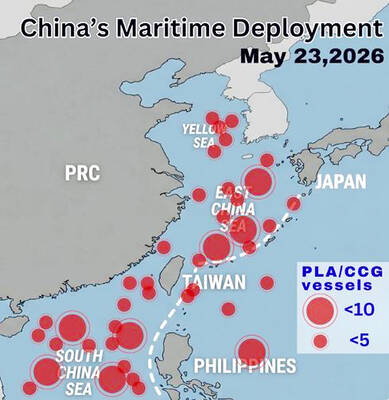
WARNING: China should stop engaging in actions that undermine regional peace and stability, as it would only build resentment among people across the Strait, the CGA said China has deployed more than 100 navy, coast guard and other vessels in waters from the Yellow Sea to the South China Sea and the western Pacific since US President Donald Trump and Chinese President Xi Jinping (習近平) met in Beijing, National Security Council Secretary-General Joseph Wu (吳釗燮) said yesterday. “In this part of the world, #China is the one & only PROBLEM wrecking the #StatusQuo & threatening regional peace & stability,” Wu wrote on X. In a separate post, he said Beijing was coercing Taiwan’s maritime domain, calling it illegal and provocative, after the Coast Guard Administration (CGA) expelled a


 RSS
RSS