


Giving Greater Taichung Mayor Jason Hu (胡志強) a thumbs-up for planning the central city’s new Bus Rapid Transit (BRT) blue line that he said is as good as a subway, President Ma Ying-jeou (馬英九) yesterday also lauded Hu’s governance as better than that of Taipei Mayor Hau Lung-bin (郝龍斌).
Ma made the remarks after a 3.5km ride on the Bus Rapid Transit route along Taiwan Boulevard on the eve of the opening of its year-long free service.
Ma, who is also Chinese Nationalist Party (KMT) chairman, said that every time he visits Greater Taichung, the city gives him a different impression, as it is gradually transforming into an international metropolis.
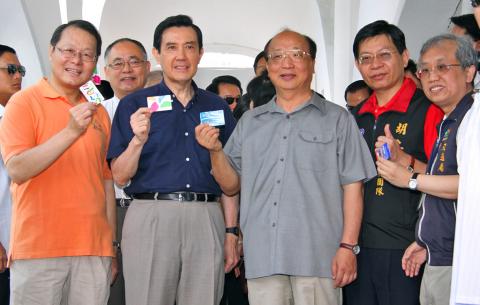
Photo: CNA
He touted the effort Hu has put into the regeneration of Maple Park, describing it as an example of “turning trash into treasure.”
Saying the bus system offers a great view along its route, Ma said he thinks the public transportation system is better than Taipei’s MRT metropolitan rail system, which is mostly underground.
Ma said he thinks the acronym “BRT” should stand for “Bravo Remarkable Taichung,” expressing hopes that there will be good follow-up work that can make the system in Taichung a model for public transport development in other cities.
Hu, a KMT member running for re-election in the Nov. 29 elections, was smiling ear to ear in response to Ma’s praise.
The 17.2km-long blue line connects Taichung’s railway station and Providence University in the western part of the city. It is one of six BRT lines that are expected to be completed one after another, with the final line opening in 2019.
The system consists of articulated buses — whose sections are connected by a pivoting point — that can carry up to 120 passengers and, for the most part, travels in a dedicated bus lane.
For the next year, passengers using electronic travel cards such as an EasyCard or iPass can use the blue line for free.
Ma also touted Hu’s management of government funds, saying he was more capable than Hau at reducing city government deficits.
In response, Hau, a KMT member, later yesterday said through a Taipei City Government spokesperson that he believes city policies should be judged as an integrated whole, adding that he thinks different cities can learn from each other’s strengths and together become better.
Separately, when questioned by reporters, independent Taipei mayoral candidate Ko Wen-je (柯文哲) said Ma made a gaffe in his compliments for Hu.
It seems Ma’s definition of “good governance” is different from that held by the general public, Ko said, likening Hau and Hu’s mayoral stints to a test in which the mayors are like two students who respectively scored 38 and 40 percent — both failing the test.
KMT Taipei mayoral candidate Sean Lien (連勝文), on the other hand, said that he thinks Hu is good at marketing Taichung and that Hau is decisive in implementing Taipei City’s policies.
“I have much to learn from them both,” Lien said.
Additional reporting by Chiu Shao-wen and Wu Liang-yi
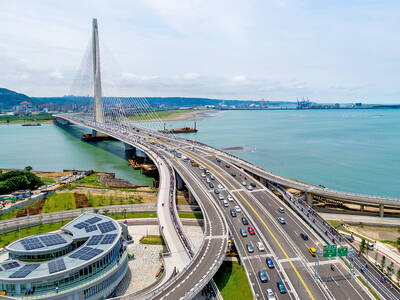
The Ministry of Transportation and Communications yesterday inaugurated the Danjiang Bridge across the Tamsui River in New Taipei City, saying that the structure would be an architectural icon and traffic artery for Taiwan. Feted as a major engineering achievement, the Danjiang Bridge is 920m long, 211m tall at the top of its pylon, and is the longest single-pylon asymmetric cable-stayed bridge in the world, the government’s Web site for the structure said. It was designed by late Iraqi-British architect Zaha Hadid. The structure, with a maximum deck of 70m, accommodates road and light rail traffic, and affords a 200m navigation channel for boats,
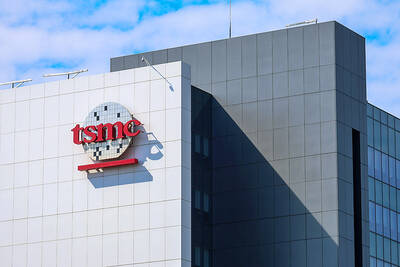
Taiwan Semiconductor Manufacturing Co (TSMC, 台積電), the world’s largest foundry service provider, yesterday said that global semiconductor revenue is projected to hit US$1.5 trillion in 2030, after the figure exceeds US$1 trillion this year, as artificial intelligence (AI) demand boosts consumption of token and compute power. “We are still at the beginning of the AI revolution, but we already see a significant impact across the whole semiconductor ecosystem,” TSMC deputy cochief operating officer Kevin Zhang (張曉強) said at the company’s annual technology symposium in Hsinchu City. “It is fair to say that in the past decade, smartphones and other mobile devices were
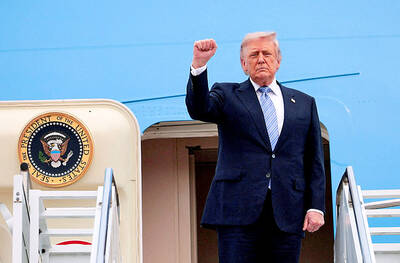
US-CHINA SUMMIT: MOFA welcomed US reassurance of no change in its Taiwan policy; Trump said he did not comment when Xi talked of opposing independence US President Donald Trump yesterday said he has not made a decision on whether to move forward with a major arms package for Taiwan after hearing concerns about it from Chinese President Xi Jinping (習近平). Trump’s comments on Taiwan came as he flew back to Washington after wrapping up critical talks in which both leaders said important progress was made in stabilizing US-China relations even as deep differences persist between the world’s two biggest powers on Iran and Taiwan. “I will make a determination,” Trump said, adding: “I’ll be making decisions. But, you know, I think the last thing we need right
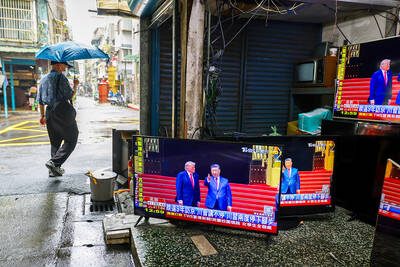
TAIWAN ISSUE: US treasury secretary Scott Bessent said on the first day of meetings that ‘it wouldn’t be a US-China summit without the Taiwan issue coming up’ There were no surprises on the first day of the summit between US President Donald Trump and Chinese President Xi Jinping (習近平), the Mainland Affairs Council (MAC) said yesterday, as the government reiterated that cross-strait stability is crucial to the Asia-Pacific region, as well as the world. As the two presidents met for a highly anticipated summit yesterday, Chinese state media reported that Xi warned Trump that missteps regarding Taiwan could push their two countries into “conflict.” Trump arrived in China with accolades for his host, calling Xi a “great leader” and “friend,” and extending an invitation to visit the White House


 RSS
RSS