


A TransAsia Airways (復興航空) plane crashed on Penghu yesterday, killing at least 47 people, the Civil Aeronautics Administration (CAA) said last night.
The flight from Greater Kaohsiung crashed near the Magong Airport’s runway with 54 passengers and four crew on board, the agency said.
Minister of Transportation and Communications Yeh Kuang-shih (葉匡時) said that 47 people were confirmed dead and 11 injured.
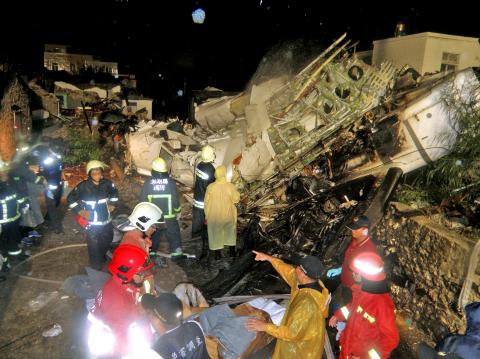
Photo: Taipei Times
According to the CAA, the 70-seat turboprop ATR72 model plane carried 54 passengers and four crew.
TransAsia Flight GE222 had been scheduled to depart Greater Kaohsiung at 4pm yesterday. However, because of Typhoon Matmo it was delayed, not departing until 5:43pm.
CAA Director General Jean Shen (沈啟) said air traffic control personnel received the request from the flight for a go-around at the Magong Airport at 7:06pm, but they lost track of the flight afterward.
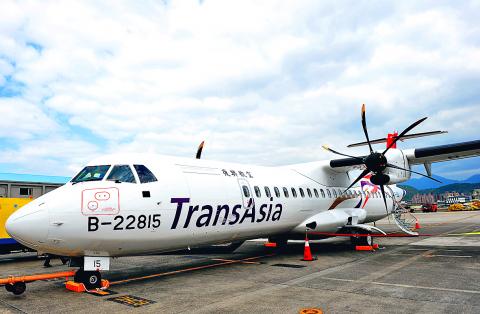
Photo: Chien Jung-fong, Taipei Times
“It’s chaotic on the scene,” Reuters quoted Shen as saying.
The plane made a forced landing in Sisi Village (西溪), just outside the airport.
Several buildings on the ground were set on fire by the crash, but no one on the ground was injured, local officials said.
"A few empty apartment buildings adjacent to the runway caught fire, but no one was inside at the time and the fire was extinguished," said Hsi Wen-guang, a spokesman for the Penghu County Government Fire Bureau.
About 100 firefighters were sent to the scene, besides 152 military personnel and 255 police, he added.
CAA information said the pilot, Lee Yi-liang (李義良), 60, has 15 years of experience in flying civilian aircraft.
The co-pilot was identified as 39-year-old Chiang Kuan-hsing (江冠興).
Witnesses have said that there was heavy rain at the time. However, the CAA said that the visual range was 800 feet (243.8m), which was adequate for landing.
The agency said that it will dispatch officials to Penghu today to help with the investigation into the cause of the crash, but the investigation will be led by the Aviation Safety Council.
Penghu County Fire Department Director-General Hong Yung-peng (洪永澎) said the airplane tried to land at the airport, but had pulled up to make another try because the heavy rain was hampering the pilot’s vision.
Executive Yuan spokesman Sun Lih-chuyn (孫立群) said Premier Jiang Yi-huah (江宜樺) had ordered the Ministry of Transportation and Communications to report on the situation as soon as possible.
Additional reporting by Shih Hsiu-chua and Reuters
This story has been updated since it was first published.
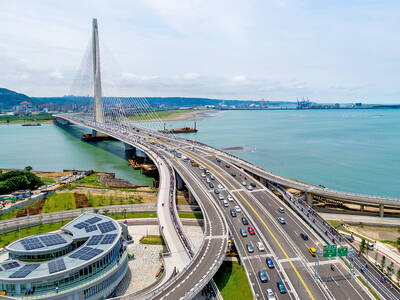
The Ministry of Transportation and Communications yesterday inaugurated the Danjiang Bridge across the Tamsui River in New Taipei City, saying that the structure would be an architectural icon and traffic artery for Taiwan. Feted as a major engineering achievement, the Danjiang Bridge is 920m long, 211m tall at the top of its pylon, and is the longest single-pylon asymmetric cable-stayed bridge in the world, the government’s Web site for the structure said. It was designed by late Iraqi-British architect Zaha Hadid. The structure, with a maximum deck of 70m, accommodates road and light rail traffic, and affords a 200m navigation channel for boats,
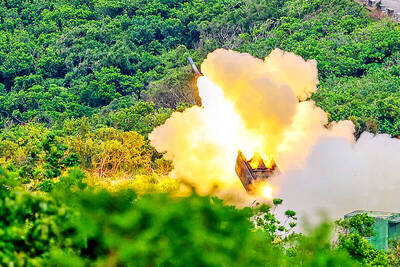
PRECISION STRIKES: The most significant reason to deploy HIMARS to outlying islands is to establish a ‘dead zone’ that the PLA would not dare enter, a source said A High Mobility Artillery Rocket System (HIMARS) would be deployed to Penghu County and Dongyin Island (東引) in Lienchiang County (Matsu) to force the Chinese military to retreat at least 100km from the coastline, a military source said yesterday. Taiwan has been procuring HIMARS and Army Tactical Missile Systems (ATACMS) from the US in batches. Once all batches have been delivered, Taiwan would possess 111 HIMARS units and 504 ATACMS, which have a range of 300km. Considering that “offense is the best defense,” the military plans to forward-deploy the systems to outlying islands such as Penghu and Dongyin so that

Taiwan Semiconductor Manufacturing Co (TSMC, 台積電), the world’s largest foundry service provider, yesterday said that global semiconductor revenue is projected to hit US$1.5 trillion in 2030, after the figure exceeds US$1 trillion this year, as artificial intelligence (AI) demand boosts consumption of token and compute power. “We are still at the beginning of the AI revolution, but we already see a significant impact across the whole semiconductor ecosystem,” TSMC deputy cochief operating officer Kevin Zhang (張曉強) said at the company’s annual technology symposium in Hsinchu City. “It is fair to say that in the past decade, smartphones and other mobile devices were

‘CLEAR MESSAGE’: The bill would set up an interagency ‘tiger team’ to review sanctions tools and other economic options to help deter any Chinese aggression toward Taiwan US Representative Young Kim has introduced a bill to deter Chinese aggression against Taiwan, calling for an interagency “tiger team” to preplan coordinated sanctions and economic measures in response to possible Chinese military or political action against Taiwan. “[Chinese President] Xi Jinping [習近平] has directed the People’s Liberation Army to be ready to invade Taiwan by 2027. China has a plan. America should have one too,” Kim said in a news release on Thursday last week. She introduced the “Deter PRC [People’s Republic of China] aggression against Taiwan act” to “ensure the US has a coordinated sanctions strategy ready should


 RSS
RSS