


Keelung City Council Speaker Huang Ching-tai (黃景泰) yesterday said he would still run in the city’s mayoral race, regardless of the Chinese Nationalist Party (KMT) withdrawing its nomination of him as its candidate.
The KMT had “failed to distinguish right from wrong,” he said yesterday morning.
The party on Wednesday said it was withdrawing Huang’s nomination after approving a member’s motion calling for him to be replaced because of concern that his alleged involvement in corruption would damage the party’s election prospects.
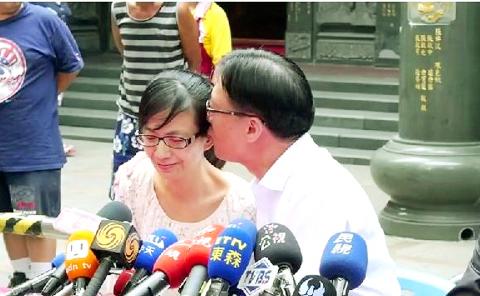
Photo: Lu Hsien-hsiu, Taipei Times
It cited Huang’s “tarnished reputation” and declining public support in several opinion polls.
Huang is facing allegations of influence peddling and bribery in a number of construction projects. He was released on NT$2 million (US$66,790) bail last month. If he had been detained, he could have lost his KMT membership.
However, Huang said he is determined to run for Keelung mayor “to help the pan-blue camp secure the only region that [could claim] victory in the Greater Taipei area.”
“I am forever a friend of the KMT, and I want to voice my support for [KMT Taipei mayoral candidate] Sean Lien (連勝文), who is now behind in the polls,” Huang said.
He said that he would “mobilize at least 50,000 voters” to offer their signatures in support of him continuing his campaign before noon on Friday next week.
“I have spent 20 years working for local residents and I believe the number of my supporters significantly exceeds the number of votes needed for a candidate to be elected,” he said.
Huang also thanked prosecutors for “clarifying the source of the NT$5 million [cash found in his office] and the NT$2 million from the KMT, which were campaign funds from friends and political donations respectively.”
“The influence peddling allegations have been misdirected, as it is unquestionable that representatives are supposed to, within legal bounds, safeguard people’s rights,” he said.
Asked whether he was upset about the KMT’s decision, Huang accused the party of not being able to distinguish right from wrong and violating its own regulations on nominations and procedural justice.
He also called on the KMT to “be consistent in upholding its standards” — after reporters mentioned KMT Miaoli County commissioner candidate Hsu Yao-chang (徐耀昌), who has been sentenced to nine years in prison, and KMT Taitung County Commissioner Justin Huang (黃健庭), who is seeking re-election and against whom prosecutors are seeking a 10-year prison term.
KMT spokesperson Charles Chen (陳以信) responded to Huang Ching-tai’s criticism by saying that there has been “no problem concerning the procedure [withdrawal of his nomination].”
Chen said the party’s resolution was simply about the withdrawal, and did not “pertain to [his] party membership or his innocence.”
“The party has never employed double standards when it comes to party discipline,” Chen said. “Any member who has been found guilty of corruption will be punished.”
However, Chen did not comment on Hsu’s and Justin Huang’s cases.
Meanwhile, Hsu said his case was “different from Huang Ching-tai’s,” and said the Keelung speaker had lost the party’s nomination due to the KMT’s evaluation of his election prospects.
“[Huang’s] 18 percent support in the opinion polls cannot compare to my 56 percent,” Hsu said.
The party is reportedly eyeing KMT Legislator Hsieh Kuo-liang (謝國樑) to run for Keelung mayor even though the lawmaker has said he has no intention to do so.
President Ma Ying-jeou (馬英九), who is also KMT chairman, summoned Hsieh for a talk yesterday. At press time, there was no further information about the meeting.
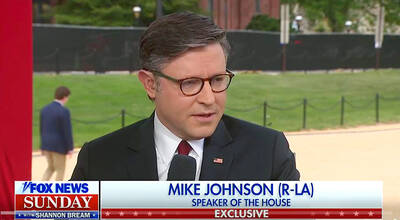
RESOLUTE BACKING: Two Republican senators are planning to introduce legislation that would impose immediate sanctions on China if it attempts to invade Taiwan US House of Representatives Speaker Mike Johnson on Sunday reaffirmed US congressional support for Taiwan, saying the US and “all freedom-loving people” have a stake in preventing China from seizing Taiwan by force. Johnson made the remarks in an interview with Fox News Sunday on US President Donald Trump’s summit with Chinese President Xi Jinping (習近平) last week. In an interview that aired on Friday on Fox News, just as Trump wrapped up a high-stakes visit to China, he said he has yet to green-light a new US$14 billion arms package to Taiwan and that it “depends on China.” “It’s a very good

DRONE CENTRAL: Taiwan aims to become Asia’s democratic hub for drones, with most exports focused on high-quality military-grade models, an official said Taiwan’s drone industry is expected to expand significantly by 2030, producing 100,000 units per month and exporting half of them, the Ministry of Economic Affairs said yesterday. Current drone production capacity is about 15,000 units per month, but the industry can quickly scale up as demand increases, Industrial Development Administration Director-General Chiou Chyou-huey (邱求慧) told a news conference in Taipei. Taiwan’s drone output grew 2.5-fold last year to NT$12.9 billion (US$408.3 million) under a government program to develop the uncrewed vehicle sector, he said. The Executive Yuan in October last year approved plans to invest NT$44.2 billion into domestic production of uncrewed aerial

WARNING: China should stop engaging in actions that undermine regional peace and stability, as it would only build resentment among people across the Strait, the CGA said China has deployed more than 100 navy, coast guard and other vessels in waters from the Yellow Sea to the South China Sea and the western Pacific since US President Donald Trump and Chinese President Xi Jinping (習近平) met in Beijing, National Security Council Secretary-General Joseph Wu (吳釗燮) said yesterday. “In this part of the world, #China is the one & only PROBLEM wrecking the #StatusQuo & threatening regional peace & stability,” Wu wrote on X. In a separate post, he said Beijing was coercing Taiwan’s maritime domain, calling it illegal and provocative, after the Coast Guard Administration (CGA) expelled a
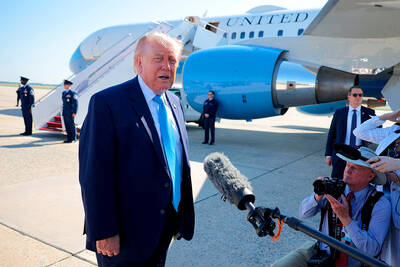
US President Donald Trump yesterday said he would speak to President William Lai (賴清德) as his administration considers whether to move ahead with a US$14 billion weapons sale to Taiwan — a potential arms deal that has drawn criticism from China. “Well, I’ll speak to him. I speak to everybody,” Trump told reporters yesterday when asked if he had any plans to call his counterpart, although he did not offer a time frame for when such a conversation could take place. Trump previously said he would speak to the person “that’s running Taiwan,” without specifying who he meant. “We have that situation very


 RSS
RSS