


The National Nuclear Abolition Action Platform yesterday accused the government of using state violence to evict anti-nuclear protesters who occupied Taipei’s Zhongxiao W Road on Sunday evening into early yesterday morning.
Tens of thousands of people on Sunday afternoon marched in an anti-nuclear protest march from Ketagalan Boulevard in front of the Presidential Office Building to Zhongxiao W Road in front of the Taipei Railway Station, where they lay down or sat in the road, paralyzing traffic in an area usually thronging with cars and buses.
At about 9pm on Sunday, the National Nuclear Abolition Action Platform, which organized the protest, said it was not satisfied with the announcement that the govenment would halt construction of the two reactors at the Fourth Nuclear Power Plant because it was made by Chinese Nationalist Party (KMT), rather than the Executive Yuan.
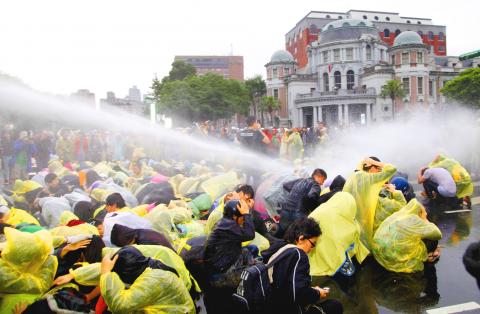
Photo: David Chang, EPA
It announced that the protesters would continue paralyze the road until they get an acceptable official response.
At about 10:30pm, Taipei Mayor Hau Lung-bin (郝龍斌) said the city government would use any means to restore traffic for Taipei residents by yesterday morning.
Despite being warned in advance by protest organizers that a forced eviction could take place after midnight, more than 1,000 protesters remained sitting on the road in raincoats, with their arms locked together.
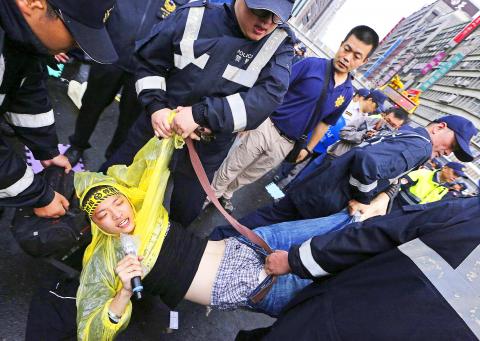
Photo: Reuters
After advising the protesters to leave on their own accord at about 12:30am yesterday, the police turned water cannons on the crowd at 2:47am, followed by police forcibly dragging away the protesters at about 2:50am, gradually herding the crowd from Guanquan Road toward Zhongshan S Road.
Several clashes broke out as rows of police with batons and shields in hand forcefully pushed the protesters to move as protesters chanted: “Terminate the Fourth Nuclear Power Plant and return power to the people,” “the people are unarmed so the police should not use violence” and “Police please step back.”
Sunflower movement student leaders Chen Wei-ting (陳為廷) and Lin Fei-fan (林飛帆) were pulled from the ground and taken into a police bus, and many other protesters were forced to leave the street after being pulled up.
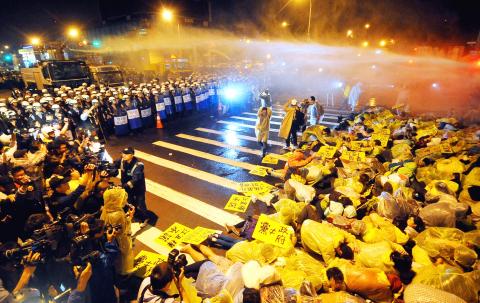
Photo: Wang Min-wei, Taipei Times
Protesters shouted: “There are children in the tents” when the police got close to tents with children in them, but the police continued herding the crowd and cleared most of Zhongxiao W Road by about 5am, with only about 100 protesters on the ground encircled by the police at the intersection with Zhongshan S Road.
During the eviction, police fired water cannons directly at the protesters more than a dozen times.
At about 6am, protesters were still being dragged or carried away one-by-one, and several reporters were also treated violently as they were evicted near the intersection, with a few of them banned from taking photographs, or hit with batons by the police, causing physical injuries or damage to equipment.
Traffic was restored on Zhongxiao W Road at about 6:50am, and some remaining protesters were forced to move to Zhongshan S Road.
Later yesterday, the National Nuclear Abolition Action Platform issued a statement saying that “Mayor Hau promised to return a normal life to citizens, but the danger caused by nuclear power has the real, serious impact on people’s lives.”
“Hau gave up the peaceful measure of asking the Cabinet to make an official and positive response, but ordered the police to use force against unarmed citizens, which is the worst measure to treat the people,” it said, adding that it “strongly condemns the government of using inappropriate violence.”
It urged protesters who were harmed or treated inappropriately during yesterday’s eviction to contact the platform for medical and judicial assistance, and urged people to submit photographic evidence of the eviction process.
Separately, Taipei Police Zhongzheng First Precinct investigative team head Chou Yu-wen (周郁文) said five people were arrested and 40 were injured early yesterday when police began dispersing the protesters.
National Taiwan University Hospital said it had treated 26 people, most of them with external injuries.
Some of the injured were also taken to Taipei City Hospital, where three of them were hospitalized for observation and 11 were treated and released, according to Ministry of Health and Welfare statistics.
Additional reporting by CNA

‘NO SECURITY RISK’: The Railway Bureau reassured the public that the technicians’ activities were limited to technical guidance and did not involve sensitive systems The Railway Bureau yesterday said it had invited eight Chinese technicians to assist with an airport MRT construction project. The bureau issued the confirmation after an Internet user said Chinese nationals had entered the construction zone of Taiwan Taoyuan International Airport’s Terminal 3 project. They asked why “individuals from an enemy state” were allowed access to such a major national infrastructure project, which raised serious concerns over Taiwan’s industrial safety, sensitive systems and information security. The bureau’s Northern Region Engineering Branch Office said subcontractor Taiwan Handle Industrial Co (台灣手把工業) of the Taoyuan airport MRT’s “Contract No. CU05 Project A14 Station Civil, MEP &

The National Chungshan Institute of Science and Technology yesterday showcased its locally developed variants of the Vision 60 robotic patrol dog, which it plans to deploy on the nation’s outlying territories in the South China Sea. The variants were produced under the Joint Lab project — created by the institute and domestic companies — and assembled with domestically produced motors, lenses and artificial intelligence (AI) systems alongside licensed tech from the US, Missile and Rocket Systems Research Division deputy director Jen Kuo-kang (任國光) told the media event at a military base in Taipei’s Dazhi (大直) area. Taiwan has built up its strengths
NOT IMMEDIATE: Taiwan has a chance to appeal the proposed 10 percent tariff before it starts, while other countries face a 12.5 percent tariff from the trade office Taiwan is among 60 economies determined by the US to have failed to impose or enforce a ban on the importation of goods produced with forced labor, according to a notice released on Tuesday by the Office of the US Trade Representative (USTR), which proposed imposing an additional 10 percent or more tariff on them. The USTR in a statement said that following an investigation, it had determined under Section 301 of the Trade Act of 1974 that the failure of the 60 economies to impose and effectively enforce a prohibition on the importation of goods produced with forced labor is

TIT-FOR-TAT: The US allegedly revoked the visa of a Chinese national working at Xinhua News Agency in the US in response to Beijing’s expulsion of Vivian Wang The Presidential Office yesterday condemned China for expelling a New York Times correspondent from Beijing following the newspaper’s interview with President William Lai (賴清德), saying the move highlighted Beijing’s suppression of press freedom and its threat to international news media. Taiwan has noted a series of recent incidents in which Beijing used similar tactics to “threaten and pressure international media outlets and journalists,” Presidential Office spokeswoman Karen Kuo (郭雅慧) said in a statement. “This concerns not only press freedom and freedom of expression, but also the safety of journalists, and Taiwan and relevant partners are paying close attention to the situation,” she


 RSS
RSS