

Former Taipei EasyCard Corp (悠遊卡公司) chairman Sean Lien (連勝文) emerged as the winner yesterday in the Chinese Nationalist Party’s (KMT) primary for the Taipei mayoral election later this year after defeating his main competitor, KMT Legislator Ting Shou-chung (丁守中), by a landslide.
The eldest son of former vice president Lien Chan (連戰) secured more than twice as many ballots as Ting to seal his selection as the ruling party’s candidate for the Taipei mayoral contest.
The winner was decided by a total score comprised of each candidate’s showing in a telephone poll conducted on April 12 and 13 that accounted for 70 percent of the score, and the vote among party members, which made up the remaining 30 percent.
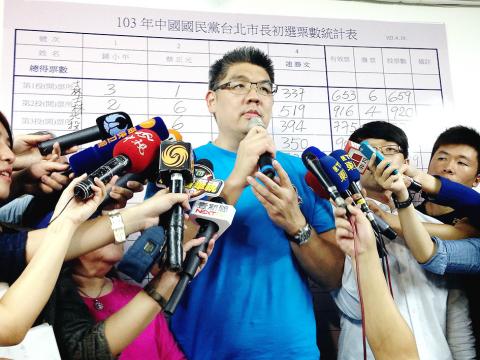
Photo: CNA
Sean Lien edged Ting in the telephone poll, gaining the support of 39.717 percent of respondents to the lawmaker’s 36.992 percent, while receiving 10,647 of the 15,758 ballots cast in the internal vote, while Ting had 4,765, according to the KMT’s Taipei branch.
A total of 37,860 KMT members were eligible to participate in yesterday’s primary poll, but voter turnout still fell short of 50 percent at 41.622 percent.
The final score put Sean Lien, who sits on the KMT’s Central Committee, first with 48.19 percent, followed by Ting’s 35.018 percent.
KMT Legislator Alex Tsai (蔡正元) and Taipei City Councilor Chung Hsiao-ping (鍾小平) were also in the race, but Tsai on Thursday bowed out at the last minute and urged his fellow party members to vote for Sean Lien instead.
In announcing his withdrawal, Tsai also disclosed the results of the telephone poll on Thursday, saying that the numbers showed he was too far behind to win, having come third with 17.5 percent, leading only Chung, who had 5.8 percent.
Ting later that day said that Tsai’s poll data were false and misleading, saying that while the candidates were allowed to dispatch observers to “audit and undertake random checks” at polling stations, the results remained confidential, so there was no way that they could get hold of the exact numbers.
Accusing Tsai of having been cooperating with the eventual winner’s camp all along by playing the role of a “foil” to Sean Lien’s “nice guy,” Ting said Tsai had been playing an unfair game from the beginning of the selection process.
After yesterday’s results were announced, Ting said that despite his defeat, he would put all his efforts toward supporting Sean Lien in the upcoming election.
Although the voting is meant to be confidential, the media accidentally saw President Ma Ying-jeou’s (馬英九) ballot yesterday.
The indiscretion occurred when the president, who is also the party’s chairman, was photographed holding a ballot that, despite being folded, showed a red circle stamped on the No. 3 candidate, Ting.
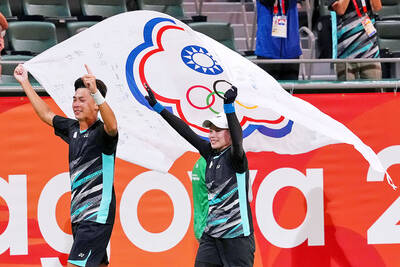
SOFT TENNIS: Yu Kai-wen and Huang Shih-yuan narrowly defeated their Japanese rivals to capture Taiwan’s first gold at the Asian Games in Nagoya Yu Kai-wen (余凱文) and Huang Shih-yuan (黃詩媛) won Taiwan’s first gold of this year’s Asian Games, defeating a Japanese duo in a nail-biter in the soft tennis mixed doubles final in Nagoya, Japan, while Johnny Sun (孫家閎) won silver in wushu and Shih Cheng-chung (石政中) won bronze in men’s kumite. Yu and Huang narrowly defeated Japan’s Toshiki Uematsu and Rena Temma 5-4 (2-4, 5-3, 4-2, 1-4, 1-4, 4-0, 1-4, 4-1, 7-5) to give Taiwan its first gold in soft tennis mixed doubles at an Asian Games since 2018. Sun secured Taiwan’s first wushu medal at this year’s game, with a combined score
CALL FOR CHANGE: They urged the UN to facilitate Taiwan’s involvement in the body, recognize its peace efforts and to work with members in preventing military conflict Representatives to the UN from five of Taiwan’s diplomatic allies sent a joint letter to UN Secretary-General Antonio Guterres on Friday, calling for the country’s inclusion in the body. Allies in the letter sent ahead of the 81st session of the UN General Assembly General Debate made three demands in support of Taiwan: inclusion, recognition and camaraderie. They implored the UN to seek an appropriate way to facilitate Taiwan’s meaningful involvement in the world governing body, saying that UN Resolution 2758, which accepted the People’s Republic of China (PRC) as a member of the UN, does not exclude Taiwan. Beijing claims that the
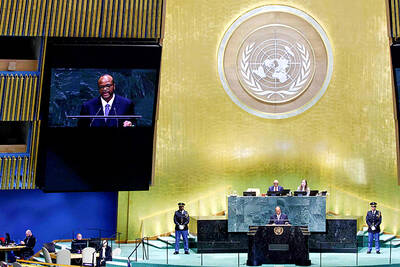
UNITY: Lai thanked the nations who spoke up for Taiwan, saying that democracies must stand together to face global authoritarian expansion Taiwan yesterday thanked eight European and Indo-Pacific countries for opposing unilateral changes to the “status quo” in the Taiwan Strait in a joint statement earlier this week, as well as three of Taiwan’s allies for speaking up for the nation’s participation in the UN at the body’s General Assembly in New York. Minister of Foreign Affairs Lin Chia-lung (林佳龍) welcomed the support and expressed his appreciation for the countries’ stance, the Ministry of Foreign Affairs said in a statement. Foreign ministers and senior representatives of Australia, France, Germany, Japan, New Zealand, Poland, South Korea and the UK issued a statement on Tuesday
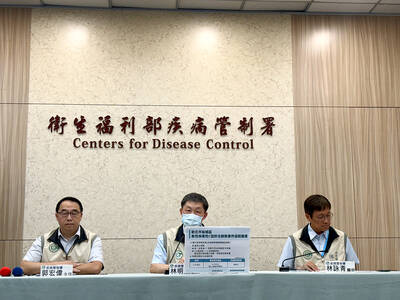
AT-RISK GROUPS: Of the accumulated 1,586 severe cases and 304 related deaths in this flu season, 65.8% were older people and 83.2% had chronic diseases, an official said The Centers for Disease Control (CDC) yesterday said that 165 severe flu cases and 30 flu-related deaths were reported last week, the highest weekly numbers in this flu season, and that cases might continue to increase, urging people to take precautions. Medical visits for flu-like illnesses increased by 1.4 percent to 141,374 last week, with 11.8 percent being emergency visits, showing that the seasonal flu is still in its epidemic period, CDC Epidemic Intelligence Center Director Guo Hung-wei (郭宏偉) said. From Tuesday last week to Monday, 165 severe flu cases and 30 flu-related deaths were confirmed, the highest weekly numbers


 RSS
RSS