


The Council of Agriculture is proposing increasing pork imports by 3,000 tonnes a month by halving the import tariff in a bid to curb rising pork prices.
The council would negotiate with the Ministry of Finance to lower the tariff to 6.25 percent from 12.5 percent, Council of Agriculture Deputy Minister Chen Wen-te (陳文德) yesterday said during a question-and-answer session at a meeting of the legislature’s Economics Committee.
The council has commissioned the National Animal Industry Foundation (NAIF) to conduct the imports, with the non-governmental organization planning to store some of the pork to minimize the impact on the local pork market, Chen said.
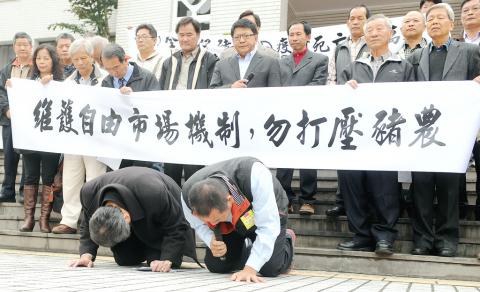
Photo: Chu Pei-hsiung, Taipei Times
Chen said the council would also conduct a nationwide census of hog farms next month and fine-tune the policy based on the results.
However, the council would not ease its standard for zero tolerance of ractopamine residues in imported pork, he said.
The council’s statistics show that the pork price soared to NT$83.6 per kilogram on March 4, while the average price this month was NT$75 per kilogram. The price dropped slightly to NT$81.47 yesterday, Chen said.
“The price increase has been caused because pork suppliers are expecting prices to increase as the result of an outbreak of porcine epidemic diarrhea [PED] from October last year to the beginning of this month, which killed 220,000 piglets,” he said.
Chen said the average weight of pigs sold in the first 10 days of this month was 122.9kg, higher than 121.6kg a year ago, as hog farmers had delayed selling their pigs on the market.
The council would also coordinate with state-run Taiwan Sugar Corp (Taisugar, 台糖) to increase pork supply by 3,000 pigs this month, Chen said, adding that until yesterday Taisugar had sold 1,350 more pigs this month.
The council would also negotiate with local frozen meat companies to sell more pork and less processed meat to the market, increasing pork supply by 400 to 600 pigs per day, Chen said.
Meanwhile, the council is also collaborating with the Fair Trade Commission to investigate whether pork suppliers at 22 meat markets and 29 frozen meat companies had colluded with each other to hoard pork and drive up prices.
Fair Trade Commission Chairman Wu Shiow-ming (吳秀明) said the commission would complete the investigation of local frozen meat companies by the end of next month, before the Dragon Boat Festival, when pork consumption increases as people make zongzi (glutinous rice dumplings) for the festival.
After the commission completes all its investigations, the council would also investigate whether pork suppliers have infringed the Agricultural Products Market Transaction Act (農產品市場交易法), which requires pork suppliers not to store excessive amounts of pork and drive up prices, Chen said, adding that pork suppliers violating the law are likely to be subject to a maximum fine of NT$300,000, or the amount the supplier gained from the illegal action.
The Directorate-General of Budget, Accounting and Statistics says the consumer price index has risen 5.53 percent in the past five years, with food prices soaring by 9.35 percent.
Prices of aquatic products increased 28.55 percent in the past five years, followed by fruit products, which surged 22.78 percent, its said, adding that the price of meat increased 15.46 percent.
Republic of China Swine Association president Yang Kuan-chang (楊冠章) said he was disappointed with the Council of Agriculture’s policy.
“We have voiced our concerns and opposition to the government’s plan, but we can now only accept the government’s decision. It’s always been this way and we couldn’t do anything about it,” Yang said. “At the end of the day, local pig farmers need support from Taiwanese consumers. We call for everyone to consume domestic pork.”
Yang was among dozens of representatives of the pig farming industry who protested against the council’s plan yesterday morning.
Democratic Progressive Party Legislator Pan Men-an (潘孟安) said that the council’s measures would further jeopardize the pig-farming industry, as local farmers face the “triple threats” of the epidemic, the increasing cost of feed and imported pork.
Additional reporting by Chris Wang

South Korea has adjusted its electronic arrival card system to no longer list Taiwan as a part of China, a move that the Ministry of Foreign Affairs said would help facilitate exchanges between the two sides. South Korea previously listed “Taiwan” as “Taiwan (China)” in the drop-down menus of its online arrival card system, where people had to fill out where they came from and their next destination. The ministry had requested South Korea make a revision and said it would change South Korea’s name on Taiwan’s online immigration system from “Republic of Korea” to “Korea (South),” should the issue not be

Tainan, Taipei and New Taipei City recorded the highest fines nationwide for illegal accommodations in the first quarter of this year, with fines issued in the three cities each exceeding NT$7 million (US$220,639), Tourism Administration data showed. Among them, Taipei had the highest number of illegal short-term rental units, with 410. There were 3,280 legally registered hotels nationwide in the first quarter, down by 14 properties, or 0.43 percent, from a year earlier, likely indicating operators exiting the market, the agency said. However, the number of unregistered properties rose to 1,174, including 314 illegal hotels and 860 illegal short-term rental

Both sides of the Taiwan Strait share a political foundation based on the “1992 consensus” and opposition to Taiwanese independence, Chinese Nationalist Party (KMT) Chairwoman Cheng Li-wun (鄭麗文) today said during her meeting with Chinese President Xi Jinping (習近平). Both sides of the Strait should plan and build institutionalized and sustainable mechanisms for dialogue and cooperation based on that foundation to make peaceful development across the Strait irreversible, she said. Peace is a shared moral value across the Strait, and both sides should move beyond political confrontation to seek institutionalized solutions to prevent war, she said. Mutually beneficial cross-strait relations are what the

ECONOMIC COERCION: Such actions are often inconsistently applied, sometimes resumed, and sometimes just halted, the Presidential Office spokeswoman said The government backs healthy and orderly cross-strait exchanges, but such arrangements should not be made with political conditions attached and never be used as leverage for political maneuvering or partisan agendas, Presidential Office spokeswoman Karen Kuo (郭雅慧) said yesterday. Kuo made the remarks after China earlier in the day announced 10 new “incentive measures” for Taiwan, following a landmark meeting between Chinese President Xi Jinping (習近平) and Chinese Nationalist Party (KMT) Chairwoman Cheng Li-wun (鄭麗文) in Beijing on Friday. The measures, unveiled by China’s Xinhua news agency, include plans to resume individual travel by residents of Shanghai and China’s Fujian


 RSS
RSS