


Residents of Miaoli County’s Dapu Borough (大埔) erupted in tears yesterday after the Taichung High Administrative Court ruled that the county government had illegally destroyed houses belonging to four families last year.
The court said the Ministry of the Interior had failed to conduct a review of a project submitted by the Miaoli County Government to demolish the private homes in Dapu to make way for a science park before approving the project.
The partial or complete demolition of homes belonging to the Chang (張), Chu (朱), Ko (柯) and Huang (黃) families was therefore unlawful, the court said.
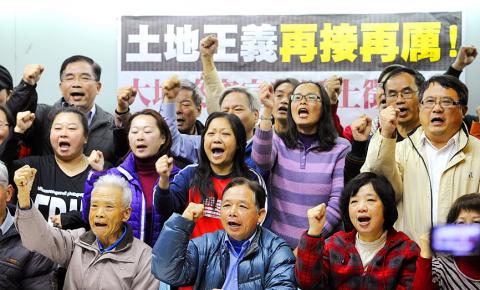
Photo: George Tsorng, Taipei Times
The very emotional Dapu residents and their supporters were quick to demand apologies from the government, reconstruction of their homes and revision of laws governing land expropriation.
“Miaoli County Commissioner Liu Cheng-hung (劉政鴻), as well as every official in the county and central governments who made the decision to flatten our houses, should apologize to us, not only through the media, but by making house-to-house apologies in person,” said Peng Hsiu-chun (彭秀春), the wife of Chang Sen-wen (張森文), who committed suicide last year after their home was demolished.
“Liu should return our land to us and rebuild our homes to their original state, but even that is not enough, because he can never bring my husband back to life,” Peng told a press conference in Taipei.
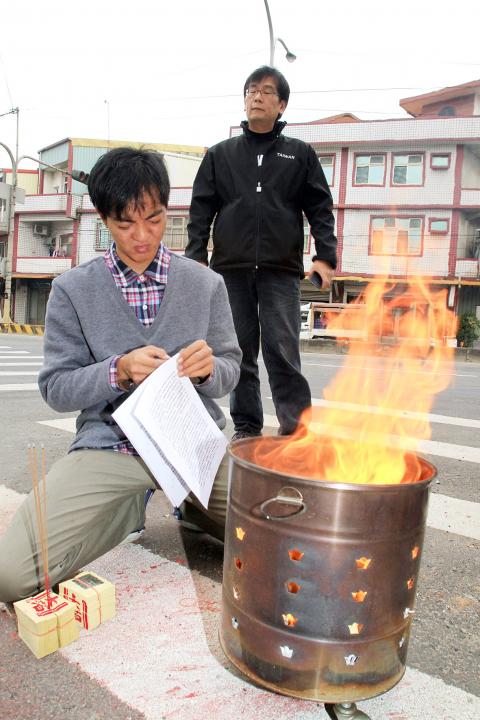
Photo: Peng Chian-lee, Taipei Times
Huang Chiu-hung (黃秋紅) tearfully recounted how her family suffered over the past few years, and how she has lived in fear that her mother might carry out her comments about committing suicide.
“The county government has destroyed the front yard of our house, and dumped rocks and debris on our farmland. I want it to rebuild everything and restore everything to its original state,” she said.
Ko Chih-chuan (柯智傳) said he appreciated the verdict, but was not happy.
“I feel no joy in winning the lawsuit, because we have a long way to go in our struggle to amend the Land Expropriation Act (土地徵收條例),” Ko said. “If the law is not revised, there will be more tragedies like the one we have suffered. We must stand up against the evil law.”
Even Liao Pen-chuan (廖本全), an associate professor at National Taipei University’s real estate and built environment department, who had appeared so strong in previous public appearances, started to cry as he talked during the press conference.
“It is hard not to be emotional if you have been following the issue for a long time,” he said. “Besides asking the government to restore everything to its original state, we should also pursue efforts to change the system and pursue the county commissioner, the ministry and the Executive Yuan who were responsible [for the destruction].”
Asked if they would seek compensation from the government, Thomas Chan (詹順貴), an attorney representing the residents, said his clients were unlikely to do so unless the money came directly from the pockets of the officials involved.
“If the compensation will come from taxpayers’ pockets, we would rather not ask for it,” he said.
At a separate press conference later in day, Deputy Minister of the Interior Hsiao Chia-chi (蕭家淇) insisted the ministry had conducted thorough reviews of the project numerous times before approving it, “but we would respect the different view of the judge.”
“The fact that the court ruled in favor of nine plaintiffs belonging to four families, but rejected the lawsuit filed by 19 others, shows that overall the project is necessary and beneficial to the public,” Hsiao said.
He said the ministry would wait until it receives the verdict in writing and discusses it with the Miaoli County Government before deciding whether to file an appeal.
Activists demonstrating in the lobby of the ministry said Hsiao was trying to confuse the public.
“The court rejected the other lawsuits not because the judge believed that the project is necessary and beneficial to the public, but, as the court statement indicated, the 19 other plaintiffs agreed to compensation measures proposed by the county government,” Taiwan Rural Front member Lin Le-xin (林樂昕) said.

‘NO SECURITY RISK’: The Railway Bureau reassured the public that the technicians’ activities were limited to technical guidance and did not involve sensitive systems The Railway Bureau yesterday said it had invited eight Chinese technicians to assist with an airport MRT construction project. The bureau issued the confirmation after an Internet user said Chinese nationals had entered the construction zone of Taiwan Taoyuan International Airport’s Terminal 3 project. They asked why “individuals from an enemy state” were allowed access to such a major national infrastructure project, which raised serious concerns over Taiwan’s industrial safety, sensitive systems and information security. The bureau’s Northern Region Engineering Branch Office said subcontractor Taiwan Handle Industrial Co (台灣手把工業) of the Taoyuan airport MRT’s “Contract No. CU05 Project A14 Station Civil, MEP &

The National Chungshan Institute of Science and Technology yesterday showcased its locally developed variants of the Vision 60 robotic patrol dog, which it plans to deploy on the nation’s outlying territories in the South China Sea. The variants were produced under the Joint Lab project — created by the institute and domestic companies — and assembled with domestically produced motors, lenses and artificial intelligence (AI) systems alongside licensed tech from the US, Missile and Rocket Systems Research Division deputy director Jen Kuo-kang (任國光) told the media event at a military base in Taipei’s Dazhi (大直) area. Taiwan has built up its strengths

TIT-FOR-TAT: The US allegedly revoked the visa of a Chinese national working at Xinhua News Agency in the US in response to Beijing’s expulsion of Vivian Wang The Presidential Office yesterday condemned China for expelling a New York Times correspondent from Beijing following the newspaper’s interview with President William Lai (賴清德), saying the move highlighted Beijing’s suppression of press freedom and its threat to international news media. Taiwan has noted a series of recent incidents in which Beijing used similar tactics to “threaten and pressure international media outlets and journalists,” Presidential Office spokeswoman Karen Kuo (郭雅慧) said in a statement. “This concerns not only press freedom and freedom of expression, but also the safety of journalists, and Taiwan and relevant partners are paying close attention to the situation,” she

NOT IMMEDIATE: Taiwan has a chance to appeal the proposed 10 percent tariff before it starts, while other countries face a 12.5 percent tariff from the trade office Taiwan is among 60 economies determined by the US to have failed to impose or enforce a ban on the importation of goods produced with forced labor, according to a notice released on Tuesday by the Office of the US Trade Representative (USTR), which proposed imposing an additional 10 percent or more tariff on them. The USTR in a statement said that following an investigation, it had determined under Section 301 of the Trade Act of 1974 that the failure of the 60 economies to impose and effectively enforce a prohibition on the importation of goods produced with forced labor is


 RSS
RSS