


Visitors to Keelung City Harbor were flabbergasted yesterday afternoon, when the giant Rubber Duck installation suddenly burst and deflated, just 11 days after it went on display.
While Keelung City Council Speaker Huang Ching-tai (黃景泰), who is in charge of the event, and the company that manufactured the Rubber Duck were still investigating what caused the mishap, a female tourist at the scene said she saw what looked like an eagle scratch the 18m tall Rubber Duck with its talons.
Local residents confirmed that eagles were seen flocking around the harbor in the past few days, with some officials saying that it was possible that an eagle’s talons had scraped the duck’s surface and made a small tear, which led to the burst.
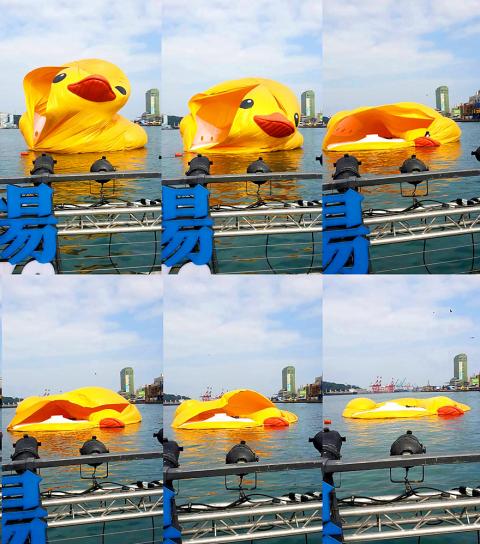
Photo: CNA, courtesy of Lai Hui-chen
However, Central Weather Bureau meteorologist Cheng Ming-tien (鄭明典) said that yesterday’s warm sunshine might have caused it.
Yesterday’s blazing sun, after weeks of cold, rainy conditions, heated up the air inside the duck to become hotter than the exterior, and the sudden change in temperature and pressure probably caused it to rupture, he said.
“We want to apologize to the fans of the yellow rubber duck. ... the weather is fine today and we haven’t found the cause of the burst. We will carefully examine the duck to determine the cause,” Huang said.
Keelung City officials initially said they would borrow a giant duck replacement from Greater Kaohsiung, which was the first local government to host the giant duck.
The officials later retracted the decision and announced that they would borrow another copy of the floating art installation that is under production by a company authorized by Dutch artist Florentijn Hofman, creator of the giant Rubber Duck, for its next showing in another country.
The replacement is to be installed in Keelung Harbor by Saturday at the earliest, the city officials said.
Keelung’s Rubber Duck is not the first one to rupture while on display in northern Taiwan.
In early November, another near-identical sculpture from the same series burst in Taoyuan County and had to be replaced by another Rubber Duck on loan from Greater Kaohsiung.
In the industrial and busy Keelung Port, the recently deceased duck has endured controversy since it was unveiled to the public on Dec. 21.
A dispute over copyrights involving merchandise sold by local vendors erupted even before that, leading Hofman to decry the Keelung event as a “commercial circus.”
Hofman, who had enthusiastically attended the premieres in Greater Kaohsiung and Taoyuan, was absent from the duck’s opening day in Keelung.
The duck was later noticeably blackened by pollution from ships passing through the industrial area, leaving organizers scratching their heads for several days as to how to clean it.
Additional reporting by Yu Shao-fu and AFP

‘NO SECURITY RISK’: The Railway Bureau reassured the public that the technicians’ activities were limited to technical guidance and did not involve sensitive systems The Railway Bureau yesterday said it had invited eight Chinese technicians to assist with an airport MRT construction project. The bureau issued the confirmation after an Internet user said Chinese nationals had entered the construction zone of Taiwan Taoyuan International Airport’s Terminal 3 project. They asked why “individuals from an enemy state” were allowed access to such a major national infrastructure project, which raised serious concerns over Taiwan’s industrial safety, sensitive systems and information security. The bureau’s Northern Region Engineering Branch Office said subcontractor Taiwan Handle Industrial Co (台灣手把工業) of the Taoyuan airport MRT’s “Contract No. CU05 Project A14 Station Civil, MEP &

The National Chungshan Institute of Science and Technology yesterday showcased its locally developed variants of the Vision 60 robotic patrol dog, which it plans to deploy on the nation’s outlying territories in the South China Sea. The variants were produced under the Joint Lab project — created by the institute and domestic companies — and assembled with domestically produced motors, lenses and artificial intelligence (AI) systems alongside licensed tech from the US, Missile and Rocket Systems Research Division deputy director Jen Kuo-kang (任國光) told the media event at a military base in Taipei’s Dazhi (大直) area. Taiwan has built up its strengths

TIT-FOR-TAT: The US allegedly revoked the visa of a Chinese national working at Xinhua News Agency in the US in response to Beijing’s expulsion of Vivian Wang The Presidential Office yesterday condemned China for expelling a New York Times correspondent from Beijing following the newspaper’s interview with President William Lai (賴清德), saying the move highlighted Beijing’s suppression of press freedom and its threat to international news media. Taiwan has noted a series of recent incidents in which Beijing used similar tactics to “threaten and pressure international media outlets and journalists,” Presidential Office spokeswoman Karen Kuo (郭雅慧) said in a statement. “This concerns not only press freedom and freedom of expression, but also the safety of journalists, and Taiwan and relevant partners are paying close attention to the situation,” she
NOT IMMEDIATE: Taiwan has a chance to appeal the proposed 10 percent tariff before it starts, while other countries face a 12.5 percent tariff from the trade office Taiwan is among 60 economies determined by the US to have failed to impose or enforce a ban on the importation of goods produced with forced labor, according to a notice released on Tuesday by the Office of the US Trade Representative (USTR), which proposed imposing an additional 10 percent or more tariff on them. The USTR in a statement said that following an investigation, it had determined under Section 301 of the Trade Act of 1974 that the failure of the 60 economies to impose and effectively enforce a prohibition on the importation of goods produced with forced labor is


 RSS
RSS