


Advanced Semiconductor Engineering Inc (ASE, 日月光半導體), the world’s biggest chip packager, yesterday apologized for a leak of toxic wastewater from its biggest plant in Grater Kaohsiung, and said it was undertaking steps to contain the damage.
The company held a press conference yesterday afternoon after one of its factories, known as K7, was fined NT$600,000 (US$20,300) and ordered to suspend operations for contravening the Water Pollution Control Act (水污染防治法).
Greater Kaohsiung’s Environmental Protection Bureau said its investigators found high levels of acidity and nickel in samples of water taken from the factory’s discharge pool and from the Houjin River (後勁溪), into which it empties.
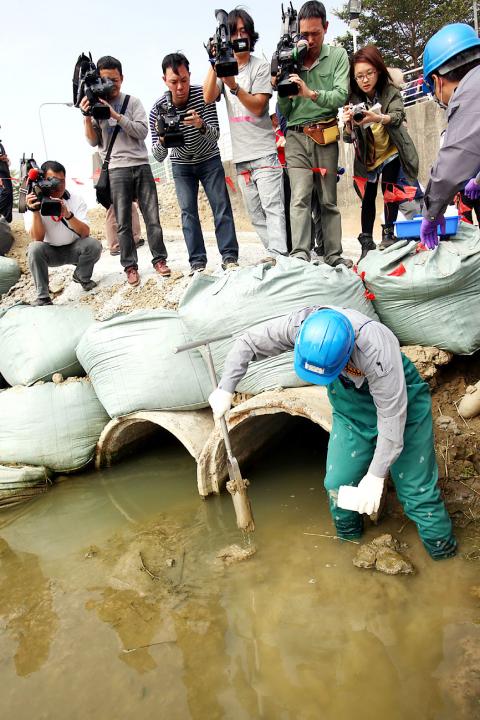
Photo: Chang Chung-i, Taipei Times
Water from the river is used to irrigate hundreds of hectares of paddy fields.
Bureau officials said highly acidic waste water with a pH of 3.02 was discovered being discharged under the Demin Bridge (德明橋) during a water quality inspection along the river on Oct. 1, and the source of the pollution was traced back to ASE’s K7 plant.
Water in the wastewater storage tank in the plant’s basement, which is connected to pipes that discharge the water into the river, was tested and found to exceed all standard levels with a pH of 2.63, 96mg/L suspended solids level, 135mg/L chemical oxygen demand level and 4.38mg/L nickel level.
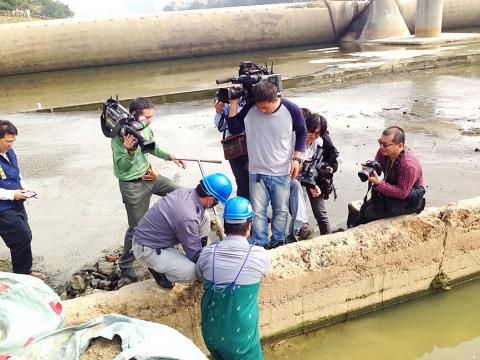
Photo: CNA
The K7 plant discharges wastewater 24 hours a day, making it the ninth-biggest discharger in the city, and the level of nickel in discharged water was about the same as the wastewater found in the plant, indicating the plant was not treating the water before discharging it, the bureau said.
Bureau Director-General Derek Chen (陳金德) on Monday said that the plant’s management showed malicious intent by trying to use tap water to dilute the highly acid wastewater when the inspectors arrived to conduct tests. Since ASE was fined three times for the same violation last year, the bureau decided to impose the stiffest fine possible and order a halt to the plant’s operations.
The company operates 17 plants in Greater Kaohsiung.
ASE officials told reporters yesterday that employees had been punished for failing to notify the environmental bureau about a hydrochloric acid leak when it occurred on Oct. 1.
To prevent a reoccurrence, ASE chief operating officer Tien Wu (吳田玉) said the firm would step up its monitoring mechanisms and review all of its wastewater treatment facilities.
“It was a one-time incident,” Wu said. “We have adjusted the piping system to avoid releasing the wastewater directly into the wastewater barrels.”
However, ASE officials said the company had not received the suspension order from the bureau, so K7 was continuing to operate.
ASE counts contract chipmaker Taiwan Semiconductor Manufacturing Co (TSMC, 台積電) and mobile phone chip supplier MediaTek Inc (聯發科) among its major clients.
The K7 plant, which is ASE’s largest wafer bumping facility for smartphone chips, accounted for 10 percent of ASE’s overall revenue, Credit Suisse analyst Randy Abrams said in a note yesterday.
“Impact on customers and sales should be limited,” Abrams said, adding that ASE needed to respond quickly to restore its reputation.

‘NO SECURITY RISK’: The Railway Bureau reassured the public that the technicians’ activities were limited to technical guidance and did not involve sensitive systems The Railway Bureau yesterday said it had invited eight Chinese technicians to assist with an airport MRT construction project. The bureau issued the confirmation after an Internet user said Chinese nationals had entered the construction zone of Taiwan Taoyuan International Airport’s Terminal 3 project. They asked why “individuals from an enemy state” were allowed access to such a major national infrastructure project, which raised serious concerns over Taiwan’s industrial safety, sensitive systems and information security. The bureau’s Northern Region Engineering Branch Office said subcontractor Taiwan Handle Industrial Co (台灣手把工業) of the Taoyuan airport MRT’s “Contract No. CU05 Project A14 Station Civil, MEP &

A signaling system malfunction disrupted high-speed rail (HSR) services beginning at 8am today, with trains temporarily reduced to three northbound and three southbound trains per hour as authorities conduct inspections. The malfunction occurred on a section of track in Miaoli County during pre-operation checks early this morning, forcing northbound and southbound trains to use a single track, the HSR operator said. The regular schedule has been replaced with three hourly trains offering only nonreserved seating in each direction, stopping at every station, it said, adding that business class cars would still have reserved seating. Departures from terminal stations are scheduled at the top

Taiwan is still in the process of assessing the possibility of recruiting workers from Eswatini, the Ministry of Foreign Affairs said yesterday, adding that its goal is to help Eswatini upgrade its vocational training centers. If there are plans to recruit workers from Eswatini, safeguarding national security, protecting public health and ensuring the employment rights of Taiwanese would be prerequisites, Department of West Asian and African Affairs Director-General Yen Chia-liang (顏嘉良) told a news conference. Key considerations would also include filling labor shortages in specific industries, and fostering bilateral professional and technical exchanges, he said. Yen was asked about the progress of labor

A US uncrewed surface vessel (USV) encountered multiple Chinese warships during an autonomous transit of the Taiwan Strait, US defense company Seasats said in a statement on Wednesday. Seasats announced that a Lightfish USV had completed the first autonomous transit of the Taiwan Strait. Over five days, the USV traversed the entire length of the Strait while constantly monitoring surface vessel traffic, the company said. The Lightfish encountered multiple Chinese warships, one of which was a Chinese People’s Liberation Army Navy (PLAN) Type 056 corvette, it said. The Chinese vessels were operating “well within Taiwan’s exclusive economic zone without transmitting their identity via the


 RSS
RSS