


The organizer of the 2015 World Exposition in Milan is reportedly only willing to place the Taiwan Pavilion in the “corporate area” rather than in the “country area,” a matter on which the Ministry of Foreign Affairs yesterday declined to comment, citing insufficient information.
Following its participation in the World Exposition held in Japan’s Osaka in 1970, Taiwan, due to interference by China, has not participated in any of the subsequent world expos until Expo 2010 in China’s Shanghai. The Bureau of Shanghai World Expo Coordination sent an official invitation to the Taipei World Trade Center organization for a Taiwan Pavilion at the expo in May 2009.
However, even then the Chinese government had been making small moves that cast doubt on Taiwan’s sovereign status: first by listing Taiwan in the China Exhibition Hall area on the official Web site, then placing it beside the Hong Kong and Macau halls.
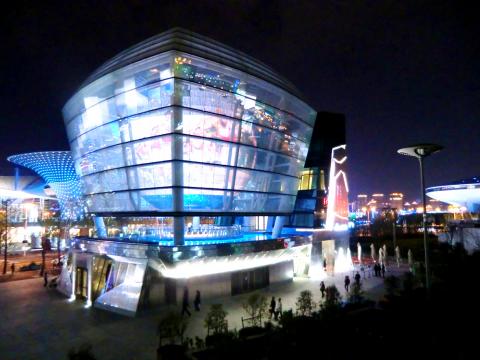
Photo: CNA
Though both incidents had been rectified after Taiwan protested, the shadow of China’s oppression and continual challenges to Taiwan’s sovereign status lingered.
The Chinese-language China Times yesterday reported that an Italian delegation, during a visit with President Ma Ying-jeou (馬英九) in Taipei last month, gave the assurance that they would contact the International Expositions Bureau and attempt to elevate Taiwan’s participation status at the global event.
According to the English-language Web site of the 2015 World Exposition, the expo, being a universal event, would be divided into four different categories, namely countries, international organizations, businesses and civil society organizations.
The site also said that invitations to the world exposition had been extended to “United Nations member countries” — Taiwan has not been a UN member since 1971 — adding that 130 countries had thus far responded to the invitations.
Commenting on the matter, Democratic Progressive Party (DPP) Legislator Lee Chun-yi (李俊俋) yesterday said that “over the past five years, President Ma Ying-jeou’s administration has again and again given tacit consent to the ‘one China’ principle, and Taiwan’s participation in international communities such as the World Health Assembly and the International Civil Aviation Organization has been based on such consent.”
“This consent has caused the international community to mistakenly perceive Taiwan as a part of China,” Lee said, adding that the Ma administration is now getting a spoonful of its own medicine.
“The ministry’s inaction against Chinese oppression and now its inability to gather information on an international event, clearly showed a dereliction of duty to the people they serve,” DPP Legislator Tsai Chi-chang (蔡其昌) said.
DPP Legislator Huang Wei-cher (黃偉哲) said that China must be behind Italy’s denial of Taiwan’s participation in the 2015 world expo as a country, adding that “if the Ma administration’s claims that cross-strait relations have never been better were true, then there should be something to show for it.”
“The government needs to actively negotiate with Italy on the issue and if we cannot affirm the sovereign status of Taiwan at the exposition, then we would rather not participate,” he added.
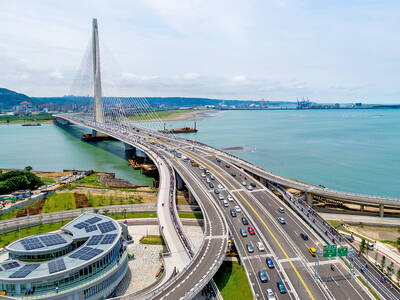
The Ministry of Transportation and Communications yesterday inaugurated the Danjiang Bridge across the Tamsui River in New Taipei City, saying that the structure would be an architectural icon and traffic artery for Taiwan. Feted as a major engineering achievement, the Danjiang Bridge is 920m long, 211m tall at the top of its pylon, and is the longest single-pylon asymmetric cable-stayed bridge in the world, the government’s Web site for the structure said. It was designed by late Iraqi-British architect Zaha Hadid. The structure, with a maximum deck of 70m, accommodates road and light rail traffic, and affords a 200m navigation channel for boats,
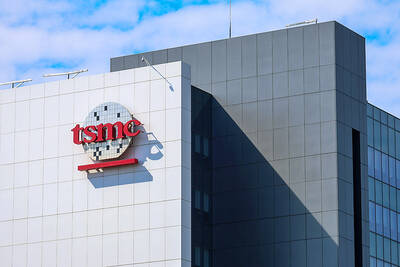
Taiwan Semiconductor Manufacturing Co (TSMC, 台積電), the world’s largest foundry service provider, yesterday said that global semiconductor revenue is projected to hit US$1.5 trillion in 2030, after the figure exceeds US$1 trillion this year, as artificial intelligence (AI) demand boosts consumption of token and compute power. “We are still at the beginning of the AI revolution, but we already see a significant impact across the whole semiconductor ecosystem,” TSMC deputy cochief operating officer Kevin Zhang (張曉強) said at the company’s annual technology symposium in Hsinchu City. “It is fair to say that in the past decade, smartphones and other mobile devices were
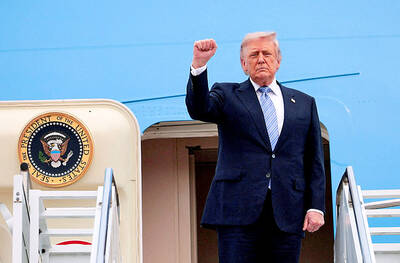
US-CHINA SUMMIT: MOFA welcomed US reassurance of no change in its Taiwan policy; Trump said he did not comment when Xi talked of opposing independence US President Donald Trump yesterday said he has not made a decision on whether to move forward with a major arms package for Taiwan after hearing concerns about it from Chinese President Xi Jinping (習近平). Trump’s comments on Taiwan came as he flew back to Washington after wrapping up critical talks in which both leaders said important progress was made in stabilizing US-China relations even as deep differences persist between the world’s two biggest powers on Iran and Taiwan. “I will make a determination,” Trump said, adding: “I’ll be making decisions. But, you know, I think the last thing we need right
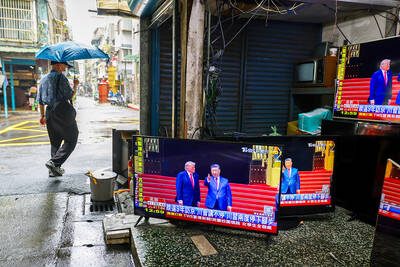
TAIWAN ISSUE: US treasury secretary Scott Bessent said on the first day of meetings that ‘it wouldn’t be a US-China summit without the Taiwan issue coming up’ There were no surprises on the first day of the summit between US President Donald Trump and Chinese President Xi Jinping (習近平), the Mainland Affairs Council (MAC) said yesterday, as the government reiterated that cross-strait stability is crucial to the Asia-Pacific region, as well as the world. As the two presidents met for a highly anticipated summit yesterday, Chinese state media reported that Xi warned Trump that missteps regarding Taiwan could push their two countries into “conflict.” Trump arrived in China with accolades for his host, calling Xi a “great leader” and “friend,” and extending an invitation to visit the White House


 RSS
RSS