


Political analysts and Democratic Progressive Party (DPP) politicians yesterday criticized President Ma Ying-jeou (馬英九) for describing cross-strait relations as not international and cross-strait flights as domestic flights.
“What Ma has been doing in the past five years, in terms of external relations, is lying. He lied to the Taiwanese, the US and Beijing, hoping to reap benefits and personal gains,” political commentator Nan Fang Shuo (南方朔) said on the sidelines of a DPP-organized forum in Taipei.
At the Chinese Nationalist Party’s (KMT) weekly Central Standing Committee meeting on Wednesday, Ma, noting that domestic flights in the US have been more profitable than international flights, said that Taiwan’s airline companies would not have been profitable if they were not operating cross-strait routes.
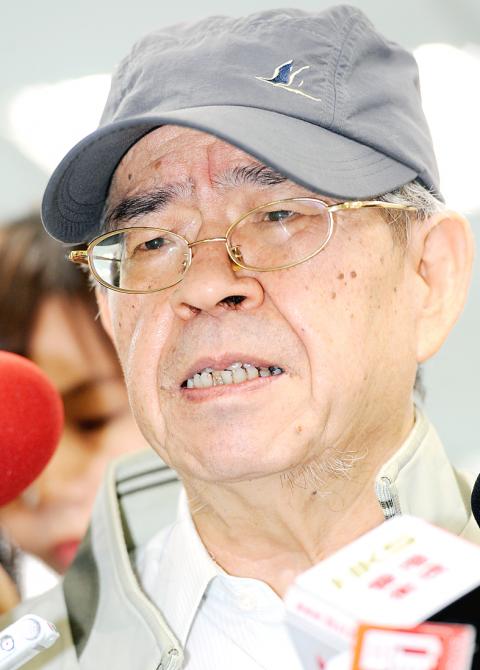
Photo: Lo Pei-der, Taipei Times
“The relations between Taiwan and China are exactly like that,” Ma was quoted as saying.
His comment was interpreted to mean that cross-strait flights are domestic flights.
Ma also drew fire with his Double Ten National Day speech on Oct. 10 when he said the cross-strait relations were not international relations.
The Ma administration’s handling of diplomatic affairs has failed to maximize Taiwan’s gain and minimize potential damages, Nan Fang Shou said, adding that Ma assumed his deceit would win him an opportunity to meet Chinese President Xi Jinping (習近平) at next year’s APEC summit in Beijing.
Asked if Ma’s recent comments underlined the necessity for a constitutional amendment, Nan Fang Shuo said that the true problem did not lie in the Constitution, but in the way Ma and the KMT distorted the Constitution.
“If someone could distort the Constitution like that, amending the Constitution would not be meaningful,” he said.
Meanwhile, Ma yesterday tried to dismiss concerns about his defining cross-strait ties as “not international relations.”
“The Republic of China [ROC] is a sovereign country, and mainland China is part of our territory according to the Constitution. Therefore, our relations with the mainland are not international relations. It is a special relationship,” he said at a meeting with a US delegation led by Wyoming Governor Matt Mead at the Presidential Office.
The president also reiterated his “three noes” policy of no unification, no independence and no use of force in handling cross-strait relations, and said that the government continued to promote cross-strait development under the so-called “1992 consensus.”
He said that cross-strait air routes are neither international flights nor domestic ones, shrugging off concerns about his comparison of US domestic flights to cross-strait flights.
“We’ve defined that the cross-strait air routes are not international ones or domestic ones. They are special flights,” he said.
“Such a definition allows the two sides of the Taiwan Strait to enhance their relations and bring profits to the people from both sides that they did not enjoy in the past,” he said.
Ma cited the signing of the Economic Cooperation Framework Agreement (ECFA) and the service trade agreement, and said the cross-strait relations are the most peaceful and stable they have been in the past 60 years.
He also said the nation will continue to seek cooperation with the US in maintaining a sustainable defense force to protect public safety.
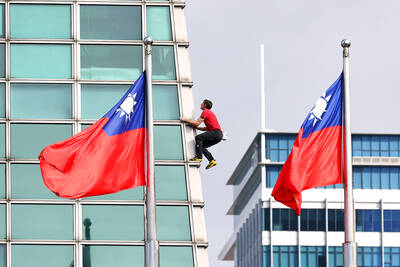
DAREDEVIL: Honnold said it had always been a dream of his to climb Taipei 101, while a Netflix producer said the skyscraper was ‘a real icon of this country’ US climber Alex Honnold yesterday took on Taiwan’s tallest building, becoming the first person to scale Taipei 101 without a rope, harness or safety net. Hundreds of spectators gathered at the base of the 101-story skyscraper to watch Honnold, 40, embark on his daredevil feat, which was also broadcast live on Netflix. Dressed in a red T-shirt and yellow custom-made climbing shoes, Honnold swiftly moved up the southeast face of the glass and steel building. At one point, he stepped onto a platform midway up to wave down at fans and onlookers who were taking photos. People watching from inside
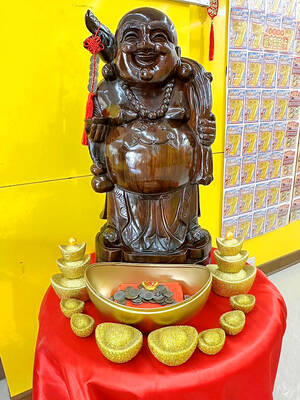
A Vietnamese migrant worker yesterday won NT$12 million (US$379,627) on a Lunar New Year scratch card in Kaohsiung as part of Taiwan Lottery Co’s (台灣彩券) “NT$12 Million Grand Fortune” (1200萬大吉利) game. The man was the first top-prize winner of the new game launched on Jan. 6 to mark the Lunar New Year. Three Vietnamese migrant workers visited a Taiwan Lottery shop on Xinyue Street in Kaohsiung’s Gangshan District (崗山), a store representative said. The player bought multiple tickets and, after winning nothing, held the final lottery ticket in one hand and rubbed the store’s statue of the Maitreya Buddha’s belly with the other,
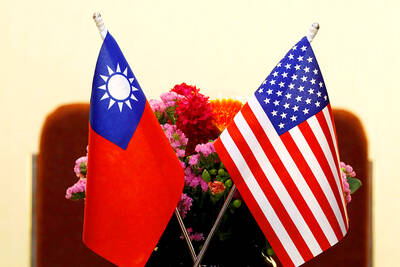
‘NATO-PLUS’: ‘Our strategic partners in the Indo-Pacific are facing increasing aggression by the Chinese Communist Party,’ US Representative Rob Wittman said The US House of Representatives on Monday released its version of the Consolidated Appropriations Act, which includes US$1.15 billion to support security cooperation with Taiwan. The omnibus act, covering US$1.2 trillion of spending, allocates US$1 billion for the Taiwan Security Cooperation Initiative, as well as US$150 million for the replacement of defense articles and reimbursement of defense services provided to Taiwan. The fund allocations were based on the US National Defense Authorization Act for fiscal 2026 that was passed by the US Congress last month and authorized up to US$1 billion to the US Defense Security Cooperation Agency in support of the
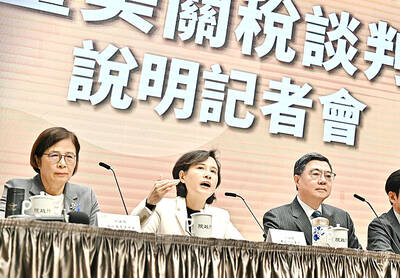
HIGH-TECH DEAL: Chipmakers that expand in the US would be able to import up to 2.5 times their new capacity with no extra tariffs during an approved construction period Taiwan aims to build a “democratic” high-tech supply chain with the US and form a strategic artificial intelligence (AI) partnership under the new tariffs deal it sealed with Washington last week, Taipei’s top negotiator in the talks said yesterday. US President Donald Trump has pushed Taiwan, a major producer of semiconductors which runs a large trade surplus with the US, to invest more in the US, specifically in chips that power AI. Under the terms of the long-negotiated deal, chipmakers such as Taiwan Semiconductor Manufacturing Co (TSMC, 台積電) that expand US production would incur a lower tariff on semiconductors or related manufacturing


 RSS
RSS