


With songs, chants, speeches and clashes, tens of thousands of people demonstrated at several locations near the Presidential Office Building on Double Ten National Day yesterday, calling on President Ma Ying-jeou (馬英九) to step down.
While different groups of demonstrators had different appeals — ranging from the fate of the country’s Fourth Nuclear Power Plant in Gongliao (貢寮), New Taipei City (新北市), to the government’s handling of an improper lobbying case allegedly involving major political figures — the call for Ma to step down was the common theme.
“A president who violates the Constitution like Ma should be ashamed of hosting a national day celebration,” said Dennis Wei (魏揚), a National Tsing Hua University graduate student and a member of a student group called “Black Island National Youth Front,” sitting in front of a line of police officers in front of the Presidential Office Building.
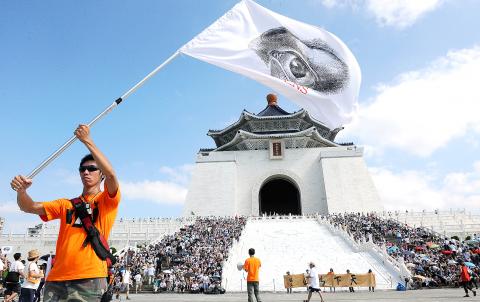
Photo: Liu Hsin-de, Taipei Times
He was referring to the Special Investigation Division’s alleged illegal monitoring of lawmakers’ telephones as well as Prosecutor-General Huang Shih-ming’s (黃世銘) report to the president on information gathered through wiretap.
Wei also accused the government of favoring large corporates by signing the cross-strait service trade pact and disregarding the suffering of ordinary people.
“The ruling elite headed by Ma and Premier Jiang Yi-huah (江宜樺) has lost its legitimacy and should therefore step down right away,” he said.
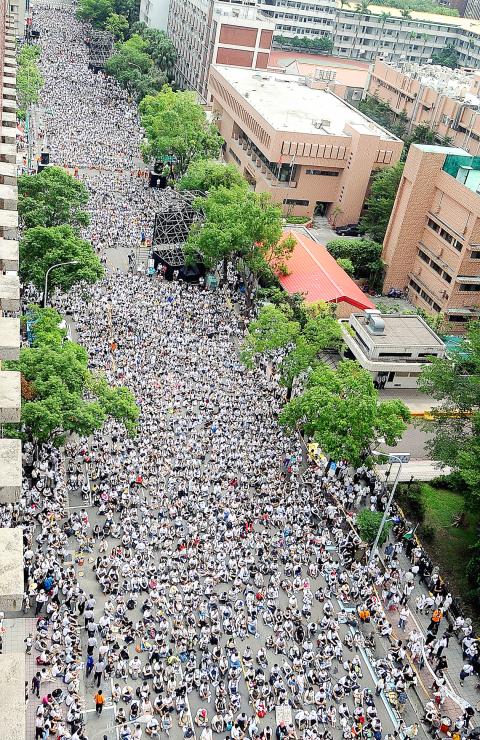
Photo: Fang Pin-chao, Taipei Times
Although the demonstration in front of the Presidential Office was peaceful, student protesters and the police engaged in serious clashes earlier in the morning when the police insisted that protesters remove a truck carrying loudspeakers, leaving several protesters and officers injured.
At a separate setting, a crowd of protesters rallied outside the Legislative Yuan at a demonstration organized by activist group Citizen 1985, calling for revisions of the Referendum Act (公民投票法), the Election and Recall Act for Public Servants (公職人員選舉罷免法), and regulations on election of legislators at-large to lower thresholds for public participation in the nation’s politics.
“When politicians in a democracy no longer listen to the people, we have the right to express our opinions through referendums, but referendums in this country have become a tool for large political parties. The threshold is so high that the only national referendums that ever made it to poll stations were those proposed by the Democratic Progressive Party, the Chinese Nationalist Party [KMT] and former president Chen Shui-bian (陳水扁),” said Huang Kuo-chang (黃國昌), an associate research fellow at Academia Sinica. “Of course the law needs to be amended.”
It is equally difficult for voters to recall elected officials, as the law also prohibits campaigns for a recall, he added.
“Politicians are allowed to launch election campaigns, but the people are prohibited from launching a recall campaign,” Huang said. “Do the politicians all think we the people are so stupid?”
At the rally, a white flag with a “citizen’s eye” on it was raised as a symbolic gesture to signify that people should take back the sovereignty of the citizenry.
Hu Shih-ho (胡世和), uncle of army corporal Hung Chung-chiu (洪仲丘) who allegedly died from abuse while serving in military, also showed up at the rally, panning the government for its slow probe into the death of his nephew despite Ma’s promises.
“Ma’s approval rating is now a little more than 9 percent, that means the people no longer trust him. Shouldn’t we take the power back from him?” Hu asked.
The crowd responded with a loud “yes.”
Later in the afternoon, the crowd moved to Liberty Square, where small forums were held to discuss various public issues.
Citizen 1985 said the rally drew 60,000 people, while police put the peak number at 10,000.
Separately, another group of protesters gathered outside the legislature, urging the government to hear the people’s call to abandon the controversial Fourth Nuclear Power Plant project, which the anti-nuclear activists said is a huge waste of taxpayers’ money and has been plagued by mishaps that could jeopardize public safety.
Additional reporting by CNA

DRONE CENTRAL: Taiwan aims to become Asia’s democratic hub for drones, with most exports focused on high-quality military-grade models, an official said Taiwan’s drone industry is expected to expand significantly by 2030, producing 100,000 units per month and exporting half of them, the Ministry of Economic Affairs said yesterday. Current drone production capacity is about 15,000 units per month, but the industry can quickly scale up as demand increases, Industrial Development Administration Director-General Chiou Chyou-huey (邱求慧) told a news conference in Taipei. Taiwan’s drone output grew 2.5-fold last year to NT$12.9 billion (US$408.3 million) under a government program to develop the uncrewed vehicle sector, he said. The Executive Yuan in October last year approved plans to invest NT$44.2 billion into domestic production of uncrewed aerial

A signaling system malfunction disrupted high-speed rail (HSR) services beginning at 8am today, with trains temporarily reduced to three northbound and three southbound trains per hour as authorities conduct inspections. The malfunction occurred on a section of track in Miaoli County during pre-operation checks early this morning, forcing northbound and southbound trains to use a single track, the HSR operator said. The regular schedule has been replaced with three hourly trains offering only nonreserved seating in each direction, stopping at every station, it said, adding that business class cars would still have reserved seating. Departures from terminal stations are scheduled at the top

VERBOSE VESSELS: A CGA cutter and a China Coast Guard exchanged verbal barbs for more than a day in Taiwanese-controlled waters before the Chinese vessel left The Taiwanese and Chinese coast guards had a standoff near the strategically located Pratas Islands (Dongsha Islands, 東沙群島) in the north of the South China Sea, the Coast Guard Administration (CGA) said yesterday. The two sides engaged in intense radio exchanges over sovereignty claims during the 33-hour standoff. China Coast Guard vessel 3501 eventually left the restricted waters, 26.6 nautical miles (49.2km) west of the Pratas Islands, at 5pm yesterday, the CGA said. Lying approximately between southern Taiwan and Hong Kong, the Taiwan-controlled Pratas are seen by some security experts as vulnerable to Chinese attack due to their distance — more than
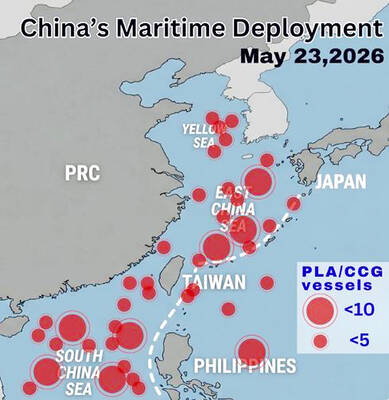
WARNING: China should stop engaging in actions that undermine regional peace and stability, as it would only build resentment among people across the Strait, the CGA said China has deployed more than 100 navy, coast guard and other vessels in waters from the Yellow Sea to the South China Sea and the western Pacific since US President Donald Trump and Chinese President Xi Jinping (習近平) met in Beijing, National Security Council Secretary-General Joseph Wu (吳釗燮) said yesterday. “In this part of the world, #China is the one & only PROBLEM wrecking the #StatusQuo & threatening regional peace & stability,” Wu wrote on X. In a separate post, he said Beijing was coercing Taiwan’s maritime domain, calling it illegal and provocative, after the Coast Guard Administration (CGA) expelled a


 RSS
RSS