

Democratic Progressive Party (DPP) Chairman Su Tseng-chang (蘇貞昌) yesterday said the party was still weighing the best constitutional option against President Ma Ying-jeou’s (馬英九) role in the ongoing political crisis, but that it did not rule out a motion of no confidence if Ma refused to step down on his own.
The party is gauging the most appropriate moment and the momentum before committing to one of the constitutional options, including recall, impeachment and motion of no confidence, to resolve the current political crisis, Su told an international press conference.
The press conference, titled “Congressgate — Constitution In Jeopardy. Democracy is Backsliding,” was held to brief international media on the Ma administration’s alleged abuse of wiretaps and infringement of the Constitution.

Photo: CNA
The DPP chairman reiterated that both Ma and Premier Jiang Yi-huah (江宜樺) should step down over the damage they had done to the Constitution, adding that Prosecutor-General Huang Shih-ming (黃世銘) and the Supreme Prosecutors’ Office Special Investigation Division (SID) must be suspended pending investigation.
“We believe that what Ma and his administration have done is far more serious than the Watergate scandal in the US,” Su said.
The DPP also demanded the SID’s abolition and the establishment of a document request committee in the Legislative Yuan to allow legislators to probe into the SID’s wiretapping of the legislature, opposition politicians and prosecutors.
The Ma administration’s violations of the law are very obvious, with the SID monitoring the legislature, the premier criticizing the speaker to gain political profit for his own party and the president interfering with an ongoing investigation and the judicial system to remove the speaker, Su said.
Asked if the party would resort to a motion of no confidence and the possible ensuing dissolution of the legislature, Su said it would be “an opportunity that is more than we could hope for.”
Pressed by another reporter on whether he would take the risk that could lead to dissolution of the legislature, Su answered: “I do.”
However, he added, “the scenario would be based on two conditions — the passage of the no-confidence motion in the legislature and the president’s decision [to dissolve the legislature].”
DPP lawmakers yesterday proposed the establishment of a special investigation committee in the legislature to investigate Ma, with Legislator Chen Li-chiun (鄭麗君) saying that focusing on Huang without investigating Ma would not likely uncover the truth.

EYE ON 2027: The US military has placed equipment, materiel and personnel on the islands near China, a US officer said while warning about the threat from China The US Army Pacific (USARPAC) is deploying forces and equipment across the region based on the assumption that Beijing could possess the military capability and the intent to invade Taiwan by next year, a top US commander said on Tuesday. Speaking at the TechNet Indo-Pacific conference in Honolulu, US General Ronald Clark said that the threat posed by the so-called “Davidson window” is “still valid,” US military newspaper Stars and Stripes reported on Wednesday. The term stems from a 2021 warning by Admiral Philip Davidson, then-head of the US Indo-Pacific Command, that the threat of Chinese military action against Taiwan could materialize
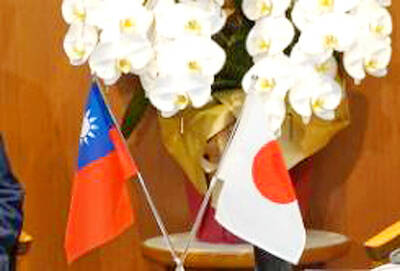
Taiwan and Japan might sign a wide-ranging trade agreement by the end of this year, which could help break a deadlock in Taiwan’s trade diplomacy if completed, Nikkei Asia reported yesterday. Japan is negotiating with the administration of President William Lai (賴清德) to reach a comprehensive economic agreement modeled after the Enhanced Trade Partnership Arrangement finalized by the UK and Taiwan in 2023, it said, citing two sources familiar with the matter. “The Enhanced Trade Partnership between the UK and Taiwan sets a precedent for Japan to follow,” one of the sources told the media outlet. The framework leaves room for future agreements

‘ONE CHINA’ DECISION: A Cabinet spokesperson said that Pakistan had pandered to Beijing, and disregarded international rules and reality with the overflight ban The first Taiwanese commercial aircraft since restrictions were lifted flew over Pakistan yesterday morning following an abrupt U-turn by authorities to approve permits that were briefly revoked due to Islamabad’s “one China” policy. EVA Airways (長榮航空) Flight 65 from Taipei to Vienna entered Pakistani airspace at about 3:30am local time, Flightradar24 tracking data showed. All other Europe-bound EVA Air and China Airlines (華航) flights that departed late on Wednesday night into early yesterday morning opted to use Russian airspace, or go via India. The airlines had been forced to detour, including flying over Russia, since Sunday, after Pakistan shut its airspace to Taiwanese
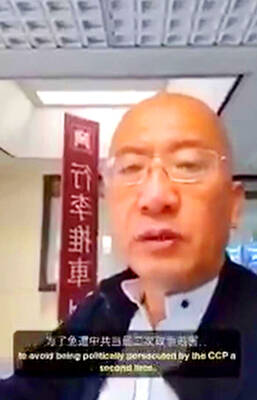
Chinese national Cheng Wanjun (程萬軍), who was at Taiwan Taoyuan International Airport after arriving on a connecting flight from Thailand on Monday and sought asylum in Taiwan, was deported to Thailand early yesterday, the National Immigration Agency (NIA) said. In a video circulating on X, Cheng identified himself as a former host at China Central Television (CCTV) and said he was seeking temporary humanitarian protection in Taiwan. Cheng said he was sentenced to six years in prison after he was recorded and reported to authorities in 2019 for criticizing “a ruler who loses his country.” After his release, he was forced to go


 RSS