


In the wake of the Chinese Nationalist Party’s (KMT) decision to postpone its party congress that was scheduled for Sunday due to protests planned against President Ma Ying-jeou (馬英九), a group of protesters from labor unions and civic groups yesterday protested outside the KMT headquarters, accusing Ma of evading public discontent and urging the party to address political strife.
Shouting: “Face the misery of the people, Ma Ying-jeou. Four KMT star politicians, stop blurring the line between right and wrong,” the protesters accused Ma and Legislative Speaker Wang Jin-pyng (王金平) of worsening living conditions for the public amid their political rift, and urged Ma’s possible successors — Vice President Wu Den-yih (吳敦義), Premier Jiang Yi-huah (江宜樺), New Taipei City (新北市) Mayor Eric Chu (朱立倫) and Taipei Mayor Hau Lung-bin (郝龍斌) — to resolve the issue for the sake of their own political futures.
“The KMT and these political stars should stop the so-called ‘Respecting Wang and supporting Ma’ approach and start addressing the issue. If they do not separate themselves from Ma and the political rift until next year’s local election, it will be too late,” National Alliance for Workers of Closed Factories representative Wu Yong-yi (吳永毅) said.
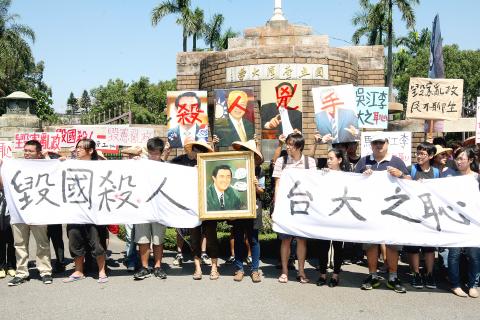
Photo: CNA
The alliance will continue to organize anti-Ma rallies, with at least 45 civic groups participating, despite the KMT’s decision to delay the party congress to next month or November, he said.
“We don’t care when or where the KMT’s congress will be held. The protests will go on, and we will follow Ma and the KMT wherever they go,” he said.
Yesterday’s protest was held in response to the KMT’s announcement on Tuesday that it has decided to delay its 19th party congress, which was to begin on Sunday at the Sun Yat-sen Memorial Hall, due to civic groups’ plans to hold a rally against Ma there that day.
The party is considering holding the congress at Chungshan Hall on Yangmingshan on Oct. 26, but no plans have been confirmed for the new date and venue.
Ma was unaffected by the protest yesterday as he presided over the KMT’s Central Standing Committee in the building. Dozens of police officers were dispatched to the KMT headquarters to prevent the protesters, of which there were about 20, from entering the building.
Democratic Progressive Party (DPP) Taipei City Councilor Chien Yu-yen (簡余晏) accused Taipei’s police department of “wasting its manpower” protecting Ma, urging the department not to become bodyguards for the president.
She said the KMT has tightened security at the party headquarters since July as more groups took their protests to the venue at the weekly Central Standing committee, and the department sent more than 140 police to the scene at a protest in July.
Hau shrugged off Chien’s accusations, saying police were dispatched in accordance with the size of rallies and protests, as well as protocols regarding the protection of the president and government officials.
Students held a separate protest on the grounds of National Taiwan University yesterday.

‘NO SECURITY RISK’: The Railway Bureau reassured the public that the technicians’ activities were limited to technical guidance and did not involve sensitive systems The Railway Bureau yesterday said it had invited eight Chinese technicians to assist with an airport MRT construction project. The bureau issued the confirmation after an Internet user said Chinese nationals had entered the construction zone of Taiwan Taoyuan International Airport’s Terminal 3 project. They asked why “individuals from an enemy state” were allowed access to such a major national infrastructure project, which raised serious concerns over Taiwan’s industrial safety, sensitive systems and information security. The bureau’s Northern Region Engineering Branch Office said subcontractor Taiwan Handle Industrial Co (台灣手把工業) of the Taoyuan airport MRT’s “Contract No. CU05 Project A14 Station Civil, MEP &

The National Chungshan Institute of Science and Technology yesterday showcased its locally developed variants of the Vision 60 robotic patrol dog, which it plans to deploy on the nation’s outlying territories in the South China Sea. The variants were produced under the Joint Lab project — created by the institute and domestic companies — and assembled with domestically produced motors, lenses and artificial intelligence (AI) systems alongside licensed tech from the US, Missile and Rocket Systems Research Division deputy director Jen Kuo-kang (任國光) told the media event at a military base in Taipei’s Dazhi (大直) area. Taiwan has built up its strengths

RIGHT DIRECTION: Taiwan’s efforts to prevent forced labor include a proposal to ‘fully prohibit’ employers from withholding workers’ documents, an official said Taiwan is to establish a mechanism to restrict imports of goods linked to forced labor, the Executive Yuan said yesterday, after the US proposed imposing additional tariffs on Taiwanese goods over labor concerns. “The Ministry of Labor and the Ministry of Economic Affairs are to establish an interministerial review procedure,” Executive Yuan spokesperson Michelle Lee (李慧芝) said at a news briefing in Taipei. “The government is to use the Foreign Trade Act [貿易法] as the legal basis to restrict imports of goods produced with forced labor” and bring its supply chain governance more in line with international standards on human rights, resilience

NOT IMMEDIATE: Taiwan has a chance to appeal the proposed 10 percent tariff before it starts, while other countries face a 12.5 percent tariff from the trade office Taiwan is among 60 economies determined by the US to have failed to impose or enforce a ban on the importation of goods produced with forced labor, according to a notice released on Tuesday by the Office of the US Trade Representative (USTR), which proposed imposing an additional 10 percent or more tariff on them. The USTR in a statement said that following an investigation, it had determined under Section 301 of the Trade Act of 1974 that the failure of the 60 economies to impose and effectively enforce a prohibition on the importation of goods produced with forced labor is


 RSS
RSS