


The Ministry of Economic Affairs’ Bureau of Energy has admitted that it bought keyword advertising linking the names of several prominent anti-nuclear activists with a pro-nuclear Web site when any of their names is entered in search engines.
The anti-nuclear activists from various civic groups discovered that when they searched for their own names on Google, Yahoo and other search engines, a pro-nuclear power Web site (anuclear-safety.twenergy.org.tw) operated by the ministry will appear as the first suggested Web site.
As the Web site’s content is clearly in contrast with the activists’ beliefs about nuclear power, the anti-nuclear advocates, including Nuclear-Free Homeland Alliance executive director Lee Cho-han (李卓翰), Tokyo-based Taiwanese anti-nuclear writer Liu Li-erh (劉黎兒) and Green Consumers Foundation chairman Jay Fang (方儉), among others, expressed anger and disgust about the advertising link.
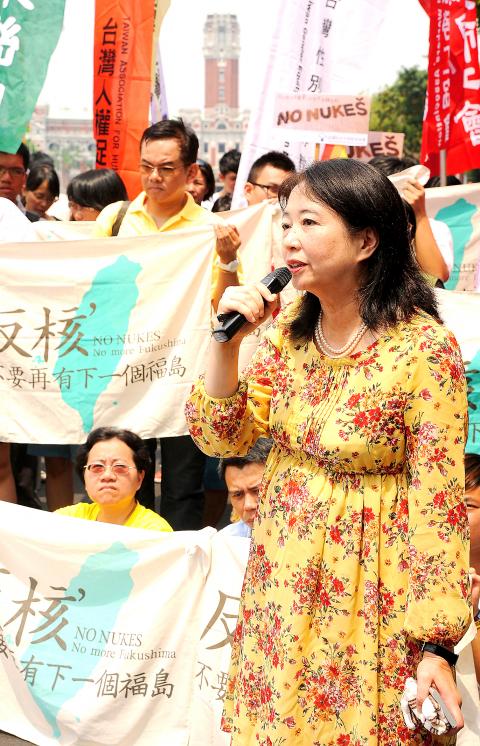
Photo: Taipei Times
The linkage was first discovered by Lee last week when he was searching for his own name on Google. He immediately contacted Google and Yahoo on the same day, asking them to take down the advertisement.
The Bureau of Energy said on Tuesday that it had bought the keyword advertisement on popular search engines, linking to a total of 92 keywords — including 29 names of people who often spoke publicly about nuclear power.
The bureau said that it not only linked the Web site to names of anti-nuclear activists, but also government officials, such as Premier Jiang Yi-huah (江宜樺) and Taiwan Power Co vice president Chen Pu-tsan (陳布燦), and that the purpose was to allow members of the public who are interested in nuclear power issues to notice the official Web site and get another perspective.
In response, Liu posted a statement on anti-nuclear power group Mom Loves Taiwan’s Facebook page, calling the ministry “detestable” for spending taxpayers’ money on “using lies and contrary opinions to link with my name, and making people who searched my name wanting to understand me, drink poison and be brainwashed.”
Fang also criticized the situation through his Facebook page, saying that the behavior is “extremely despicable” and suggested that legislators and the Control Yuan investigate whether the government official that spent taxpayers’ money on buying advertisements, thereby infringing upon basic human rights are qualified to manage the nation’s energy policies.
Although the search engines took down the links on Tuesday, Lee said he is considering filing a lawsuit against the bureau for its disrespect to these individuals, for which it had not even apologized.

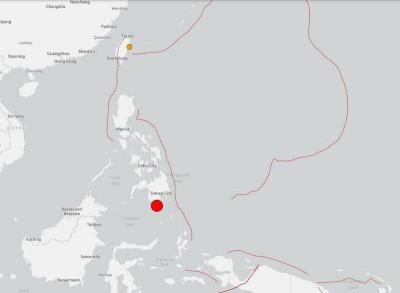
A magnitude 7.8 earthquake struck off the southern coast of Mindanao in the Philippines at 7:38am today, prompting the US Tsunami Warning System to issue an alert for neighboring countries, including Taiwan. The system issued a purple alert indicating a "tsunami threat." The potential threat zone includes Taiwan, the Philippines, Papua New Guinea, Yap and Palau. There were no immediate reports of major damage in the Philippines or Indonesia. The quake struck at a depth of 10km, said the German Research Centre for Geosciences, which had earlier pegged the earthquake at magnitude 8.2. Phivolcs, the Philippine agency, said the quake was magnitude 7 and

RESILIENCE: Taiwan plays a key role in semiconductors, energy, information infrastructure and advanced manufacturing, AIT Director Raymond Greene said Taiwan’s continued investment in deterrence and resilience remains vital, especially in uncrewed systems and other emerging technologies, American Institute in Taiwan (AIT) Director Raymond Greene said yesterday. Greene made the remarks at the annual National Strategic Summit on Supply Chain Resilience held by the Research Institute for Democracy, Society and Emerging Technology (DSET), a government-backed think tank. As Taiwan last year became the US’ fourth-largest trading partner and supply chain security is becoming more important, cooperation in emerging technologies continues to deepen between the two countries, he said. The US is committed to accelerating innovation, building key infrastructure, strengthening cooperation

The National Chungshan Institute of Science and Technology yesterday showcased its locally developed variants of the Vision 60 robotic patrol dog, which it plans to deploy on the nation’s outlying territories in the South China Sea. The variants were produced under the Joint Lab project — created by the institute and domestic companies — and assembled with domestically produced motors, lenses and artificial intelligence (AI) systems alongside licensed tech from the US, Missile and Rocket Systems Research Division deputy director Jen Kuo-kang (任國光) told the media event at a military base in Taipei’s Dazhi (大直) area. Taiwan has built up its strengths

RIGHT DIRECTION: Taiwan’s efforts to prevent forced labor include a proposal to ‘fully prohibit’ employers from withholding workers’ documents, an official said Taiwan is to establish a mechanism to restrict imports of goods linked to forced labor, the Executive Yuan said yesterday, after the US proposed imposing additional tariffs on Taiwanese goods over labor concerns. “The Ministry of Labor and the Ministry of Economic Affairs are to establish an interministerial review procedure,” Executive Yuan spokesperson Michelle Lee (李慧芝) said at a news briefing in Taipei. “The government is to use the Foreign Trade Act [貿易法] as the legal basis to restrict imports of goods produced with forced labor” and bring its supply chain governance more in line with international standards on human rights, resilience


 RSS
RSS