


As President Ma Ying-jeou (馬英九) left the US on Monday, the Wall Street Journal published a hard-hitting article charging that Taiwan now “faces a new political crossroads.”
It said that following the tragic hazing death of army corporal Hung Chung-chiu (洪仲丘) the entire nation had been thrown into turmoil and that the way the Chinese Nationalist Party (KMT) handles the scandal “could destabilize relations with both the US and China.”
Written by US-Taiwan Business Council president Rupert Hammond-Chambers, the article said that pro-China forces had jumped on the opportunity to further undermine the Ministry of National Defense (MND) and claim the military was “unworthy of robust support.”
Hammond-Chambers said Washington had “reason to worry” because the ministry was the most important pro-US institution within the government.
He said some in the KMT wanted to impose further financial restrictions on the ministry to “starve the beast” in the aftermath of the scandal.
“This would further weaken the already underfunded MND at a time when the military requires resources and support to transform itself into a modern, well-equipped and all-volunteer force,” Hammond-Chambers said.
It comes, he said, as some members of Ma’s party want him to open political and military talks with Beijing.
“The deep blue camp wants to restrict funds to the MND, claiming that China’s ongoing military build-up is nothing to worry about and that the money should be spent elsewhere,” he said. “Chinese leaders must be watching these developments with positive glee.”
“Taipei is doing more damage to its own ability to deter mainland [sic] coercion and military attack than any weapon the People’s Liberation Army could conceive,” Hammond-Chambers said.
“This damage represents a serious threat to Taiwan’s national security and by extension to the national security of the US and Japan,” he said.
Hammond-Chambers said that US President Barack Obama’s decision “rhetorically and substantially” to omit Taiwan from his pivot to Asia had telegraphed to China that Taiwan was no longer central to US policy.
“By doing so, the US is inviting Chinese adventurism,” he said.
Hammond-Chambers concluded that the US can recalibrate its Taiwan policy by restarting arms sales to Taiwan that have been stalled for two years.
“The first step should be new F-16C/D fighters, followed by assistance with the procurement of submarines,” he said.
As Ma ended his one-night stopover in the US and left New York to start a 12-day diplomatic tour of the Americas, he met with US politicians including US Representative Eliot Engel, the ranking member of the US House of Representatives Committee on Foreign Affairs.
Engel said he had “a very productive conversation” with Ma about “how to reinforce the strong bond between our two countries.”
He said that more could be done to deepen economic, security and political ties.
US Senate Foreign Relations Committee Chairman Robert Menendez left on Monday for a nine-day visit to Asia that includes a stop in Taiwan.
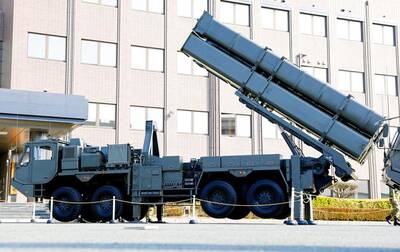
Japan has deployed long-range missiles in a southwestern region near China, the Japanese defense minister said yesterday, at a time when ties with Beijing are at their lowest in recent years. The missiles were installed in Kumamoto in the southern region of Kyushu, as Japan is attempting to shore up its military capacity as China steps up naval activity in the East China Sea. “Standoff defense capabilities enable us to counter the threat of enemy forces attempting to invade our country ... while ensuring the safety of our personnel,” Japanese Minister of Defense Shinjiro Koizumi said. “This is an extremely important initiative for
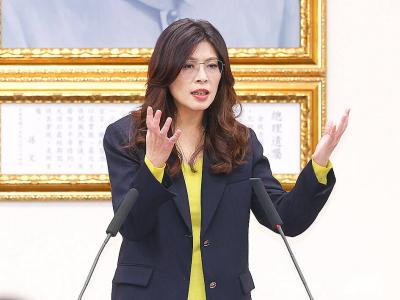
Chinese Nationalist Party (KMT) Chairwoman Cheng Li-wun (鄭麗文) today accepted an invitation from Chinese President Xi Jinping (習近平) to lead a delegation to China next month, saying she hopes to promote the peaceful development of cross-strait relations and bring stability to the Taiwan Strait. “I am grateful and happy to accept this invitation,” Cheng said in a statement from the KMT chairperson’s office. Cheng said she hopes both sides can work together to promote the peaceful development of cross-strait relations, enhance exchange and cooperation, bring stability to the Taiwan Strait and improve people’s livelihoods. At today's news conference, Cheng said any efforts to
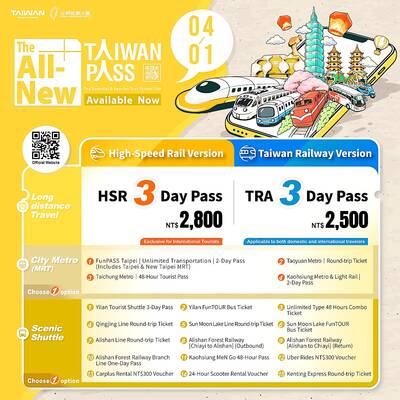
MORE POPULAR: Taiwan Pass sales increased by 59 percent during the first quarter compared with the same period last year, the Tourism Administration said The Tourism Administration yesterday said that it has streamlined the Taiwan Pass, with two versions available for purchase beginning today. The tourism agency has made the pass available to international tourists since 2024, allowing them to access the high-speed rail, Taiwan Railway Corp services, four MRT systems and four Taiwan Tourist Shuttles. Previously, five types of Taiwan Pass were available, but some tourists have said that the offerings were too complicated. The agency said only two types of Taiwan Pass would be available, starting from a three-day pass with the high-speed rail and a three-day pass with Taiwan Railway Corp. The former costs NT$2,800

The nation’s fastest supercomputer, Nano 4 (晶創26), is scheduled to be launched in the third quarter, and would be used to train large language models in finance and national defense sectors, the National Center for High-Performance Computing (NCHC) said. The supercomputer, which would operate at about 86.05 petaflops, is being tested at a new cloud computing center in the Southern Taiwan Science Park in Tainan. The exterior of the server cabinet features chip circuitry patterns overlaid with a map of Taiwan, highlighting the nation’s central position in the semiconductor industry. The center also houses Taiwania 2, Taiwania 3, Forerunner 1 and


 RSS
RSS