


Miaoli County Commissioner Liu Cheng-hung (劉政鴻) was on Wednesday night nominated as a member of the Chinese Nationalist Party’s (KMT) Central Committee, despite the recent public outcry over the forced demolition of four houses in Miaoli County’s Dapu Borough (大埔).
On President Ma Ying-jeou’s (馬英九) nomination list, Liu was ranked 32th out of 210 nominees.
Keelung Mayor Chang Tung-rong (張通榮), who has low approval ratings, ranked 34th.
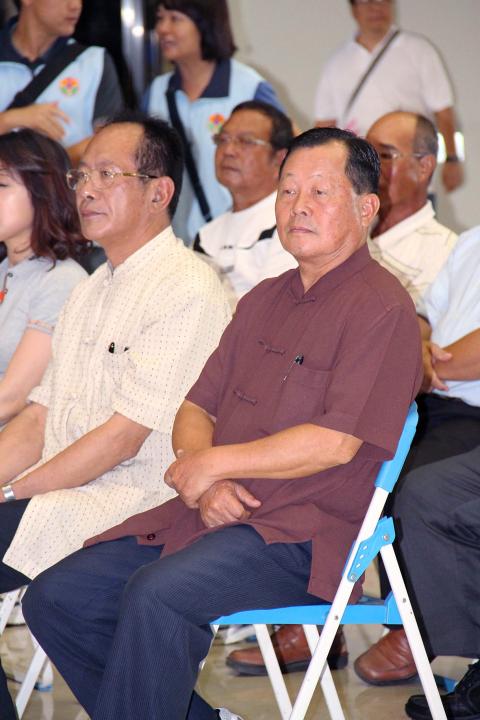
Photo: CNA
Liu ranked 77th in the previous nomination list presented by former KMT chairman Wu Poh-hsiung (吳伯雄).
The top five nominees included KMT legislators Huang Chao-shun (黃昭順) and Yuang Chiung-ying (楊瓊瓔), and KMT Central Standing Committee members Lee Chuan-chiao (李全教), Hung Yu-chin (洪玉欽) and Hsu Hsian-rong (許顯榮).
The nomination list sparked criticism from the opposition camp, with Democratic Progressive Party (DPP) caucus convener Ker Chien-ming (柯建銘) saying that Ma’s list will generate public dissent against the KMT, and his nomination of Liu as a Central Committee member reflected his ignorance of public opinion.
The KMT yesterday declined to comment on Ma’s nomination of Liu as a Central Committee member amid continuous protests against Liu and the county government.
A KMT official, who spoke on condition of anonymity, rebutted Ker’s criticism by insisting that the party’s nomination list did not guarantee that all nominees will be elected, as party delegates also have the right to nominate Central Committee members via petitions.
The official acknowledged that Ma’s nomination should guarantee election, but added that party members aiming for the Central Committee can still qualify to enter the race by obtaining signatures from at least six party delegates.
Former Taipei EasyCard Corp chairman Sean Lien (連勝文), son of former KMT chairman Lien Chan (連戰), and KMT Central Standing Committee member Hsieh Kung-hung (謝坤宏), who failed in his attempt to compete with Ma in the KMT chairmanship election earlier this month, are also on the nomination list.
The KMT will elect 210 Central Committee members on Aug. 17, while party delegates will elect 32 Central Standing Committee members from those Central Committee members on Sept. 7.


RESILIENCE: Taiwan plays a key role in semiconductors, energy, information infrastructure and advanced manufacturing, AIT Director Raymond Greene said Taiwan’s continued investment in deterrence and resilience remains vital, especially in uncrewed systems and other emerging technologies, American Institute in Taiwan (AIT) Director Raymond Greene said yesterday. Greene made the remarks at the annual National Strategic Summit on Supply Chain Resilience held by the Research Institute for Democracy, Society and Emerging Technology (DSET), a government-backed think tank. As Taiwan last year became the US’ fourth-largest trading partner and supply chain security is becoming more important, cooperation in emerging technologies continues to deepen between the two countries, he said. The US is committed to accelerating innovation, building key infrastructure, strengthening cooperation

The National Chungshan Institute of Science and Technology yesterday showcased its locally developed variants of the Vision 60 robotic patrol dog, which it plans to deploy on the nation’s outlying territories in the South China Sea. The variants were produced under the Joint Lab project — created by the institute and domestic companies — and assembled with domestically produced motors, lenses and artificial intelligence (AI) systems alongside licensed tech from the US, Missile and Rocket Systems Research Division deputy director Jen Kuo-kang (任國光) told the media event at a military base in Taipei’s Dazhi (大直) area. Taiwan has built up its strengths

RIGHT DIRECTION: Taiwan’s efforts to prevent forced labor include a proposal to ‘fully prohibit’ employers from withholding workers’ documents, an official said Taiwan is to establish a mechanism to restrict imports of goods linked to forced labor, the Executive Yuan said yesterday, after the US proposed imposing additional tariffs on Taiwanese goods over labor concerns. “The Ministry of Labor and the Ministry of Economic Affairs are to establish an interministerial review procedure,” Executive Yuan spokesperson Michelle Lee (李慧芝) said at a news briefing in Taipei. “The government is to use the Foreign Trade Act [貿易法] as the legal basis to restrict imports of goods produced with forced labor” and bring its supply chain governance more in line with international standards on human rights, resilience

NOT IMMEDIATE: Taiwan has a chance to appeal the proposed 10 percent tariff before it starts, while other countries face a 12.5 percent tariff from the trade office Taiwan is among 60 economies determined by the US to have failed to impose or enforce a ban on the importation of goods produced with forced labor, according to a notice released on Tuesday by the Office of the US Trade Representative (USTR), which proposed imposing an additional 10 percent or more tariff on them. The USTR in a statement said that following an investigation, it had determined under Section 301 of the Trade Act of 1974 that the failure of the 60 economies to impose and effectively enforce a prohibition on the importation of goods produced with forced labor is


 RSS
RSS