


Tens of thousands protesters, many clad in white, demonstrated in front of the Ministry of National Defense in Taipei yesterday, demanding that the military reveal the truth about the death of conscript Hung Chung-chiu (洪仲丘) and bring the perpetrators to justice.
Shouting slogans and holding placards bearing messages such as: “Give justice to the victim’s family,” “Ensure human rights in the military” and “Without the truth, there is no forgiveness,” the protesters also called for the inclusion of an independent third party in the investigation into Hung’s death.
Hung died on July 4, following punishing exercises he had been forced to do as part of his punishment while being confined to detention barracks.
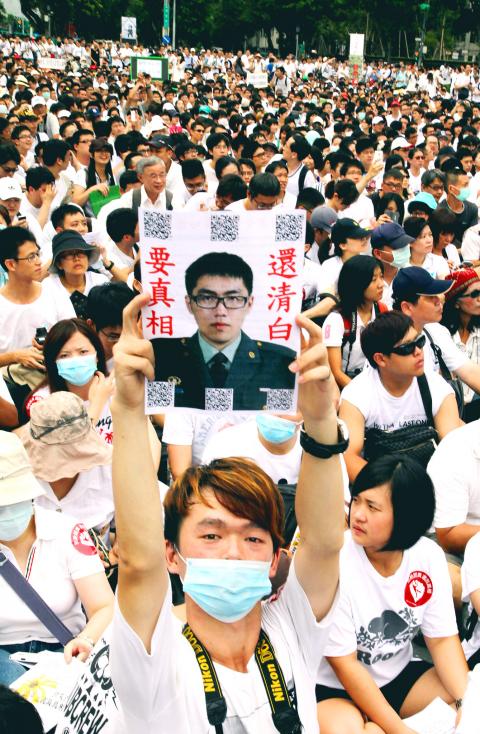
Photo: David Chang, EPA
In making the appeal, dozens of young male protesters sang military songs with revised lyrics criticizing the army officers thought to have been involved in Hung’s death, while others made a show of drinking bottled water — a reference to reports that Hung’s superiors allegedly refused to give him water despite repeated requests.
The protesters also observed a minute of silence to mourn the deceased corporal.
Among the protesters were the parents of late naval solider Yao Tai-yuan (姚泰源), who carried a photograph of their son as they rallied. Yao’s parents say their son was pushed from a naval harbor and drowned last year, but the military did not consider his death to be a murder.
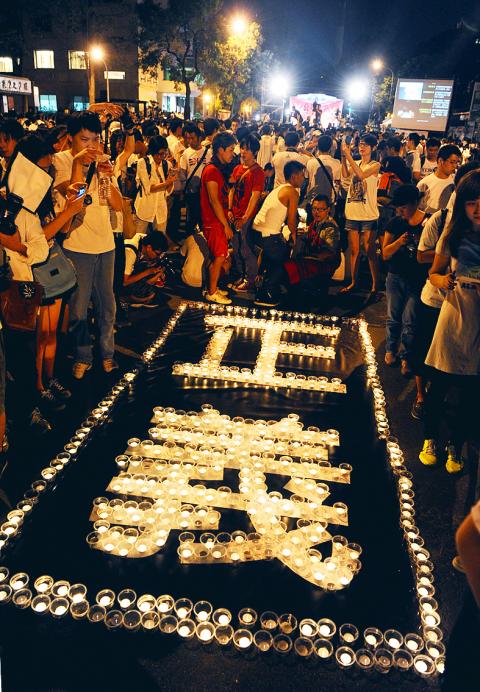
Photo: Lo Pei-der, Taipei Times
Hung’s uncle, Hu Shih-ho (胡世和), also attended the rally, where he thanked the protesters and supported their calls.
“We [Hung’s family] demand the truth,” Hu said.
Many protesters booed loudly when Deputy Minister of National Defense Andrew Yang (楊念祖) turned up on behalf of the ministry to accept a letter submitted by Citizen 1985, the civic group that had organized the rally.
“We ask the public to give the ministry a chance to rectify our errors,” Yang said, bowing to the crowd, apologizing and promising to establish Hung’s cause of death.
Citizen 1985 made three appeals in the rally: the call for the involvement of a third party; that key material evidence in the case be examined and maintained by civil professorial authorities; and that the military reform its disciplinary system, as well as its 1985 hotline complaint system.
According to the group, there are only two kinds of conscripts who dare to call the 1985 helpline, which is designed for them to voice any issues or complaints: new ones who do not know that their supervisors will likely exact revenge and outgoing conscripts who think they can escape retribution because they will soon be discharged.
The ministry later said in a press statement that it accepted the three appeals, adding that the Taoyuan District Prosecutors’ Office has agreed to take part in the case.
It also agreed that material evidence be kept and examined by civil professional authorities, and guaranteed the safety of all witnesses in the case, the statement said, adding that it would also amend the hotline system.
While the civic group had previously estimated that about 5,000 people would join in the protest, it said nearly 30,000 people showed up yesterday. Police estimated that there were 15,000 demonstrators.
The demonstration ended before noon and was followed by an evening vigil in Hung’s memory near the Legislative Yuan.
Hung was serving in the army’s 542nd Brigade in Hsinchu County and was due to be discharged on July 6. He was transferred to the 269th Brigade in Taoyuan on June 28 for disciplinary reasons after bringing a camera-equipped cellphone onto base without permission.
On July 3, Hung suffered heat exhaustion during a training session and was sent to a military hospital in Taipei. He died at the hospital of multiple organ failure after efforts to resuscitate him failed.
The incident has sparked a public outcry, partly because of the circumstances surrounding Hung’s death, including that he was confined to detention barracks for an offense that only merited a reprimand.
Many have also criticized the military for what they perceive as its lack of urgency in handling the case and seeming disinterest in learning the truth behind why Hung was detained and how he was treated while in confinement.
Additional reporting by AFP

RESILIENCE: Taiwan plays a key role in semiconductors, energy, information infrastructure and advanced manufacturing, AIT Director Raymond Greene said Taiwan’s continued investment in deterrence and resilience remains vital, especially in uncrewed systems and other emerging technologies, American Institute in Taiwan (AIT) Director Raymond Greene said yesterday. Greene made the remarks at the annual National Strategic Summit on Supply Chain Resilience held by the Research Institute for Democracy, Society and Emerging Technology (DSET), a government-backed think tank. As Taiwan last year became the US’ fourth-largest trading partner and supply chain security is becoming more important, cooperation in emerging technologies continues to deepen between the two countries, he said. The US is committed to accelerating innovation, building key infrastructure, strengthening cooperation

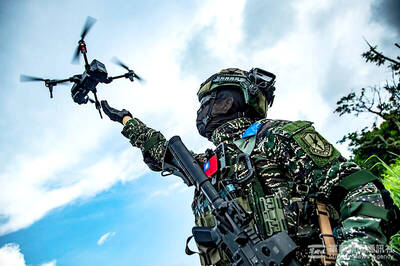
The National Chungshan Institute of Science and Technology yesterday showcased its locally developed variants of the Vision 60 robotic patrol dog, which it plans to deploy on the nation’s outlying territories in the South China Sea. The variants were produced under the Joint Lab project — created by the institute and domestic companies — and assembled with domestically produced motors, lenses and artificial intelligence (AI) systems alongside licensed tech from the US, Missile and Rocket Systems Research Division deputy director Jen Kuo-kang (任國光) told the media event at a military base in Taipei’s Dazhi (大直) area. Taiwan has built up its strengths

RIGHT DIRECTION: Taiwan’s efforts to prevent forced labor include a proposal to ‘fully prohibit’ employers from withholding workers’ documents, an official said Taiwan is to establish a mechanism to restrict imports of goods linked to forced labor, the Executive Yuan said yesterday, after the US proposed imposing additional tariffs on Taiwanese goods over labor concerns. “The Ministry of Labor and the Ministry of Economic Affairs are to establish an interministerial review procedure,” Executive Yuan spokesperson Michelle Lee (李慧芝) said at a news briefing in Taipei. “The government is to use the Foreign Trade Act [貿易法] as the legal basis to restrict imports of goods produced with forced labor” and bring its supply chain governance more in line with international standards on human rights, resilience
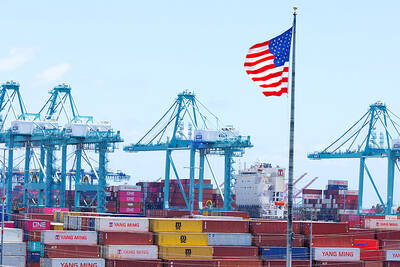
NOT IMMEDIATE: Taiwan has a chance to appeal the proposed 10 percent tariff before it starts, while other countries face a 12.5 percent tariff from the trade office Taiwan is among 60 economies determined by the US to have failed to impose or enforce a ban on the importation of goods produced with forced labor, according to a notice released on Tuesday by the Office of the US Trade Representative (USTR), which proposed imposing an additional 10 percent or more tariff on them. The USTR in a statement said that following an investigation, it had determined under Section 301 of the Trade Act of 1974 that the failure of the 60 economies to impose and effectively enforce a prohibition on the importation of goods produced with forced labor is


 RSS
RSS