


Academics yesterday warned that the Hsinchu City Government’s investigation into Austrian lecturer Max Gufler’s work permit after he criticized the city government was reminiscent of the White Terror era.
In an open letter released on May 10, Gufler, a lecturer at National Hsinchu University of Education and an environmentalist, urged the city government not to sponsor three firework shows in October as part of Double Ten National Day celebrations because the shows would cause air pollution and waste public funds.
Lu Chung-chin (呂忠津), Taiwan Association of University Professors (TAUP) president, told a news conference that Hsinchu’s Department of Labor began a probe into Gufler’s work permit on May 14.
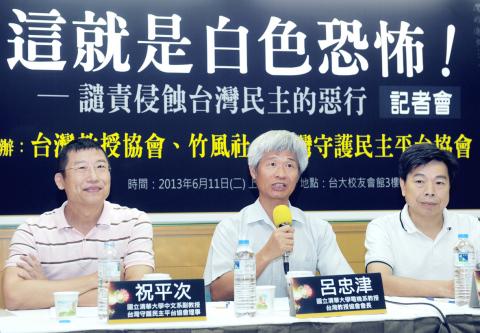
Photo: CNA
The probe was widely criticized and prompted a city councilor to question Hsinchu Mayor Hsu Ming-tsai (許明財) about the investigation, Lu said.
Hsu has officially apologized to Gufler, but the TAUP, Taiwan Democracy Watch (TDW) and National Chiao Tung University’s Chufeng Society said the government and Hsu should apologize for jeopardizing Taiwan’s proud democracy with their “disgusting behavior.”
Chu Ping-tzu (祝平次), a National Tsinghua University professor who represented TDW at the news conference, said the incident showed that the mentality of some government officials “is pretty much the same as the government’s mentality in the Martial Law era.”
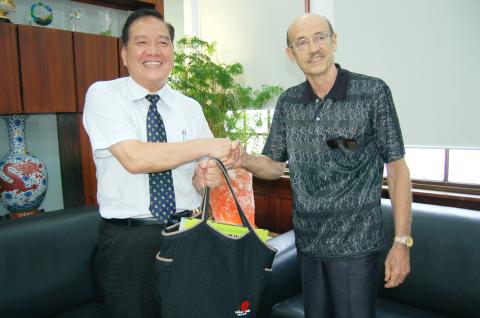
Photo: Chen Wei-jen, Taipei Times
Citing US whistleblower Edward Snowden, the source behind the recent leaks of information about the US National Security Agency’s activities, Chu said the county government’s practice “was perhaps not that surprising since that even the US government violates democracy from time to time.”
Chu said a series of recent incidents nationwide have worried academics and rights advocates about the status of Taiwan’s “campus democracy,” citing the Ministry of Education’s letters to students who participated in a protest, National Taiwan University’s request for police officers to maintain order on campus and the suppression of students’ speech of freedom at several schools.
Liu Chun-hsiu (劉俊秀), a professor at National Chiao Tung University, said the harassment of Gufler was the kind of strategy the government used during the White Terror era, along with lawsuits, so that the victims would eventually be subdued through fear.
“The perpetrators’ primary objective is intimidation, which would be enough to silence the protesters and advocates, because no one wants to endure prolonged legal proceedings and constant harassment,” Liu said.


RESILIENCE: Taiwan plays a key role in semiconductors, energy, information infrastructure and advanced manufacturing, AIT Director Raymond Greene said Taiwan’s continued investment in deterrence and resilience remains vital, especially in uncrewed systems and other emerging technologies, American Institute in Taiwan (AIT) Director Raymond Greene said yesterday. Greene made the remarks at the annual National Strategic Summit on Supply Chain Resilience held by the Research Institute for Democracy, Society and Emerging Technology (DSET), a government-backed think tank. As Taiwan last year became the US’ fourth-largest trading partner and supply chain security is becoming more important, cooperation in emerging technologies continues to deepen between the two countries, he said. The US is committed to accelerating innovation, building key infrastructure, strengthening cooperation

The National Chungshan Institute of Science and Technology yesterday showcased its locally developed variants of the Vision 60 robotic patrol dog, which it plans to deploy on the nation’s outlying territories in the South China Sea. The variants were produced under the Joint Lab project — created by the institute and domestic companies — and assembled with domestically produced motors, lenses and artificial intelligence (AI) systems alongside licensed tech from the US, Missile and Rocket Systems Research Division deputy director Jen Kuo-kang (任國光) told the media event at a military base in Taipei’s Dazhi (大直) area. Taiwan has built up its strengths

RIGHT DIRECTION: Taiwan’s efforts to prevent forced labor include a proposal to ‘fully prohibit’ employers from withholding workers’ documents, an official said Taiwan is to establish a mechanism to restrict imports of goods linked to forced labor, the Executive Yuan said yesterday, after the US proposed imposing additional tariffs on Taiwanese goods over labor concerns. “The Ministry of Labor and the Ministry of Economic Affairs are to establish an interministerial review procedure,” Executive Yuan spokesperson Michelle Lee (李慧芝) said at a news briefing in Taipei. “The government is to use the Foreign Trade Act [貿易法] as the legal basis to restrict imports of goods produced with forced labor” and bring its supply chain governance more in line with international standards on human rights, resilience

NOT IMMEDIATE: Taiwan has a chance to appeal the proposed 10 percent tariff before it starts, while other countries face a 12.5 percent tariff from the trade office Taiwan is among 60 economies determined by the US to have failed to impose or enforce a ban on the importation of goods produced with forced labor, according to a notice released on Tuesday by the Office of the US Trade Representative (USTR), which proposed imposing an additional 10 percent or more tariff on them. The USTR in a statement said that following an investigation, it had determined under Section 301 of the Trade Act of 1974 that the failure of the 60 economies to impose and effectively enforce a prohibition on the importation of goods produced with forced labor is


 RSS
RSS