


A sister-city agreement between Greater Kaohsiung and the Maldivian capital, Male, was declared invalid by the Maldivian Ministry of Foreign Affairs on Monday, one day after the pact was signed.
A Ministry of Foreign Affairs official in Taipei yesterday said it was the first time a local government’s efforts to establish sister-city ties with a foreign city had been thwarted due to apparent pressure from China.
The Greater Kaohsiung Government has not yet responded to the Maldivian statement, posted on the Web site of the Maldivian ministry, which said that the government of the Maldives “does not recognize the memorandum of understanding.”
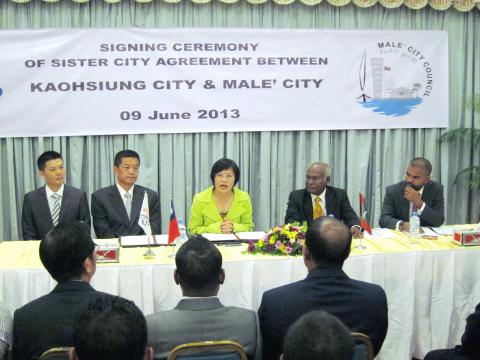
Photo courtesy of the Kaohsiung City
The government reaffirms its commitment and support to China’s national unity and to the “one China” policy, the statement said.
The Maldives’ firm belief in the “one China” policy is guided by the principles of respect for sovereignty, territorial integrity and non-interference in the internal affairs of states and it considers Taiwan an integral part of the People’s Republic of China (PRC), the statement said.
China is a very important development partner for the Maldives and the government of the Maldives will continue to work with the PRC government to strengthen the close ties of friendship and cooperation that exist between the two countries, the statement said.
The signing ceremony was held on Sunday, just hours after a delegation of Greater Kaohsiung Government officials led by Kaohsiung Deputy Mayor Liu Shih-fang (劉世芳) arrived in Male for the four-day visit. The main purpose of trip was to sign the agreement.
The delegation is scheduled to return home tomorrow.
A Greater Kaohsiung Government official, who spoke on condition of anonymity because she was not authorized to speak to reporters, said the idea for the sister-city link was proposed by Male Mayor Maizan Ali Maniku when he visited Greater Kaohsiung in November last year.
Ali Maniku and his delegation were interested in learning about Kaohsiung’s experience in promoting sustainable development, the official said.
Ali Maniku met with Kaohsiung Mayor Chen Chu (陳菊) and they decided to become sister cities to forge a partnership on sustainable development, the official said. The two sides had discussions that led to the signing of the agreement covering urban infrastructure, tourism, the environment and the social and cultural arenas, she said.
Greater Kaohsiung was the first city in the nation to become a formal municipal member of Local Governments for Sustainability (ICLEI), which was founded in 1990 as the International Council for Local Environmental Initiatives.
The ICLEI designated Greater Kaohsiung as one of its seven mentor cities in May last year in recognition of its achievements in promoting sustainable development.
At last year’s ICLEI World Congress, Greater Kaohsiung was assigned to mentor Male and help it facilitate sustainability.
A press release from the Greater Kaohsiung Government said the delegation had shared with its hosts the city’s experience in drainage pipeline network management, waste disposal, offshore submerged breakwaters, plant diseases and pest control, and solar power development. The delegation also conducted a field study of Male’s construction of a rainwater sewer system, erosion-prone sea embankment and how it deals with waste disposal and processes raw kitchen waste, the press release said.
Male would have been Greater Kaohsiung’s 28th sister city and Kaohsiung would have been Male’s second.

‘NO SECURITY RISK’: The Railway Bureau reassured the public that the technicians’ activities were limited to technical guidance and did not involve sensitive systems The Railway Bureau yesterday said it had invited eight Chinese technicians to assist with an airport MRT construction project. The bureau issued the confirmation after an Internet user said Chinese nationals had entered the construction zone of Taiwan Taoyuan International Airport’s Terminal 3 project. They asked why “individuals from an enemy state” were allowed access to such a major national infrastructure project, which raised serious concerns over Taiwan’s industrial safety, sensitive systems and information security. The bureau’s Northern Region Engineering Branch Office said subcontractor Taiwan Handle Industrial Co (台灣手把工業) of the Taoyuan airport MRT’s “Contract No. CU05 Project A14 Station Civil, MEP &

A US uncrewed surface vessel (USV) encountered multiple Chinese warships during an autonomous transit of the Taiwan Strait, US defense company Seasats said in a statement on Wednesday. Seasats announced that a Lightfish USV had completed the first autonomous transit of the Taiwan Strait. Over five days, the USV traversed the entire length of the Strait while constantly monitoring surface vessel traffic, the company said. The Lightfish encountered multiple Chinese warships, one of which was a Chinese People’s Liberation Army Navy (PLAN) Type 056 corvette, it said. The Chinese vessels were operating “well within Taiwan’s exclusive economic zone without transmitting their identity via the
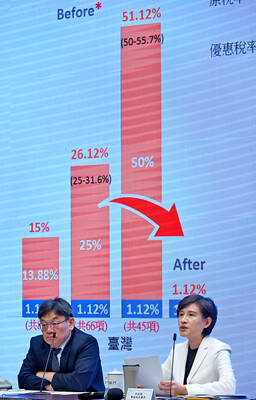
GREATER REACH? Auto parts and wood products would face tariffs of up to 15%, matching those targeting the EU, Japan and South Korea, Vice Premier said The US has announced that preferential tariff treatment for Taiwan’s non-semiconductor Section 232 goods would take effect retroactively from May 1, the Executive Yuan said yesterday. The US government yesterday posted a notice on the Federal Register’s public inspection Web site previewing tariff concessions for Taiwan under a memorandum of understanding (MOU) on Taiwan-US investment after two months of negotiations. The MOU signed on Jan. 15 stipulated three major preferential tariff arrangements: a 15 percent “reciprocal” tariff rate for Taiwan without stacking most-favored nation (MFN) rates; preferential Section 232 treatment for semiconductors and related products; and preferential Section 232 treatment for non-semiconductor

TIT-FOR-TAT: The US allegedly revoked the visa of a Chinese national working at Xinhua News Agency in the US in response to Beijing’s expulsion of Vivian Wang The Presidential Office yesterday condemned China for expelling a New York Times correspondent from Beijing following the newspaper’s interview with President William Lai (賴清德), saying the move highlighted Beijing’s suppression of press freedom and its threat to international news media. Taiwan has noted a series of recent incidents in which Beijing used similar tactics to “threaten and pressure international media outlets and journalists,” Presidential Office spokeswoman Karen Kuo (郭雅慧) said in a statement. “This concerns not only press freedom and freedom of expression, but also the safety of journalists, and Taiwan and relevant partners are paying close attention to the situation,” she


 RSS
RSS