


The Fisheries Agency yesterday released information concerning Kuang Ta Hsing No. 28’s position and movement throughout its voyage to disprove the claim by the Philippines that the fishing boat had intruded into its territorial waters, leading to the fatal shooting of Taiwanese fisherman Hung Shih-cheng (洪石成).
From the time the 15-tonne Kuang Ta Hsing No. 28 left Siaoliouciou (小琉球), an island off Pingtung County, on May 4, until it was disabled by Philippine Coast Guard personnel on May 9, the voyage data recorder (VDR) system onboard “was kept operational all along the voyage,” Fisheries Agency Deputy Director-General Tsay Tzu-yaw (蔡日耀) said.
Tsay said the information from the boat’s VDR, which recorded vital information related to the vessel’s operation, showed that the boat was operating within the nation’s exclusive economic zone and had never entered the territorial waters of the Philippines.
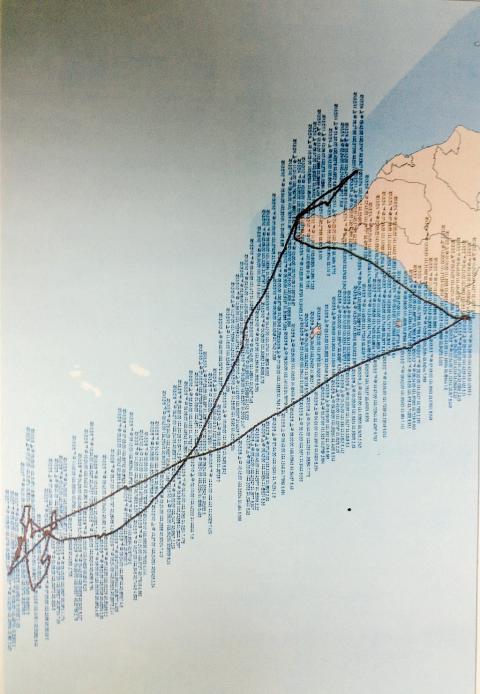
Photo: Huang Liang-chieh, Taipei Times
According to the information, the ship arrived at 20o north latitude and 123o east longitude at 2:30am on May 7 and was operating in the area between 19o 50 minutes and 20o 10 minutes north latitude, and between 122o 48 minutes and 123o 25 minutes east longitude until 8:24am on May 9, Tsay said.
From midnight on May 9 to 6:18am that day, the ship was sailing west by south at a speed of between 3 knots and 8 knots (5.6kph and 14.8kph) before it arrived at 19o 57 minutes north latitude, 122o 48 minutes east longitude, where it sailed at a lower speed of between 0 knots and 1 knot, he said.
The data showed that the ship sailed at a speed of between 4 knots and 5 knots in an east-south-east direction at 8:24am that day, while its speed increased to 10 knots at 10:12am, when its location was measured at 19o 59 minutes north latitude, 122o 55 minutes east longitude, “presumably being chased” by the Philippine vessel, Tsay said.
Tsay said the ship lost power at 11:24am at 20o 7 minutes, 123o east longitude, when its speed was measured at zero, data showed.
Analysis of the information has showed that it “contained no disruption to data recording during the voyage,” meaning that that the VDR system was operational, Tsay said.
The claims by the Philippines that its coast guard personnel were carrying out their duty to stop illegal fishing were “defamatory,” Tsay said.
“We have shown our evidence, but they haven’t,” he said.
Meanwhile, the Ministry of Justice said the Philippines had agreed to allow Taiwanese investigators to board the Philippine vessel that attacked the Kuang Ta Hsing No. 28.
Deputy Minister of Justice Chen Ming-tang (陳明堂) said the Philippines had agreed to allow Taiwanese investigators to inspect the firearms used and compare ballistics results with those obtained by Philippine investigators.
Chen said ministry official Yang Wan-li (楊婉莉) is now negotiating matters involving the investigation with the authorities in Manila.
The ministry is seeking to see the video of the incident shot by the Philippine patrol boat, but the negotiation is ongoing, Chen said.
He said the Philippines refused to allow Taiwanese to interview Philippine Coast Guard officers, but the ministry hoped that questions prepared for the suspects could be asked by Philippine investigators.
He reiterated that allowing Taiwanese investigators to join the probe in Manila would not intrude on the Philippine’s judicial sovereignty.
Chen said the ministry has agreed to Manila sending a team to Taiwan.
Earlier on Monday, Philippine Secretary of Justice Leila de Lima reiterated her opposition to the idea of a joint investigation, saying that Taiwan and the Philippines were instead conducting “parallel” or “respective” investigations.
“It’s not advisable to agree to a joint probe, because you know, aside from sovereignty issues involved, there is foreign policy implications involved because of the ‘one China’ policy,” De Lima said.
However, a Taiwanese team would be allowed to view written testimony given by the officers, De Lima said.
The Philippines has also expressed interest in sending its investigators to Taiwan to gain further information on the shooting.
De Lima said Manila hoped to meet the Taiwanese fishermen who were on the boat at the time of the incident and get their statements, as well as conduct another autopsy on the deceased fisherman, if his family agrees.
De Lima said that the Philippine National Bureau of Investigation had completed its investigation in the Philippines and was waiting to go to Taiwan to continue the investigation there, before issuing a final report.

PROVOCATIVE: Chinese Deputy Ambassador to the UN Sun Lei accused Japan of sending military vessels to deliberately provoke tensions in the Taiwan Strait China denounced remarks by Japan and the EU about the South China Sea at a UN Security Council meeting on Monday, and accused Tokyo of provocative behavior in the Taiwan Strait and planning military expansion. Ayano Kunimitsu, a Japanese vice foreign minister, told the Council meeting on maritime security that Tokyo was seriously concerned about the situation in the East China and South China seas, and reiterated Japan’s opposition to any attempt to change the “status quo” by force, and obstruction of freedom of navigation and overflight. Stavros Lambrinidis, head of the EU delegation to the UN, also highlighted South China Sea
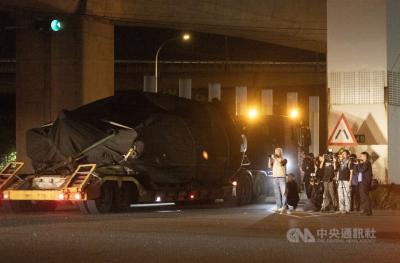
The final batch of 28 M1A2T Abrams tanks purchased from the US arrived at Taipei Port last night and were transported to the Armor Training Command in Hsinchu County’s Hukou Township (湖口), completing the military’s multi-year procurement of 108 of the tanks. Starting at 12:10am today, reporters observed more than a dozen civilian flatbed trailers departing from Taipei Port, each carrying an M1A2T tank covered with black waterproof tarps. Escorted by military vehicles, the convoy traveled via the West Coast Expressway to the Armor Training Command, with police implementing traffic control. The army operates about 1,000 tanks, including CM-11 Brave Tiger

Taiwan Semiconductor Manufacturing Co (TSMC, 台積電), the world’s largest contract chipmaker, said it expects its 2-nanometer (2nm) chip capacity to grow at a compound annual rate of 70 percent from this year to 2028. The projection comes as five fabs begin volume production of 2-nanometer chips this year — two in Hsinchu and three in Kaohsiung — TSMC senior vice president and deputy cochief operating officer Cliff Hou (侯永清) said at the company’s annual technology symposium in Silicon Valley, California, last week. Output in the first year of 2-nanometer production, which began in the fourth quarter of last year, is expected to

Taiwan’s drone exports surged past US$100 million in the first quarter, exceeding last year’s full-year total, with the Czech Republic emerging as the largest buyer, the Ministry of Economic Affairs said. Exports of complete drones reached US$115.85 million in the period, about 1.2 times the total recorded for all of last year, the ministry said in a report. Exports to the Czech Republic accounted for about US$100 million, far outpacing other markets. Poland, last year’s top destination, recorded about US$11.75 million in the first quarter. Taiwan’s drone exports have expanded rapidly in the past few years, with last year’s total


 RSS
RSS