


Despite strong pressure and repeated efforts, the US has again declined to issue an outright condemnation of the Philippines for shooting a Taiwanese fisherman.
However, US Department of State spokesperson Jennifer Psaki has confirmed that Washington is now trying to play a role in calming the growing crisis.
“We regret the tragic death of a Taiwan fishing boat master during the May 9 confrontation at sea with a Philippine patrol vessel,” Psaki said on Monday.
“The United States has been in touch with both the Philippine government and the Taiwan authorities regarding the incident,” she said.
Psaki said that the US welcomed the Philippine government’s pledge to conduct a “full and transparent” investigation.
While the State Department has refused to give details, sources with knowledge of the situation told the Taipei Times that US diplomats are currently talking to both sides and strongly urging caution.
Asked if the US was worried about a possible escalation, Psaki said: “We continue to urge all parties, in any scenario, to ensure maritime safety and to refrain from provocative actions.”
“The Philippine government is going to be conducting an investigation and they will be working with the Taiwan authorities to establish what happened in this case,” she said.
Pressed to condemn the Philippine authorities for firing on the Taiwanese boat, Psaki appeared to equivocate.
She was asked to explain what actions Taiwan had taken that the US was concerned about when only one side — the Philippines — had actually done any shooting.
“When you’re warning both sides, you’re giving an equivalency. What is the Taiwanese action that you’re concerned about?” Psaki was asked.
“The Philippine government is looking into this case — I don’t want to get ahead of their process of investigating what happened,” she said.
At a regular daily press briefing, Psaki was again pressured to be more specific.
“The Taiwanese fisherman was unarmed. It’s a fishing boat — small compared to the government vessel that the Filipinos had. When you say confrontation, only one side was shooting the other, using a machine gun. Fifty-nine bullet holes were found in that small boat. I want you to comment on the fact that someone opened fire in the South China Sea,” a reporter said.
Psaki said that she was just making a broad point that both sides should refrain from provocative actions.
“I’m not going to speculate on this specific case,” she said.
Asked where, in the US’ view, the shooting took place, Psaki said: “The precise location of the incident is not yet clear, although it appears the incident took place in or near disputed waters, where both claim fishing rights.”
Psaki said that the US regretted the “tragic death” and encouraged “peaceful negotiation and peaceful resolution.”
“When you see people doing things that run directly counter to behavior that would lead to stability, are you going to stand up and point that out, and hold these governments to account? You’re holding the victimizer and the victim to equal account, so it doesn’t seem to match,” the reporter said.
Psaki replied: “There will be an investigation run by the Philippine government into what happened here. I don’t think that is holding both sides to the same account.”
In a final effort the reporter asked: “Would you condemn the killing of an innocent fisherman, unarmed, in this incident? Or would you condone that?”
“I certainly didn’t condone it. I said we regret the tragic death of this fisherman,” Psaki said.
It was the second time the US Department of State has refused to condemn the incident.
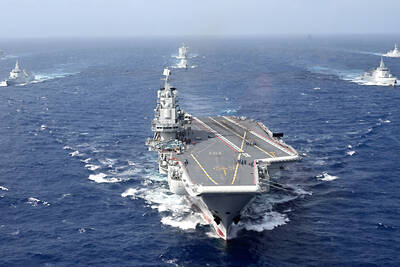
PROVOCATIVE: Chinese Deputy Ambassador to the UN Sun Lei accused Japan of sending military vessels to deliberately provoke tensions in the Taiwan Strait China denounced remarks by Japan and the EU about the South China Sea at a UN Security Council meeting on Monday, and accused Tokyo of provocative behavior in the Taiwan Strait and planning military expansion. Ayano Kunimitsu, a Japanese vice foreign minister, told the Council meeting on maritime security that Tokyo was seriously concerned about the situation in the East China and South China seas, and reiterated Japan’s opposition to any attempt to change the “status quo” by force, and obstruction of freedom of navigation and overflight. Stavros Lambrinidis, head of the EU delegation to the UN, also highlighted South China Sea
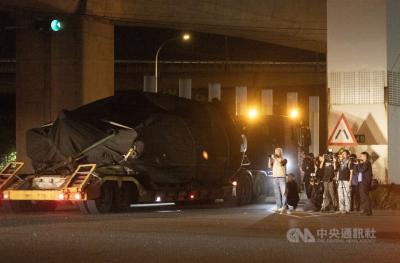
The final batch of 28 M1A2T Abrams tanks purchased from the US arrived at Taipei Port last night and were transported to the Armor Training Command in Hsinchu County’s Hukou Township (湖口), completing the military’s multi-year procurement of 108 of the tanks. Starting at 12:10am today, reporters observed more than a dozen civilian flatbed trailers departing from Taipei Port, each carrying an M1A2T tank covered with black waterproof tarps. Escorted by military vehicles, the convoy traveled via the West Coast Expressway to the Armor Training Command, with police implementing traffic control. The army operates about 1,000 tanks, including CM-11 Brave Tiger
Taiwan Semiconductor Manufacturing Co (TSMC, 台積電), the world’s largest contract chipmaker, said it expects its 2-nanometer (2nm) chip capacity to grow at a compound annual rate of 70 percent from this year to 2028. The projection comes as five fabs begin volume production of 2-nanometer chips this year — two in Hsinchu and three in Kaohsiung — TSMC senior vice president and deputy cochief operating officer Cliff Hou (侯永清) said at the company’s annual technology symposium in Silicon Valley, California, last week. Output in the first year of 2-nanometer production, which began in the fourth quarter of last year, is expected to

Taiwan’s drone exports surged past US$100 million in the first quarter, exceeding last year’s full-year total, with the Czech Republic emerging as the largest buyer, the Ministry of Economic Affairs said. Exports of complete drones reached US$115.85 million in the period, about 1.2 times the total recorded for all of last year, the ministry said in a report. Exports to the Czech Republic accounted for about US$100 million, far outpacing other markets. Poland, last year’s top destination, recorded about US$11.75 million in the first quarter. Taiwan’s drone exports have expanded rapidly in the past few years, with last year’s total


 RSS
RSS