


Tens of thousands of Bangladeshis joined May Day protests yesterday to demand the execution of textile bosses over the collapse of a factory complex, as rescuers warned that the final death toll could be more than 500.
Despite calls by the prime minister for “cool heads,” tensions over the country’s deadliest industrial disaster showed little sign of abating, and there were fears of more violence and vandalism at textile mills.
Workers holding red banners and flags chanted: “Hang the killers, hang the factory owners,” as they took to the streets of Dhaka at the start of a series of nationwide demonstrations during the public holiday.
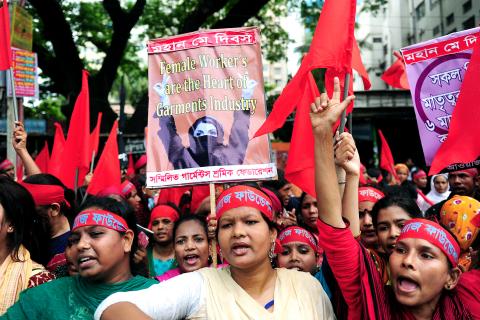
Photo: AFP
Police put the number of protesters at the main rally in Dhaka at more than 20,000, and there were smaller-scale protests elsewhere in the capital and in other cities.
Kamrul Anam, one of the leaders of the Bangladesh Textile and Garments Workers League, said the demonstrators were angry at “the murder” of their colleagues in the disaster at Savar on the outskirts of Dhaka on Wednesday last week.
“We want the severest punishment possible for those responsible for this tragedy,” he said.
“Enough is enough,” said Liakot Khan, another protester taking part in the Dhaka rally, which echoed to the sound of drums and horns.
“The government should hang the proprietor and the factory owners. We want justice for these murders,” he said.
The Bangladesh government is also facing foreign pressure to take credible moves to raise safety standards in the garment industry, with the collapse at the Rana Plaza factory complex the latest in a series of deadly disasters.
The EU said late on Tuesday that it would look at steps to promote better practices in a sector that depends on Western brands, with clothes from retailers Primark, Benetton and Mango produced recently at the site.
Workers’ rights campaigners say Western retailers who source their clothing to Bangladesh must also take a share of the blame.
With bulldozers busy clawing through the ruins of the eight-story complex, Bangladesh military spokesman Mir Rabbi said that the confirmed death toll now stood at 402.
An army general also told reporters that local officials had drawn up a list of 149 people who are still unaccounted for.
Eight people have so far been arrested and charged with “death by negligence” over the collapse of the eight-story building which housed five separate garment factories.
Those charged have had to wear bulletproof vests at their court appearances.
Many of the country’s 4,500 garment factories have been closed since Wednesday last week, a major blow for the Bangladeshi economy, which is powered in large part by the US$20 billion industry.
Speaking in parliament on Tuesday night, Bangladeshi Prime Minister Sheikh Hasina urged employees to return to work and criticized reported attacks on some factories.
“I would like to tell the workers to keep their head cool, keep mills and factories operative, otherwise you will end up losing your jobs,” she said.

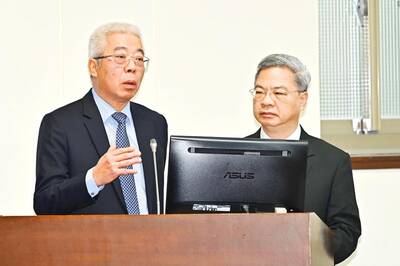
Taiwan has arranged for about 8 million barrels of crude oil, or about one-third of its monthly needs, to be shipped from the Red Sea this month to bypass the Strait of Hormuz and ease domestic supply pressures, CPC Corp, Taiwan (CPC, 台灣中油) said yesterday. The state-run oil company has worked with Middle Eastern suppliers to secure routes other than the Strait of Hormuz, through which about 20 percent of the world’s oil and liquefied natural gas typically passes, CPC chairman Fang Jeng-zen (方振仁) said at a meeting of the legislature’s Economics Committee in Taipei. Suppliers in Saudi Arabia have indicated they
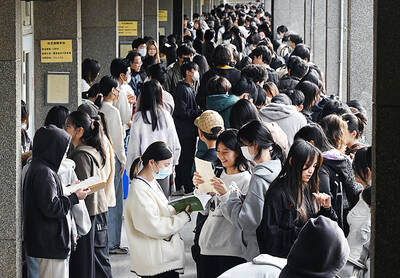
A global survey showed that 60 percent of Taiwanese had attained higher education, second only to Canada, the Ministry of the Interior said. Taiwan easily surpassed the global average of 43 percent and ranked ahead of major economies, including Japan, South Korea and the US, data from the Organisation for Economic Co-operation and Development (OECD) for 2024 showed. Taiwan has a high literacy rate, data released by the ministry showed. As of the end of last year, Taiwan had 20.617 million people aged 15 or older, accounting for 88.5 percent of the total population, with a literacy rate of 99.4 percent, the data

CCP ‘PAWN’? Beijing could use the KMT chairwoman’s visit to signal to the world that many people in Taiwan support the ‘one China’ principle, an academic said Chinese Nationalist Party (KMT) Chairwoman Cheng Li-wun (鄭麗文) yesterday arrived in China for a “peace” mission and potential meeting with Chinese President Xi Jinping (習近平), while a Taiwanese minister detailed the number of Chinese warships currently deployed around the nation. Cheng is visiting at a time of increased Chinese military pressure on Taiwan, as the opposition-dominated Legislative Yuan stalls a government plan for US$40 billion in extra defense spending. Speaking to reporters before going to the airport, Cheng said she was going on a “historic journey for peace,” but added that some people felt uneasy about her trip. “If you truly love Taiwan,

NEW LOW: The council in 2024 based predictions on a pessimistic estimate for the nation’s total fertility rate of 0.84, but last year that rate was 0.69, 17 percent lower An expected National Development Council (NDC) report expects the nation’s population to drop below 12 million by 2065, with the old-age dependency ratio to top 100 percent sooner than 2070, sources said yesterday. The council is slated to release its latest population projections in August, using an ultra-low fertility model, the sources said. The previous report projected that Taiwan’s population would fall to 14.37 million by 2070, but based on a new estimate of the total fertility rate (TFR) — the average number of children born to a woman over her lifetime — the population is expected to reach 12 million by


 RSS
RSS