


Hundreds of people marched in the streets of Taipei yesterday to commemorate the 66th anniversary of the 228 Incident, urging the public not to forget the tragedy and ensuing White Terror era, which wiped out almost an entire generation of Taiwan’s elite.
Representatives from various civic groups and victims’ families joined the parade, which started at Yongle Market at 2:28pm and ended at Liberty Square.
The march, held under the theme of “Never forget the March massacre,” has become an annual ritual to commemorate victims of the bloody suppression of anti-government uprisings that began on Feb. 27, 1947, resulting in the deaths of tens of thousands of civilians.
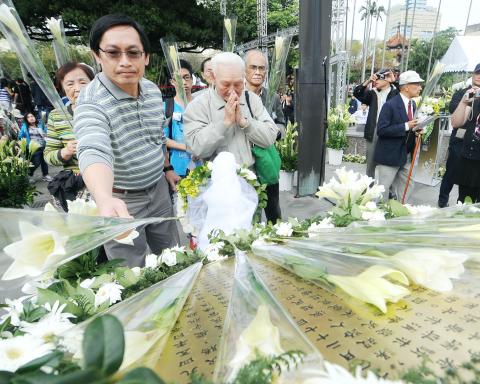
Photo: Wang Min-wei, Taipei Times
In a speech at Yongle Market, Democratic Progressive Party (DPP) Chairman Su Tseng-chang (蘇貞昌) lamented the death of many Taiwanese leaders and intellectuals in the “March crackdown (三月清鄉).”
The compensation for victims’ families should be paid by the Chinese Nationalist Party (KMT), the perpetrator of the massacre, and not taxpayers, Su said, adding that the “real history” should be included in textbooks and taught in school because the public is entitled to know the truth about the tragedy.
“Most important of all, Taiwanese should have the self-awareness to be their own master and determine their own fate,” Su said.
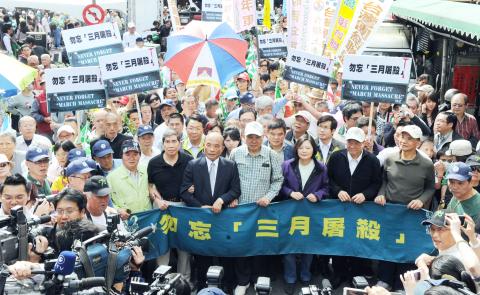
Photo: Lo Pei-der, Taipei Times
Former DPP chairperson Tsai Ing-wen (蔡英文) called on the public to have the courage to keep moving forward and fight for democracy like their predecessors, who persevered despite having to endure state violence in the 228 Massacre and the ensuing White Terror period during which democracy and freedom were non-existent.
Taiwan Solidarity Union Chairman Huang Kun-huei (黃昆輝) said the 228 Massacre was the result of forcibly merging two different cultures, with one side holding a military advantage.
Taiwan’s current status is similar to that in 1947, as China and some Taiwanese politicians have been trying to merge the two sides by force, with Beijing enjoying superior military capability, he said.
“If Taiwanese failed to learn from the past, there could be another 228 Incident,” Huang said.
Waving flags and holding chrysanthemums, participants in the march reached Liberty Square after about one hour.
While most of the participants were senior citizens, young people joined them at the square, where a music festival and speeches were held in the evening.
Pro-independence groups and students associations from universities across the country set up tents at the square. A bulletin board describing the 228 Massacre was also set up to help people understand the tragic incident.
The master of ceremonies, a preacher from Taiwan Presbyterian Church, spoke in Mandarin throughout the event to help Chinese tourists at the square — a popular sightseeing spot — understand what the ceremony was about.
The evening session was co-organized by various student groups to help people remember the massacre “in a lighter, but still serious” way, said Lin Kai-hsiang (林楷翔), a co-convener of the event, which was titled “Symbiosis Music Festival (共生音樂節).”
Several bands, including Kou Chou Ching (拷秋勤) and Fire Ex (滅火器), performed and a number of university professors spoke at the festival.
In response to reporters’ questions about tightened security at the 228 memorial ceremony, Tsai expressed regret over the measure.
“On a day of introspection for everyone, in particular for the KMT, it is a pity that the administration of [President] Ma [Ying-jeou (馬英九)] would resort to inappropriate security deployment to restrict people’s freedom of movement,” Tsai said, adding that “it was not an attitude that the KMT should be showing on the anniversary of the 228 Massacre.”

‘NO SECURITY RISK’: The Railway Bureau reassured the public that the technicians’ activities were limited to technical guidance and did not involve sensitive systems The Railway Bureau yesterday said it had invited eight Chinese technicians to assist with an airport MRT construction project. The bureau issued the confirmation after an Internet user said Chinese nationals had entered the construction zone of Taiwan Taoyuan International Airport’s Terminal 3 project. They asked why “individuals from an enemy state” were allowed access to such a major national infrastructure project, which raised serious concerns over Taiwan’s industrial safety, sensitive systems and information security. The bureau’s Northern Region Engineering Branch Office said subcontractor Taiwan Handle Industrial Co (台灣手把工業) of the Taoyuan airport MRT’s “Contract No. CU05 Project A14 Station Civil, MEP &

The National Chungshan Institute of Science and Technology yesterday showcased its locally developed variants of the Vision 60 robotic patrol dog, which it plans to deploy on the nation’s outlying territories in the South China Sea. The variants were produced under the Joint Lab project — created by the institute and domestic companies — and assembled with domestically produced motors, lenses and artificial intelligence (AI) systems alongside licensed tech from the US, Missile and Rocket Systems Research Division deputy director Jen Kuo-kang (任國光) told the media event at a military base in Taipei’s Dazhi (大直) area. Taiwan has built up its strengths

NOT IMMEDIATE: Taiwan has a chance to appeal the proposed 10 percent tariff before it starts, while other countries face a 12.5 percent tariff from the trade office Taiwan is among 60 economies determined by the US to have failed to impose or enforce a ban on the importation of goods produced with forced labor, according to a notice released on Tuesday by the Office of the US Trade Representative (USTR), which proposed imposing an additional 10 percent or more tariff on them. The USTR in a statement said that following an investigation, it had determined under Section 301 of the Trade Act of 1974 that the failure of the 60 economies to impose and effectively enforce a prohibition on the importation of goods produced with forced labor is
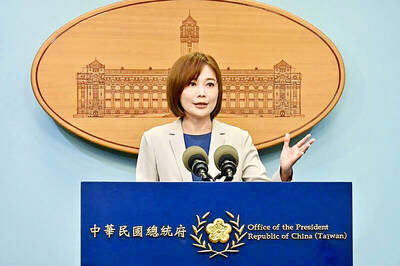
TIT-FOR-TAT: The US allegedly revoked the visa of a Chinese national working at Xinhua News Agency in the US in response to Beijing’s expulsion of Vivian Wang The Presidential Office yesterday condemned China for expelling a New York Times correspondent from Beijing following the newspaper’s interview with President William Lai (賴清德), saying the move highlighted Beijing’s suppression of press freedom and its threat to international news media. Taiwan has noted a series of recent incidents in which Beijing used similar tactics to “threaten and pressure international media outlets and journalists,” Presidential Office spokeswoman Karen Kuo (郭雅慧) said in a statement. “This concerns not only press freedom and freedom of expression, but also the safety of journalists, and Taiwan and relevant partners are paying close attention to the situation,” she


 RSS
RSS