


Chinese Nationalist Party (KMT) candidate Yen Kuan-hen (顏寬恆) won the legislative by-election in Greater Taichung’s second district yesterday against his Democratic Progressive Party (DPP) counterpart Chen Shi-kai (陳世凱) by a small margin of less than 1,200 votes, managing to only just maintain the KMT’s momentum amid low approval ratings for President Ma Ying-jeou’s (馬英九) administration.
Yen received 66,457 votes in the by-election, while Chen received 65,319 votes, according to the Tai-chung City Election Commission.
The by-election was held to fill a post left vacant by Yen’s father, former Non-Partisan Solidarity Union legislator Yen Ching-piao (顏清標), whose status was revoked after he was found guilty of corruption.
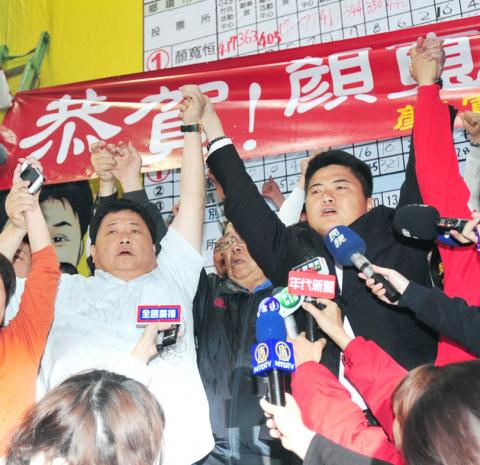
Photo: Liao Yau-tung, Taipei Times
Yen Kuan-hen’s campaign office unfurled a red banner and declared victory at about 5:30pm, while the official vote count at the time suggested that Chen was leading the race by several hundred votes.
Amid deafening cheers from supporters and exploding firecrackers, Yen Kuan-hen and his father showed up at the campaign office shortly after the self-declared victory and thanked voters for their support.
“It was a neck-and-neck race, but we’ve won the final victory. This is a victory for all Taichung residents in the district. My family and I will work harder to strive for the rights of local residents and to promote local development,” Yen Kuan-hen said.
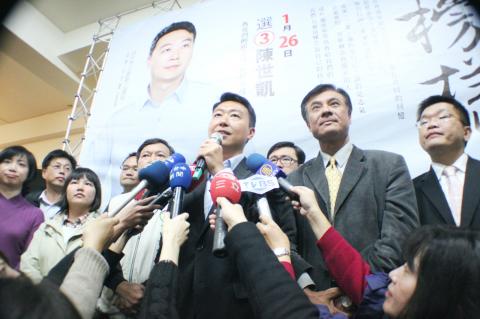
Photo: Yu Po-lin, Taipei Times
Yen Ching-piao, an influential politician in the electoral district with a deep political presence even after he was found guilty of corruption, said they had fought a tough battle against the DPP and promised that his son will be dedicated in developing Greater Taichung.
“Thanks to local supporters and our campaign team, we managed to win the by-election while the overall environment is in a bad shape. My son will work harder than me in the legislature and spare no effort to serve the people of Greater Taichung,” he said.
Yen Kuan-hen’s victory became decisive as the vote count in the districts of Shalu (沙鹿) and Longjing (龍井) — two of the Yen family’s big support bases — showed that he was leading Chen.
Yen Ching-piao said the campaign office had planned to announce his son’s victory earlier because it finished the vote count after collecting the results from each booth, but delayed the announcement and recounted the votes over and over again to confirm the result as local media outlets suggested that Chen was leading their camp by 500 votes.
KMT Secretary-General Tseng Yung-chuan (曾永權) yesterday said the by-election result showed that Taichung residents approved of Yen Ching-piao and Yen Kuan-hen’s dedication to local development, and promised that the KMT and the government will strengthen their efforts to consolidate local support.
“The KMT will not be satisfied with the by-election result. We will be dedicated to local development and seek more support with with pragmatic acts,” he said.
According to the Central Election Committee, Greater Taichung’s second district, a traditional KMT stronghold, includes Shalu (沙鹿), Longjing (龍井), Wurih (烏日), Dadu (大肚), Wufeng (霧峰) and part of Dali (大里) and is home to about 275,086 voters.
At about 7pm, Chen arrived at his campaign headquarters for his concession speech, in which he expressed appreciation for people’s “fearless support” under strong political pressure from local communities and said that he respected people’s choice despite losing the election.
The 36-year-old said the DPP “had worked extremely hard in the shortest campaign in history against the massive resources the KMT and the Yen family hold” and would keep up his effort in working for people in Greater Taichung.
The DPP campaign had a roller-coaster experience during yesterday’s vote-counting process.
Chen had taken a lead of about 500 votes less than 20 minutes into the ballot counting, which began at 4pm, and the margin increased to about 1,000 while supporters at the campaign headquarters looked upbeat about the outcome.
As television broadcasts showed that Yen Kuan-hen’s campaign surprisingly claimed victory at about 5:30pm and the vote count suddenly shifted in Yen Kuan-hen’s favor, the joyful mood turned into silence, with supporters staring at the TV monitor in disbelief.
The vote tally showed that Chen lost in the Yen family’s stronghold of Shalu by more than 3,000 votes and in Longjing by 1,500 votes, and those margins were too large to overcome.
The DPP had campaigned extremely hard in the relatively short 40-day campaign, with almost every party heavyweight visiting Greater Taichung every week to campaign for Chen and calling for voters to use the election as a vote of no confidence against Ma, who doubles as KMT chairman.
The strategy appeared to have worked wonders as the DPP turned the election into a close race, after its legislative candidate Lee Shun-liang (李順涼) lost to Yen Ching-piao by almost 39,000 votes, or about 20 percent of the total votes, in the same constituency in January last year.
“The DPP may have lost the election, but nevertheless proved that it was able to hold its own and compete with the KMT neck-and-neck in central Taiwan,” DPP Tainan City Councilor Wang Ding-yu (王定宇) said.
DPP spokesperson Lin Chun-hsien (林俊憲) admitted that the low turnout rate was worse than expected and the party had to figure out why voters did not come out to support the DPP, despite not being happy with Ma and the KMT’s performance.
Taiwan Semiconductor Manufacturing Co (TSMC, 台積電), the world’s largest foundry service provider, yesterday said that global semiconductor revenue is projected to hit US$1.5 trillion in 2030, after the figure exceeds US$1 trillion this year, as artificial intelligence (AI) demand boosts consumption of token and compute power. “We are still at the beginning of the AI revolution, but we already see a significant impact across the whole semiconductor ecosystem,” TSMC deputy cochief operating officer Kevin Zhang (張曉強) said at the company’s annual technology symposium in Hsinchu City. “It is fair to say that in the past decade, smartphones and other mobile devices were
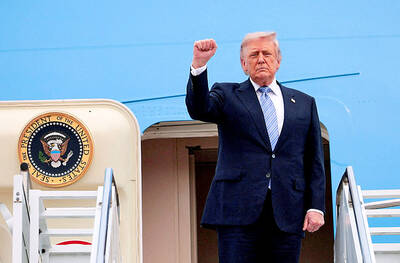
US-CHINA SUMMIT: MOFA welcomed US reassurance of no change in its Taiwan policy; Trump said he did not comment when Xi talked of opposing independence US President Donald Trump yesterday said he has not made a decision on whether to move forward with a major arms package for Taiwan after hearing concerns about it from Chinese President Xi Jinping (習近平). Trump’s comments on Taiwan came as he flew back to Washington after wrapping up critical talks in which both leaders said important progress was made in stabilizing US-China relations even as deep differences persist between the world’s two biggest powers on Iran and Taiwan. “I will make a determination,” Trump said, adding: “I’ll be making decisions. But, you know, I think the last thing we need right

TAIWAN ISSUE: US treasury secretary Scott Bessent said on the first day of meetings that ‘it wouldn’t be a US-China summit without the Taiwan issue coming up’ There were no surprises on the first day of the summit between US President Donald Trump and Chinese President Xi Jinping (習近平), the Mainland Affairs Council (MAC) said yesterday, as the government reiterated that cross-strait stability is crucial to the Asia-Pacific region, as well as the world. As the two presidents met for a highly anticipated summit yesterday, Chinese state media reported that Xi warned Trump that missteps regarding Taiwan could push their two countries into “conflict.” Trump arrived in China with accolades for his host, calling Xi a “great leader” and “friend,” and extending an invitation to visit the White House
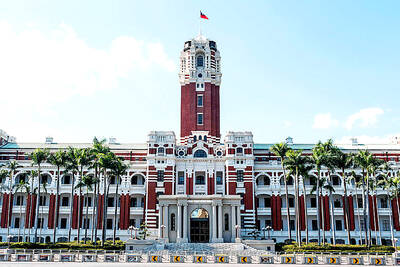
SECURITY: Taipei presses the US for arms supplies, saying the arms sales are not only a reflection of the US security commitment to Taiwan but also serve as a mutual deterrent against regional threats Taiwan is committed to preserving the cross-strait “status quo” and contributing to regional peace and stability, the Presidential Office said yesterday. “It is an undeniable fact that the Republic of China is a sovereign and independent democratic nation,” Presidential Office spokeswoman Karen Kuo (郭雅慧) reiterated, adding that Beijing has no right to claim sovereignty over Taiwan. The statements came after US President Donald Trump warned against Taiwanese independence. Trump wrapped up a state visit to Beijing on Friday, during which Chinese President Xi Jinping (習近平) had pressed him not to support Taiwan. Taiwan depends heavily on US security backing to deter China from carrying


 RSS
RSS