


President Ma Ying-jeou (馬英九) and Minister of Culture Lung Ying-tai (龍應台) joined victims of the White Terror era on Human Rights Day yesterday to take part in events at the Jingmei Human Rights Memorial and Cultural Park in New Taipei City’s (新北市) Sindian District (新店).
About 170 victims of the White Terror era from across the country gathered to mark the day, observed every year around the world, with Aboriginal music and dancing performed by family members of the victims.
During the event, Ma also presented certificates of appreciation to a number of victims who donated culturally significant items to the national human rights museum, which is currently under development, including Chen Meng-ho (陳孟和), who was jailed at Green Island’s New Life Correction Center for 15 years, as well as former political prisoners Huang Kuang-hai (黃廣海) and Liu Chen-tan (劉辰旦).
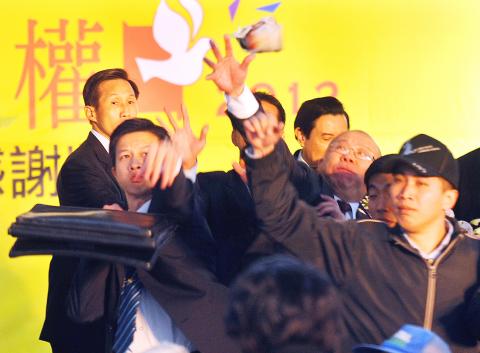
Photo: Liao Chen-hui, Taipei Times
The event was disrupted by occasional shouting, as a number of indignant victims shouted: “There are no human rights in Taiwan” and “Ma Ying-jeou step down” while Lung delivered a speech.
While calling for respect of White Terror victims, Lung said: “If it was the intolerance of the government at the time that put you through such an ordeal, then I want to call for tolerance now from all the victims present to respect those who voice different opinions.”
Despite the appeal, the event descended into chaos when Ma addressed the audience, with Alliance of Referendum for Taiwan convener Tsay Ting-kuei (蔡丁貴) shouting: “Ma Ying-jeou doesn’t deserve to be here” and “Give back A-bian’s [former president Chen Shui-bian’s (陳水扁)] human rights.”
One person then threw a shoe at Ma, which fell short.
“It is the attitude of tolerance and mutual respect that serves as the fundamental value in Taiwan’s human rights development,” Ma said in his speech.
Calm was restored after Chen Hsin-chi (陳新吉), a White Terror victim who volunteers at the human rights memorial and cultural park, stepped onto the stage for his speech.
“When I no longer clench my fists in anger, I am always ready to accept others’ kindness and to make peace. On the contrary, I can’t get anything if I double up my fists again,” he said.
“Open your hands and make peace with yourself, with others or even with this society,” he said.
Earlier in the morning, rights advocates rallied outside the Far Eastern Plaza Hotel in Taipei as Ma presided over the Asia Democracy and Human Rights Award (ADHRA) ceremony, accusing him of being a human rights violator and of not qualifying to present the award.
Representatives of laid-off workers, urban renewal victims, a former nuclear power plant engineer with cancer suspected to have been triggered by exposure to radiation and a Tibetan-Taiwanese lay on a red carpet outside a hotel as the ceremony took place inside, while human rights advocates performed a skit to express that Ma had walked over them to hand out the award.
“Human rights conditions are declining in Taiwan because our government is incapable of defending people’s rights — it only cares about economic development and the interests of big corporations,” Taiwan Association for Human Rights (TAHR) secretary-general Tsai Chi-hsun (蔡季勳) said. “We are here to show the president how much the people have suffered because of his carelessness.”
Labor activist Lin Tzu-wen (林子文) and Taiwan Labour Front secretary-general Son Yu-lian (孫友聯) both accused the government of trying to lower standards for working conditions — for example, rejecting a recommendation to raise the minimum wage made by the Council of Labor Affairs and mulling raising the age for retirement — to benefit corporations.
“The biggest joke is that the council — a government authority in charge of protecting workers’ rights — has listed a budget of more than NT$20 million (US$687,000) to sue laid-off workers because they could not afford to repay loans given to them by the council in lieu of retirement benefits after their bosses ran away 16 years ago,” Lin said. “This is despite a promise by the council at the time that the workers would not have to pay the loans back, and that it would get the runaway employers to repay the loans instead.”
Chen Chih-hsiao (陳致曉), spokesperson for a self-help organization, spoke out against a project to demolish more than 400 houses on an 8km strip for a project to move railroad tracks in Greater Tainan underground.
Tashi Tsering (札西慈仁), a Tibetan-Taiwanese, demanded that Ma honor his promise to show concern for human rights in Tibet.
“During the 2008 presidential campaign when he was running for his first term, Ma used some very strong words to show his concern for human rights conditions in Tibet,” Tashi Tsering said. “However, since his election, he has remained silent as human rights situation have deteriorated in Tibet.”
Residents of Huaguang (華光) and Shaoxing (紹興) communities in Taipei, most of whom voted for Ma in the past two presidential elections, said they regretted supporting him, because the government is forcing them to leave their homes to make way for new building projects.
Alliance of Victims of Urban Renewal chairman Peng Lung-san (彭龍三) said he did not believe the president’s remarks that Taiwan is a country that upholds human rights.
“Where were these human rights when police officers escorted hydraulic shovels into private farmland, or broke into private homes to evict people by force to make way for factory or apartment building projects initiated by corporations,” Peng asked. “They said it was in the ‘public’s interest,’ but I say it was for private commercial interests.”
The demonstrators were blocked by police when they tried to approach Ma as he left the hotel.
Unable to talk to the president, the demonstrators chanted slogans calling Ma a human rights violator who is not qualified to present an award for human rights.
At the ceremony, Ma said he worried about an increase in child abuse in Taiwan as he presented the ADHRA to ECPAT International chairperson Maureen Crombie.
EPCAT stands for End Child Prostitution, Child Pornography and Trafficking of Children for Sexual Purposes.
“About 20 years ago in Taiwan, children being exploited for prostitution was a concern. Now the number of cases of child prostitution has decreased significantly, but not the cases of child abuse. This is another phenomenon that we have to pay attention to,” the president said.
Taiwan has been lauded by the international community for its achievements in preventing and combating human trafficking and it has been placed in the Tier 1 category of the US Department of State’s Trafficking in Persons Report for third consecutive year this year because of its complete legal framework and law enforcement efforts regarding children’s rights, Ma said.
“Despite the efforts, there are always points we overlooked,” Ma said, saying that his administration will spare no efforts to protect human rights. “We won’t be able to sustain our democracy if we do not have human rights.”
The government-affiliated Taiwan Foundation for Democracy (TFD) established the ADHRA in 2006 to encourage individuals and organizations that have made significant contributions to promotion of democracy and human rights through peaceful means in Asia.
On behalf of ECPAT International, Crombie received a trophy from Ma and a cash prize of US$100,000 from Legislative Speaker and TFD chairman Wang Jyn-pyng (王金平).
ECPAT International is the leading global network working to end the commercial sexual exploitation of children. Founded in 1991 as a campaign to stop child sex tourism in Asia, ECPAT has broadened its mandate to include the protection of children from all forms of commercial sexual exploitation.
The ECPAT network has expanded to include more than 80 members in more than 75 countries worldwide, from only four groups in the early 1990s.
Since 2004, the ECPAT has held special consultative status with the Economic and Social Council of the UN (ECOSOC). Its secretariat is now based in Bangkok, Thailand.
During Ma’s speech, he said that he was also concerned about the human rights situation in China because “human rights have no borders.”

‘NO SECURITY RISK’: The Railway Bureau reassured the public that the technicians’ activities were limited to technical guidance and did not involve sensitive systems The Railway Bureau yesterday said it had invited eight Chinese technicians to assist with an airport MRT construction project. The bureau issued the confirmation after an Internet user said Chinese nationals had entered the construction zone of Taiwan Taoyuan International Airport’s Terminal 3 project. They asked why “individuals from an enemy state” were allowed access to such a major national infrastructure project, which raised serious concerns over Taiwan’s industrial safety, sensitive systems and information security. The bureau’s Northern Region Engineering Branch Office said subcontractor Taiwan Handle Industrial Co (台灣手把工業) of the Taoyuan airport MRT’s “Contract No. CU05 Project A14 Station Civil, MEP &

A US uncrewed surface vessel (USV) encountered multiple Chinese warships during an autonomous transit of the Taiwan Strait, US defense company Seasats said in a statement on Wednesday. Seasats announced that a Lightfish USV had completed the first autonomous transit of the Taiwan Strait. Over five days, the USV traversed the entire length of the Strait while constantly monitoring surface vessel traffic, the company said. The Lightfish encountered multiple Chinese warships, one of which was a Chinese People’s Liberation Army Navy (PLAN) Type 056 corvette, it said. The Chinese vessels were operating “well within Taiwan’s exclusive economic zone without transmitting their identity via the
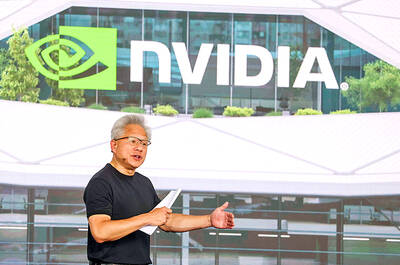
‘BOOMING’: ’ The number of partners we have here is incredible. You can see from their stock prices. They’re doing so well, they’re so happy,’ Jensen Huang said Nvidia Corp’s spending in Taiwan has ballooned to about US$150 billion a year, 10 times the US$10 billion to US$15 billion the company spent five years ago, Nvidia chief executive officer Jensen Huang (黃仁勳) said yesterday, suggesting Taiwan’s strategic importance in the global artificial intelligence (AI) supply chain. “Taiwan is the epicenter of the AI revolution. This is where the chips come, packaging comes. This is where the systems are made. This is where AI supercomputers were created,” Huang said at a meeting for the company’s employees in Beitou-Shilin Technology Park (北投士林科技園區) in Taipei, the planned site of Nvidia’s Taipei headquarters. “Taiwan
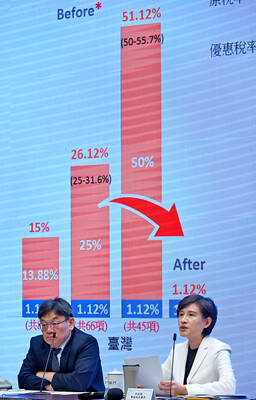
GREATER REACH? Auto parts and wood products would face tariffs of up to 15%, matching those targeting the EU, Japan and South Korea, Vice Premier said The US has announced that preferential tariff treatment for Taiwan’s non-semiconductor Section 232 goods would take effect retroactively from May 1, the Executive Yuan said yesterday. The US government yesterday posted a notice on the Federal Register’s public inspection Web site previewing tariff concessions for Taiwan under a memorandum of understanding (MOU) on Taiwan-US investment after two months of negotiations. The MOU signed on Jan. 15 stipulated three major preferential tariff arrangements: a 15 percent “reciprocal” tariff rate for Taiwan without stacking most-favored nation (MFN) rates; preferential Section 232 treatment for semiconductors and related products; and preferential Section 232 treatment for non-semiconductor


 RSS
RSS