


The Democratic Progressive Party (DPP) said yesterday it would hold a series of rallies this month and stage a mass protest next month against the “inaction and incompetence” of the administration of President Ma Ying-jeou (馬英九) and to let the voice of the people be heard.
“The DPP’s Central Standing Committee has passed a resolution to hold a series of events with the theme: ‘Needed: livelihood, democracy and reform,’” DPP Chairman Su Tseng-chang (蘇貞昌) said after the committee meeting yesterday.
The public and the DPP have no choice but to take to the streets to voice their anger, because the Ma administration has either stayed inactive on people’s suffering or caused it due its failed policies, Su said.
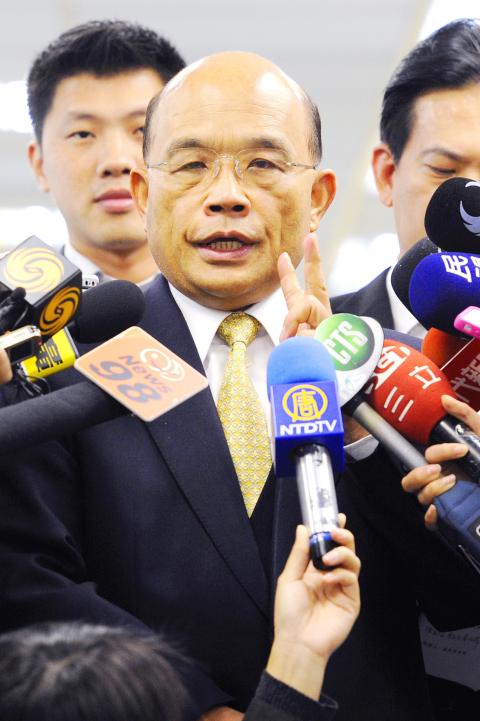
Photo: George Tsorng, Taipei Times
“Ma has refused to reshuffle the Cabinet and to call a national affairs conference to solve the nation’s fiscal problems. He has remained silent on the controversial Next Media Group (壹傳媒集團) deal and China’s infringement of Taiwan’s sovereignty with its new passports. Most of all, he has failed to boost the economy,” Su said.
DPP caucus whip Tsai Chi-chang (蔡其昌) added that while people are lamenting their poverty, the government has shown little concern for their problems by instead focusing on whether to continue to pay year-end bonuses to public-sector retirees.
DPP spokesperson Lin Chun-hsien (林俊憲) said the party has applied for the right to protest on Ketagalan Boulevard in front of the Presidential Office on at least three dates this month, adding that the party would unveil its policies and the main thrust of next month’s demonstration at the rallies.
Lin also criticized the Ministry of Foreign Affairs, which has warned people about using passport stickers made by the DPP as a counter move to Beijing’s inclusion of Taiwan on its new passports, saying the stickers are “a violation of regulations and could cause trouble for tourists when clearing customs and entering foreign countries.”
The stickers are for passport covers rather than inside passports and there would be no violation of regulations, Lin said.
In related developments, amid a lingering dispute in the Chinese Nationalist Party (KMT) over a government-proposed plan to limit year-end pension benefits for government retirees, Examination Yuan President John Kuan (關中) yesterday called on the Executive Yuan to stick to its reforms.
“The government has to insist on the policy that was decided on or risk creating doubts about its determination to carry out reforms,” Kuan said in an interview on Hit FM radio.
In response to concerns raised by the DPP over what it said are illegitimate and unfair privileges granted to 445,708 retirees from the military, the government, public schools and state-owned enterprises, at an amount equivalent to 1.5 months of their pre-retirement salary, Premier Sean Chen (陳冲) in October proposed reducing the recipients to two groups of people.
He proposed that only retirees or the families of deceased retirees who receive a monthly pension of less than NT$20,000 and families of retirees who were killed, injured or disabled in wars or on military exercises should receive the benefit this year.
That would slash the budget to a 19th of its original size, which was approximately NT$20.2 billion (US$697 million), and the number of recipients to about 40,000.
However, KMT lawmakers remain divided on the issue.
Executive Yuan Secretary-General Steven Chen (陳士魁) said yesterday that the Cabinet remained steadfast in distributing the bonuses in accordance with the premier’s plan.
The Directorate-General of Personnel Administration is studying how to institutionalize the year-end bonuses and is expected to come up with a plan by Monday, he said.
There is a possibility that pension payments could vary according to economic conditions, Steve Chen added.

‘NO SECURITY RISK’: The Railway Bureau reassured the public that the technicians’ activities were limited to technical guidance and did not involve sensitive systems The Railway Bureau yesterday said it had invited eight Chinese technicians to assist with an airport MRT construction project. The bureau issued the confirmation after an Internet user said Chinese nationals had entered the construction zone of Taiwan Taoyuan International Airport’s Terminal 3 project. They asked why “individuals from an enemy state” were allowed access to such a major national infrastructure project, which raised serious concerns over Taiwan’s industrial safety, sensitive systems and information security. The bureau’s Northern Region Engineering Branch Office said subcontractor Taiwan Handle Industrial Co (台灣手把工業) of the Taoyuan airport MRT’s “Contract No. CU05 Project A14 Station Civil, MEP &

The National Chungshan Institute of Science and Technology yesterday showcased its locally developed variants of the Vision 60 robotic patrol dog, which it plans to deploy on the nation’s outlying territories in the South China Sea. The variants were produced under the Joint Lab project — created by the institute and domestic companies — and assembled with domestically produced motors, lenses and artificial intelligence (AI) systems alongside licensed tech from the US, Missile and Rocket Systems Research Division deputy director Jen Kuo-kang (任國光) told the media event at a military base in Taipei’s Dazhi (大直) area. Taiwan has built up its strengths

NOT IMMEDIATE: Taiwan has a chance to appeal the proposed 10 percent tariff before it starts, while other countries face a 12.5 percent tariff from the trade office Taiwan is among 60 economies determined by the US to have failed to impose or enforce a ban on the importation of goods produced with forced labor, according to a notice released on Tuesday by the Office of the US Trade Representative (USTR), which proposed imposing an additional 10 percent or more tariff on them. The USTR in a statement said that following an investigation, it had determined under Section 301 of the Trade Act of 1974 that the failure of the 60 economies to impose and effectively enforce a prohibition on the importation of goods produced with forced labor is

TIT-FOR-TAT: The US allegedly revoked the visa of a Chinese national working at Xinhua News Agency in the US in response to Beijing’s expulsion of Vivian Wang The Presidential Office yesterday condemned China for expelling a New York Times correspondent from Beijing following the newspaper’s interview with President William Lai (賴清德), saying the move highlighted Beijing’s suppression of press freedom and its threat to international news media. Taiwan has noted a series of recent incidents in which Beijing used similar tactics to “threaten and pressure international media outlets and journalists,” Presidential Office spokeswoman Karen Kuo (郭雅慧) said in a statement. “This concerns not only press freedom and freedom of expression, but also the safety of journalists, and Taiwan and relevant partners are paying close attention to the situation,” she


 RSS
RSS