


A cloud of secrecy yesterday surrounded the expected signing in Macau of a deal between Next Media Group (壹傳媒集團) and a consortium of three Taiwanese business leaders for the acquisition of Next Media’s four outlets in Taiwan, a deal that raises the specter of increased Chinese influence over Taiwanese media.
According to reports by the Hong Kong-based Apple Daily, a consortium led by Chinatrust Charity Foundation (中信慈善基金會) chairman Jeffrey Koo Jr (辜仲諒), Formosa Plastics Group (台塑集團) chairman William Wong (王文淵) and Want Want China Times Group (旺旺中時集團) chairman Tsai Eng-meng (蔡衍明) was to sign a contract to buy the media outlets from the Hong Kong-listed Next Media at 3pm in Macau.
The former Portuguese colony was reportedly chosen as the location for the signing because of tax incentives.
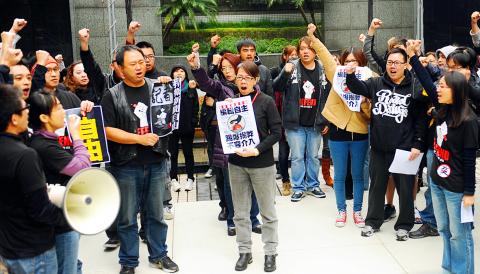
Photo: Chang Chia-ming, Taipei Times
As of press time, none of the parties involved in the acquisition had confirmed news of the signing. Reports said that as of 8pm, negotiations were still ongoing.
Next Media signed a memorandum of understanding with Koo in the middle of last month, following Hong Kong media baron Jimmy Lai’s (黎智英) announcement that he was selling the four outlets — the Chinese-language Apple Daily, Next Magazine, Sharp Daily and Next TV — for NT$17.5 billion (US$600 million).
Hon Hai Precision Industry Co Ltd (鴻海精密), which had also been tipped as a potential fourth buyer, rejected rumors of a role in the deal yesterday and declined to comment further.
There was also media speculation that Lung Yen Life Service Co (龍巖集團) could be a fourth buyer.
In Hong Kong, Next Media did not suspend trading of its shares and experienced a quiet trading session in the morning.
Following media reports in the afternoon that the deal for the Taiwanese outlets was to be finalized, the company’s shares rose 4.6 percent to HK$1.59 and closed with a trading volume of HK$15 million (US$1.9 million).
The deal will require the approval of Taiwan’s regulatory authorities — the Financial Supervisory Commission, the Fair Trade Commission and the National Communications Commission — to be valid.
Meanwhile, the unions of the four Taiwanese outlets, which staged an overnight sit-in at the company’s headquarters in Taipei’s Neihu District (內湖) on Monday night, issued a statement urging the new owners to sign a deal with journalists to safeguard their editorial independence.
“Today, Nov. 27, 2012, is an unfortunate day for all Next Media Group employees. It is on this day that the contract for Next Media buyout is signed and one month from now, the group will have new owners,” the statement said.
The statement added that while they were forced to accept the new owners, of whose credentials and motives the public and Next Media Group employees are skeptical, the owners should think about how to regain the trust of their employees and their readers.
“If you [the new owners] are only buying these outlets for the sake of glorifying or covering up the negative news for your flagship enterprises, or for the purpose of using the group as a bargaining chip when your corporations enter the Chinese market, you are doomed to be despised by the Taiwanese public and eventually get caught in your own traps,” the statement said.
“You [the new owners] may be able to buy the Next Media Group with NT$17.5 billion, but you can never buy our [the employees’] souls,” the statement added.
The statement also urged the new owners to make public their transaction processes via a press conference and to write in black and white their pledges not to lay off employees or change employee benefits.
Dozens of Next Media employees in Hong Kong last night held a candlelight vigil at the company’s headquarters in Kowloon in solidarity with their colleagues in Taiwan.
Additional reporting by Chris Wang

‘NO SECURITY RISK’: The Railway Bureau reassured the public that the technicians’ activities were limited to technical guidance and did not involve sensitive systems The Railway Bureau yesterday said it had invited eight Chinese technicians to assist with an airport MRT construction project. The bureau issued the confirmation after an Internet user said Chinese nationals had entered the construction zone of Taiwan Taoyuan International Airport’s Terminal 3 project. They asked why “individuals from an enemy state” were allowed access to such a major national infrastructure project, which raised serious concerns over Taiwan’s industrial safety, sensitive systems and information security. The bureau’s Northern Region Engineering Branch Office said subcontractor Taiwan Handle Industrial Co (台灣手把工業) of the Taoyuan airport MRT’s “Contract No. CU05 Project A14 Station Civil, MEP &

The National Chungshan Institute of Science and Technology yesterday showcased its locally developed variants of the Vision 60 robotic patrol dog, which it plans to deploy on the nation’s outlying territories in the South China Sea. The variants were produced under the Joint Lab project — created by the institute and domestic companies — and assembled with domestically produced motors, lenses and artificial intelligence (AI) systems alongside licensed tech from the US, Missile and Rocket Systems Research Division deputy director Jen Kuo-kang (任國光) told the media event at a military base in Taipei’s Dazhi (大直) area. Taiwan has built up its strengths

NOT IMMEDIATE: Taiwan has a chance to appeal the proposed 10 percent tariff before it starts, while other countries face a 12.5 percent tariff from the trade office Taiwan is among 60 economies determined by the US to have failed to impose or enforce a ban on the importation of goods produced with forced labor, according to a notice released on Tuesday by the Office of the US Trade Representative (USTR), which proposed imposing an additional 10 percent or more tariff on them. The USTR in a statement said that following an investigation, it had determined under Section 301 of the Trade Act of 1974 that the failure of the 60 economies to impose and effectively enforce a prohibition on the importation of goods produced with forced labor is

TIT-FOR-TAT: The US allegedly revoked the visa of a Chinese national working at Xinhua News Agency in the US in response to Beijing’s expulsion of Vivian Wang The Presidential Office yesterday condemned China for expelling a New York Times correspondent from Beijing following the newspaper’s interview with President William Lai (賴清德), saying the move highlighted Beijing’s suppression of press freedom and its threat to international news media. Taiwan has noted a series of recent incidents in which Beijing used similar tactics to “threaten and pressure international media outlets and journalists,” Presidential Office spokeswoman Karen Kuo (郭雅慧) said in a statement. “This concerns not only press freedom and freedom of expression, but also the safety of journalists, and Taiwan and relevant partners are paying close attention to the situation,” she


 RSS
RSS