


The Democratic Progressive Party (DPP) caucus yesterday described an Executive Yuan advertisement as “ridiculous” after netizens reported the ad as fraudulent to the management of video-sharing Web site YouTube, leading to its removal and the termination of the Executive Yuan’s account for “serious violation of community guidelines.”
The ad promoted the “Economic Power-up Plan,” the government’s massive stimulus plan to rejuvenate the economy, but “was a waste of taxpayers’ money and probably the worst ad in history because it told people nothing while supposedly promoting government policies,” DPP Legislator Chen Ou-po (陳歐珀) told a press conference.
The 40-second ad showed four people — a young man, a ship owner, a female office worker and an elderly woman — staring cluelessly at a sign reading: “The Economic Power-up Plan” before a narrative cut in.
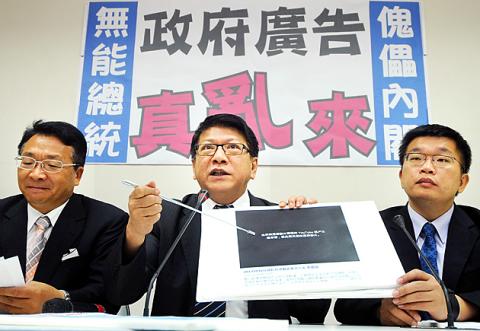
Photo: Fang Pin-chao, Taipei Times
“What exactly is the Economic Power-up Plan? We would very much like to explain it to you in simple words, but it is impossible due to the complexity … The most important thing is that a lot of things are being done,” the narrator said.
“We might as well run until our legs break instead of just simply talking,” the narrator added.
In addition to being aired on TV, the ad was also uploaded to YouTube under the account “Cabinet168” yesterday. However, so many viewers “flagged” it as inappropriate, saying the commercial and the government were fraudulent, that the video was taken down and the account suspended by YouTube.
“A government account being suspended by YouTube … Our government has became a global joke,” DPP Legislator Tsai Chi-chang (蔡其昌) said, adding that the Executive Yuan “shouldn’t have produced the commercial if it assumed people would not understand the policy no matter how the government tries to explain it.”
Cabinet Deputy Secretary-General Huang Min-kung (黃敏恭) said the video ad was the second in a series of five video clips aimed at advertising the Economic Power-up Plan.
Former Executive Yuan spokesperson Hu Yu-wei (胡幼偉), while still in office early last month, came up with the idea to promote the core concept of the economic stimulus plan in ads to get people to pay attention to the proposal, Huang said, adding that the core concept was: “To boost the economy, just do it.”
At a press conference held at the Executive Yuan yesterday afternoon, Huang described the removal of the ad from YouTube as a “windfall” in a sense that “now everyone knows that we have the Economic Power-up Plan.”
Under Hu’s plan, the video would have been also aired on TV channels and played in movie theaters for two weeks, but “now I have decided to withdraw all advertising,” Huang said.
“The removal of the video has caught everyone’s eye,” he said.
According to Huang, the Executive Yuan spent NT$1.19 million (US$40,832) producing five video clips and NT$1.75 million broadcasting them.
Before the video was uploaded to YouTube, Executive Yuan Secretary-General Steven Chen (陳士魁) had a chance to watch it, Huang said.
Huang said the video was also shown at a meeting of ministry spokespeople, including himself, on Tuesday before it was uploaded.
Asked how the spokespeople felt about the ad, Huang said: “At first, we did not understand it at all. But at the end, we realized that the purpose of the ad was to make the Economic Power-up Plan a catchy name and convey the idea that the way to boost the economy was to ‘just do it.’”
He added that the Executive Yuan has contacted Google Inc, YouTube’s parent company, to find out why the ad was pulled, but has not yet received a response.
When contacted by the Taipei Times, the corporation’s department of communication said in a written reply that “we are currently analyzing the situation” and will reply to the questions soon.
No further reply was received as of press time.

MAKING WAVES: China’s maritime militia could become a nontraditional threat in war, clogging up shipping lanes to prevent US or Japanese intervention, a report said About 1,900 Chinese ships flying flags of convenience and fishing vessels that participated in China’s military exercises around Taiwan last month and in January have been listed for monitoring, Coast Guard Administration (CGA) Deputy Director-General Hsieh Ching-chin (謝慶欽) said yesterday. Following amendments to the Commercial Port Act (商港法) and the Law of Ships (船舶法) last month, the CGA can designate possible berthing areas or deny ports of call for vessels suspected of loitering around areas where undersea cables can be accessed, Oceans Affairs Council Minister Kuan Bi-ling (管碧玲) said. The list of suspected ships, originally 300, had risen to about 1,900 as

Japan’s strategic alliance with the US would collapse if Tokyo were to turn away from a conflict in Taiwan, Japanese Prime Minister Sanae Takaichi said yesterday, but distanced herself from previous comments that suggested a possible military response in such an event. Takaichi expressed her latest views on a nationally broadcast TV program late on Monday, where an opposition party leader criticized her for igniting tensions with China with the earlier remarks. Ties between Japan and China have sunk to the worst level in years after Takaichi said in November that a hypothetical Chinese attack on Taiwan could bring about a Japanese
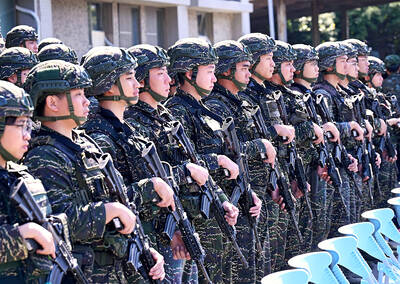
MORE RESPONSIBILITY: Draftees would be expected to fight alongside professional soldiers, likely requiring the transformation of some training brigades into combat units The armed forces are to start incorporating new conscripts into combined arms brigades this year to enhance combat readiness, the Executive Yuan’s latest policy report said. The new policy would affect Taiwanese men entering the military for their compulsory service, which was extended to one year under reforms by then-president Tsai Ing-wen (蔡英文) in 2022. The conscripts would be trained to operate machine guns, uncrewed aerial vehicles, anti-tank guided missile launchers and Stinger air defense systems, the report said, adding that the basic training would be lengthened to eight weeks. After basic training, conscripts would be sorted into infantry battalions that would take
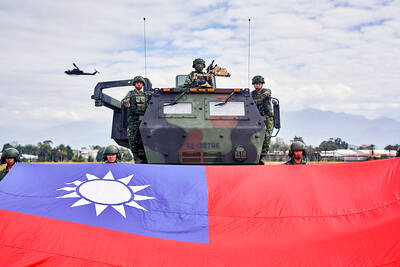
DEEP-STRIKE CAPABILITY: The scenario simulated a PLA drill that turned into an assault on Taiwan’s critical infrastructure, with the launchers providing fire support Taiwan yesterday conducted this year’s first military exercises at Longsiang Base in Taichung, demonstrating the newly acquired High Mobility Artillery Rocket System’s (HIMARS) ability to provide fire support and deep-strike capabilities. The scenario simulated an attack on Penghu County, with HIMARS trucks immediately rolling into designated launch areas and firing barrages at the Wangan (望安) and Cimei (七美) islands, simulating the provision of fire support against invading forces. The HIMARS are supposed to “fire and leave,” which would significantly increase personnel and equipment survivability, a military official said. The drill simulated an exercise launched by the Chinese People’s Liberation Army (PLA) Eastern


 RSS
RSS