

The Philippines and its largest Muslim rebel group signed a peace deal yesterday that serves as a road map to forming a new autonomous region in the south, but both sides agree much more needs to be done to end more than 40 years of conflict.
A successful agreement would be a boost for Philippine President Benigno Aquino III at home and among foreign investors, managing what two presidents before him failed to achieve — peace with the Moro Islamic Liberation Front (MILF).
Manila and the MILF want to set up the region, to be known as “Bangsamoro,” in the south of the mainly Roman Catholic country before Aquino steps down in 2016, giving the Muslim-dominated area greater political powers and more control over resources.

Photo: AFP
They will return to the negotiating table next month in Malaysia to discuss details on wealth and power sharing, as well as the pace of decommissioning the rebels’ 11,000-strong army.
Aquino and MILF chairman Ebrahim Murad held one-on-one talks before the signing of the framework agreement. Murad handed Aquino a miniature gong, which he ritually sounded.
“This is the sound of peace,” he told Aquino.
It was Murad and Aquino’s second meeting since early August last year, when they held secret talks in Tokyo, a turning point in interrupted peace negotiations that have lasted nearly 15 years.
“Much work remains to be done in order to fully reap the fruits of this framework agreement. We have commitments to fulfill, people to lead and dreams to achieve,” Aquino said at the signing ceremony.
Not everyone was so optimistic. Nur Misuari, founder and leader of another Muslim rebel group, the Moro National Liberation Front, which signed a peace deal with the government in 1996, said the MILF was “signing its death sentence.”
Misuari said thousands of MILF members were abandoning the group because they do not want to surrender their arms, a claim that the government and rebel peace panel members disputed.
A small breakaway MILF force, criminal gangs, feuding clans and al-Qaeda-linked radical Islamic militants are also actively operating in the area, a reminder to potential investors of the volatile security situation in the south.
Aquino is expected to form a 15-member transition commission that will propose new legislation to create a new Muslim local government for Bangsamoro, the name given by the Moro tribes to their homeland.
A plebiscite by 2015 in Muslim-dominated areas in the south will determine the shape and size of the new Bangsamoro region.
The autonomous government will have greater political powers and more control over resources, including minerals, oil and natural gas, than the existing Muslim-governed entity. Currency, postal services, defense and foreign policy will remain under control of the central government.
The agreement did not give details of the power-sharing arrangement, but it guarantees rights of both Muslims and non-Muslims, unlike a 2008 deal that was struck down by the Philippine Supreme Court as unconstitutional.
“Negotiated political settlement is the most civilized and practical way to solve the Moro problem,” Murad said in his speech. “We in the MILF central committee did not waver and vacillate in pursuing it to the end, despite the devastating three all-out wars in 2003 and 2008 waged by previous Philippine regimes.”
Baibonn Sangid, 47, former chairperson of the Young Moro Professional Network, cried during the ceremony, remembering how her mother was killed during the war in the early 1970s.
“I can’t contain my happiness,” she said, adding she and her family used to flee to evacuation centers as a child during military encounters.
Hundreds of Muslims, many in a 20-vehicle caravan from Mindanao, gathered on a busy street about 200m from the presidential palace to lend support to the peace agreement, shouting Allahu Akbar (“God is great”).
They also waved banners and held placards that read: “Give peace a chance” and “We support lasting peace in Mindanao.”
“There’s no room for pessimism,” Norhaiya Macusang, of political group Anak Mindanao, told the crowd.

China deployed a record number of coast guard, scientific research and other ships near Taiwan’s waters last month, the Coast Guard Administration (CGA) said, as Beijing dials up pressure on Taipei. The coast guard warned of an increasingly severe situation, as analysts say the increased activity is part of China’s bid to map the region for submarine warfare. The number of Chinese ships detected around Taiwan proper soared to a record 244 last month — an average of nearly eight every day, official data showed. That compares with 55 ships detected in June and 30 in May, and 58 in July last year. In
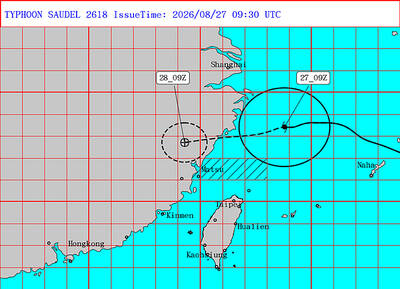
Taiwan is bracing for heavy rain in the south and rough seas around outlying Lienchiang County (Matsu), as Typhoon Saudel passes north toward eastern China, with forecasters yesterday warning of localized flooding over the next two days. Saudel is expected to pass closest to Taiwan today, when its outer rain bands are forecast to brush past Matsu, before making landfall at about noon in China’s Zhejiang Province and weakening significantly, the Central Weather Administration said. The storm’s outer bands, combined with strengthening southwesterly winds, are expected to bring heavy rain to southern and southeastern Taiwan today, it said. As the storm approaches Matsu,

LIMITED: The bill’s NT$40bn annual spending cap would prevent Taiwan from effectively building up its drone combat capabilities, National Defense Minister Wellington Koo said The legislature yesterday rejected the Executive Yuan’s NT$210 billion (US$6.62 billion) special budget proposal to buy military drones and instead passed its own plan, which earmarks NT$40 billion per year over six consecutive years. The Executive Yuan said its plan to buy about 210,000 drones by 2031 could not wait, as the wars in Ukraine and Iran showed the importance of uncrewed systems in modern warfare amid a rising threat from China. However, the Chinese Nationalist Party (KMT) and Taiwan People’s Party (TPP) used their opposition majority to pass a bill providing NT$240 billion through annual budgets over six years, with annual

INCREASING IMBALANCE: The percentage of working-age people is expected to shrink to 42.3% of the population, while older people would comprise 52.9%, the agency said Taiwan’s population is projected to shrink by almost half over the next five decades, intensifying labor shortages and placing a growing drag on economic growth as the technology-intensive economy confronts a rapidly aging workforce. The population is expected to fall to 12.15 million by 2075, a 48 percent decline from this year, National Development Council projections released yesterday showed. The decline would fundamentally alter Taiwan’s workforce. From 2037, more than half of the working-age population is projected to be aged between 45 and 64, signaling the end of an era when the economy could rely on a relatively large labor force. The shift


 RSS
RSS