


The rain-battered south heaved a sigh of relief yesterday after Typhoon Tembin skirted past before dawn without making landfall, leaving little damage except on Orchid Island, where three people were injured.
TV footage showed wave damage on Orchid Island’s coastal highway.
Three people were injured when 8m waves ripped off the roofs of their homes.
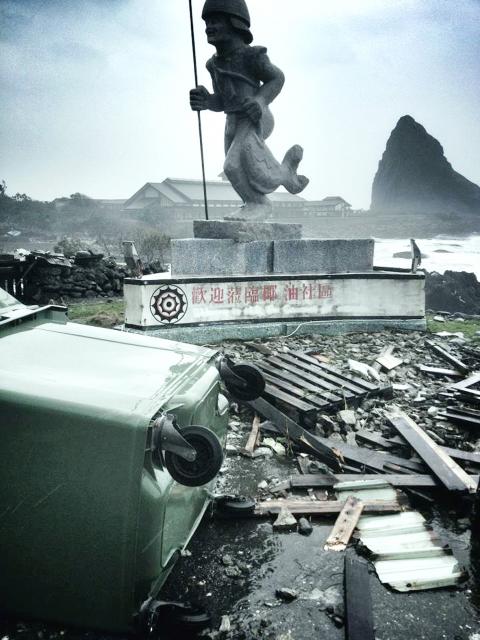
Photo courtesy of Yen Tzu-yu
Electricity, mobile phone networks and fixed telephone lines on the island were also cut off.
The island’s only supermarket, the credit department of the Taitung Area Farmers’ Association and the gas station were all destroyed by the waves.
The emergency operation center in Taitung was forced to direct rescue efforts through radio communication.
Some Orchid Island residents also expressed fear that food and clean water supplies would soon come under pressure.
Orchid Island Township Warden Chiang Duo-li (江多利) said this could be the worst damage ever caused by a typhoon to the island.
Statistics from the Central Emergency Operation Center showed that 556 households on Orchid Island had yet to be reconnected to water supplies as of 5pm yesterday.
Electricity was not available at about 9,400 households in Greater Kaohsiung, Pintung and Taitung.
About 3,000 people had also been evacuated in southern parts of the country.
Strong wind and torrential rain damaged houses in Checheng (車城), Pingtung County, and caused flooding in farmland.
Twenty-nine domestic flights and five international flights were either canceled or delayed, the Civil Aeronautics Administration said.
Meanwhile, a bus owned by Ho Hsin Bus Traffic Co (和欣客運) overturned and flipped down the embankment at the northbound section of the Sun Yat-Sen Freeway in Greater Tainan, injuring eight passengers.
The Greater Tainan Police Department said the bus was driving at 85kph and the driver was not drunk.
It suspected the accident was caused by gusts generated by the typhoon.
The Central Weather Bureau said Tembin had been downgraded from a typhoon to a tropical storm after traveling over the sea area near the nation’s southeast coast.
“I feel relieved now,” Hengchun (恆春) Mayor Yeh Ming-shun (葉明順) said after the typhoon failed to make landfall, sparing the area a second round of battering in less than a week.
As of 5:30pm, the eye of the typhoon was 160km east of Yilan County. It was moving northeast at 20kph.
Statistics from the bureau showed that Jingfong Township (金峰), Taitung County, had the highest accumulated rainfall in the past three days, reaching 326mm.
It was followed by Hongyeshan (紅葉山) and Jhihben (知本), with 287mm and 250mm respectively.
Bureau forecaster Chen Yi--liang (陳怡良) said most of Taiwan proper was out of the circumfluence of the storm by 5pm yesterday, except Yilan and New Taipei City (新北市).
The bureau lifted its land warning at 8:30pm yesterday, but a heavy rain or extremely heavy rain advisory remained in effect from last night through early this morning.
The bureau was also scheduled to lift the sea warning early this morning if the speed and path of the storm system remained unchanged.
Chances of showers are high in southern and southeastern Taiwan, as well as in central parts of the country.
Residents in northern and northeastern regions could see afternoon thundershowers.
Additional reporting by AFP and CNA

A signaling system malfunction disrupted high-speed rail (HSR) services beginning at 8am today, with trains temporarily reduced to three northbound and three southbound trains per hour as authorities conduct inspections. The malfunction occurred on a section of track in Miaoli County during pre-operation checks early this morning, forcing northbound and southbound trains to use a single track, the HSR operator said. The regular schedule has been replaced with three hourly trains offering only nonreserved seating in each direction, stopping at every station, it said, adding that business class cars would still have reserved seating. Departures from terminal stations are scheduled at the top

Taiwan is still in the process of assessing the possibility of recruiting workers from Eswatini, the Ministry of Foreign Affairs said yesterday, adding that its goal is to help Eswatini upgrade its vocational training centers. If there are plans to recruit workers from Eswatini, safeguarding national security, protecting public health and ensuring the employment rights of Taiwanese would be prerequisites, Department of West Asian and African Affairs Director-General Yen Chia-liang (顏嘉良) told a news conference. Key considerations would also include filling labor shortages in specific industries, and fostering bilateral professional and technical exchanges, he said. Yen was asked about the progress of labor

A US uncrewed surface vessel (USV) encountered multiple Chinese warships during an autonomous transit of the Taiwan Strait, US defense company Seasats said in a statement on Wednesday. Seasats announced that a Lightfish USV had completed the first autonomous transit of the Taiwan Strait. Over five days, the USV traversed the entire length of the Strait while constantly monitoring surface vessel traffic, the company said. The Lightfish encountered multiple Chinese warships, one of which was a Chinese People’s Liberation Army Navy (PLAN) Type 056 corvette, it said. The Chinese vessels were operating “well within Taiwan’s exclusive economic zone without transmitting their identity via the

VERBOSE VESSELS: A CGA cutter and a China Coast Guard exchanged verbal barbs for more than a day in Taiwanese-controlled waters before the Chinese vessel left The Taiwanese and Chinese coast guards had a standoff near the strategically located Pratas Islands (Dongsha Islands, 東沙群島) in the north of the South China Sea, the Coast Guard Administration (CGA) said yesterday. The two sides engaged in intense radio exchanges over sovereignty claims during the 33-hour standoff. China Coast Guard vessel 3501 eventually left the restricted waters, 26.6 nautical miles (49.2km) west of the Pratas Islands, at 5pm yesterday, the CGA said. Lying approximately between southern Taiwan and Hong Kong, the Taiwan-controlled Pratas are seen by some security experts as vulnerable to Chinese attack due to their distance — more than


 RSS
RSS