


South Korean President Lee Myung-bak paid a surprise visit yesterday to islands at the center of a decades-long territorial dispute with Japan, which recalled its ambassador from Seoul in protest.
Lee was making the first-ever visit by a South Korean president to the rocky volcanic outcrops in the Sea of Japan (also known as the “East Sea” in South Korea), roughly midway between South Korea and its former colonial ruler Japan. Disregarding Tokyo’s warnings that the visit would strain already prickly relations, Lee toured the main island and shook hands with coastguards.
“Dokdo is our territory. We must keep it under close guard,” reports quoted him as saying.
Television footage showed him posing for a photograph in front of a rock painted with the slogan “ROK [Republic of Korea] territory.”
The South has stationed a small coastguard detachment since 1954 on the islands known as Dokdo in Korea and Takeshima in Japan.
Japan reacted angrily, recalling its envoy indefinitely and calling in Seoul’s ambassador to Tokyo to receive a strong protest.
“I told him I have no understanding of why President Lee visited the islands at this time,” said Japanese Foreign Minister Koichiro Gemba, who had warned earlier in the day that a visit “would have a great impact” on relations.
The trip was made just days before the anniversary on Wednesday of Japan’s World War II surrender, which ended its 35-year rule over South Korea.
Lee’s conservative party faces a presidential election in December, although he himself is constitutionally barred from a second term. Many older South Koreans have bitter memories of Japan’s brutal rule. Historical disputes such as Dokdo still mar their relationship, despite close economic ties and a shared concern over North Korea’s missile and nuclear programs.
South Korea last week summoned a senior Japanese diplomat to protest against his country’s renewed claim to the islands in its latest defense white paper.
Earlier last month, it was Tokyo’s turn to protest when a South Korean rammed his truck into the main gate of Japan’s embassy in Seoul.
Among other issues, Seoul is irked at Tokyo’s refusal to compensate elderly South Korean women forced into sexual slavery for Japanese troops in World War II.
In June, the South shelved the signing of a military information-sharing agreement with Japan following Korean protests. One analyst said Lee’s trip was an overreaction to diplomatic strains and should have been considered more thoroughly.
Strategically, the visit to the Dokdo islets would be one of the strongest actions the president could take, Jin Chang-soo of South Korea’s Sejong Institute think tank said.
“In the long term, considering there will be many problems [between the two countries], I doubt whether this is the right time to play this card,” he told reporters.
Jin said Japan was currently unstable, engaged in territorial disputes with other countries “and we’ve just added fuel to the fire. What good can it do?”
With just over six months until his term ends, Lee’s popularity has slumped amid corruption scandals allegedly involving his brother and close aides.
Dokdo has a total land area of 18.7 hectares. Apart from the coastguards, there are two civilian residents, an elderly man and his wife.
It is situated amid rich fishing grounds and Seoul officials say the seabed contains reserves of gas hydrates, although the amount is still unclear.
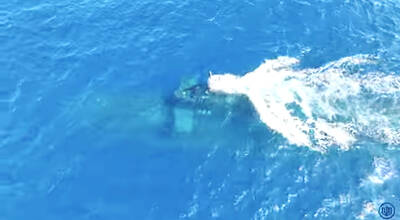
CSBC Corp, Taiwan (台灣國際造船) yesterday released the first video documenting the submerged sea trials of Taiwan’s indigenous defense submarine prototype, the Hai Kun (海鯤), or Narwhal, showing underwater navigation and the launch of countermeasures. The footage shows the vessel’s first dive, steering and control system tests, and the raising and lowering of the periscope and antenna masts. It offered a rare look at the progress in the submarine’s sea acceptance tests. The Hai Kun carried out its first shallow-water diving trial late last month and has since completed four submerged tests, CSBC said. The newly released video compiles images recorded from Jan. 29 to
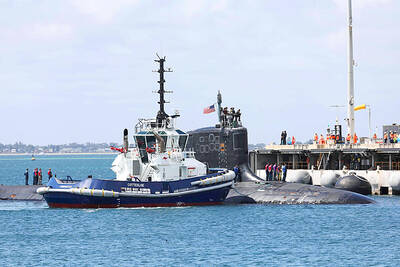
DETERRENCE EFFORTS: Washington and partners hope demonstrations of force would convince Beijing that military action against Taiwan would carry high costs The US is considering using HMAS Stirling in Western Australia as a forward base to strengthen its naval posture in a potential conflict with China, particularly over Taiwan, the Wall Street Journal reported on Saturday. As part of its Indo-Pacific strategy, Washington plans to deploy up to four nuclear-powered submarines at Stirling starting in 2027, providing a base near potential hot spots such as Taiwan and the South China Sea. The move also aims to enhance military integration with Pacific allies under the Australia-UK-US trilateral security partnership, the report said. Currently, US submarines operate from Guam, but the island could
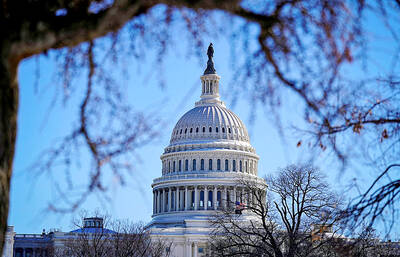
RESTRAINTS: Should China’s actions pose any threat to Taiwan’s security, economic or social systems, China would be excluded from major financial institutions, the bill says The US House of Representatives on Monday passed the PROTECT Taiwan Act, which states that Washington would exclude China from participating in major global financial organizations if its actions directly threaten Taiwan’s security. The bill, proposed by Republican Representative Frank Lucas, passed with 395 votes in favor and two against. It stipulates that if China’s actions pose any threat to Taiwan’s security, economic or social systems, the US would, “to the maximum extent practicable,” exclude Beijing from international financial institutions, including the G20, the Bank for International Settlements and the Financial Stability Board. The bill makes it clear that China must be prepared

Taiwanese trade negotiators told Washington that Taipei would not relocate 40 percent of its semiconductor production to the US, and that its most advanced technologies would remain in the nation, Vice Premier Cheng Li-chiun (鄭麗君) said on Sunday. “I told the US side very clearly — that’s impossible,” Cheng, who led the negotiation team, said in an interview that aired on Sunday night on Chinese Television System. Cheng was referring to remarks last month by US Secretary of Commerce Howard Lutnick, in which he said his goal was to bring 40 percent of Taiwan’s chip supply chain to the US Taiwan’s almost


 RSS
RSS