


A country will not move forward with a “silent generation” of young people, former president Lee Teng-hui (李登輝) said in Changhua County yesterday, voicing his support for young students protesting against a major media merger deal.
Responding to media inquiries, Lee said he did not understand all the details of the Want Want China Times Group’s (旺旺中時媒體集團) acquisition of cable TV services owned by China Network Systems (CNS, 中嘉網路), but he supported young students speaking up for media freedom.
About 700 people, most of them students, protested on Tuesday against the deal, which they said would create a media monopoly, and the media group’s sustained attacks on Academia Sinica associate research fellow Huang Kuo-chang (黃國昌), an outspoken media expert who opposes the merger.
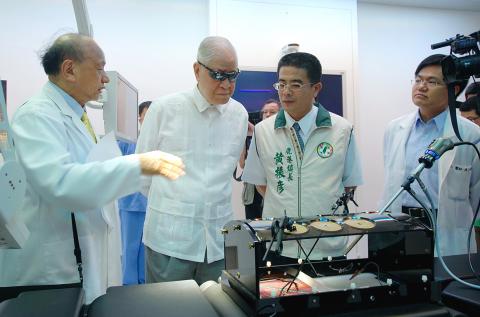
Photo: CNA
Freedom of speech should never be monopolized, Lee said on the second day of his three-day visit to central Taiwan, adding that media freedom is essential for a healthy society because people need adequate information to be able to pass judgements and make assessments.
Lee said he participated in protests before going into politics.
As a 40-year-old university professor, Lee and five academics launched a protest against private businesses’ planned purchase of 4,000 hectares of land in Yunlin County’s Sihhu (四湖) and Kouhu (口湖) townships, the former president said.
The protest stopped the land deal.
“A country cannot move forward without young people who have a sense of justice and fairness,” Lee said.
The former president, who was given the nickname “Mr Democracy,” also addressed several political issues.
On the disputed Diaoyutai Islands (釣魚台), Lee, who holds that the islands are Japanese territory, said Taiwanese and Chinese leaders had failed to demonstrate through historical fact or international law how the islands could be considered their territory.
Territory cannot be transferred without an act of war or a signature on a treaty, Lee said.
“China always loves to say this place or that place is its ‘traditional territory.’ But you need to address issues like this based on facts and history,” Lee said.
For a Taiwanese government to say that the islands fall under the administration of Toucheng Township (頭城), Yilan County, shows that the nation’s leader “did not conduct enough research and was kind of stupid,” he said.
On Chinese officials’ comments that “both sides of the Taiwan Strait belong to one country,” Lee said that before the birth of the Republic of China, there was no nation known as China, just dynasties with different names, so it is ridiculous to cite history and tradition as the basis for both sides of the Taiwan Strait belonging to one country.
Lee also warned the Democratic Progressive Party about its “new mentality” in dealing with its cross-strait policy after suffering a defeat in the presidential election in January.
“Improving mutual understanding does not necessarily require the establishment of a Chinese Affairs Committee or anything like that,” he said.
Both sides should respect each other’s independence during the process of forging mutual understanding, he said, adding that improving bilateral relations “does not mean you have to say anything for the sake of pleasing Beijing.”
Lee said he was invited to give a speech about the democratization of Taiwan and the Chinese Nationalist Party (KMT) at Beijing University, but judged it was too early to visit a country ruled by an authoritarian regime.

‘NO SECURITY RISK’: The Railway Bureau reassured the public that the technicians’ activities were limited to technical guidance and did not involve sensitive systems The Railway Bureau yesterday said it had invited eight Chinese technicians to assist with an airport MRT construction project. The bureau issued the confirmation after an Internet user said Chinese nationals had entered the construction zone of Taiwan Taoyuan International Airport’s Terminal 3 project. They asked why “individuals from an enemy state” were allowed access to such a major national infrastructure project, which raised serious concerns over Taiwan’s industrial safety, sensitive systems and information security. The bureau’s Northern Region Engineering Branch Office said subcontractor Taiwan Handle Industrial Co (台灣手把工業) of the Taoyuan airport MRT’s “Contract No. CU05 Project A14 Station Civil, MEP &

The National Chungshan Institute of Science and Technology yesterday showcased its locally developed variants of the Vision 60 robotic patrol dog, which it plans to deploy on the nation’s outlying territories in the South China Sea. The variants were produced under the Joint Lab project — created by the institute and domestic companies — and assembled with domestically produced motors, lenses and artificial intelligence (AI) systems alongside licensed tech from the US, Missile and Rocket Systems Research Division deputy director Jen Kuo-kang (任國光) told the media event at a military base in Taipei’s Dazhi (大直) area. Taiwan has built up its strengths

NOT IMMEDIATE: Taiwan has a chance to appeal the proposed 10 percent tariff before it starts, while other countries face a 12.5 percent tariff from the trade office Taiwan is among 60 economies determined by the US to have failed to impose or enforce a ban on the importation of goods produced with forced labor, according to a notice released on Tuesday by the Office of the US Trade Representative (USTR), which proposed imposing an additional 10 percent or more tariff on them. The USTR in a statement said that following an investigation, it had determined under Section 301 of the Trade Act of 1974 that the failure of the 60 economies to impose and effectively enforce a prohibition on the importation of goods produced with forced labor is

TIT-FOR-TAT: The US allegedly revoked the visa of a Chinese national working at Xinhua News Agency in the US in response to Beijing’s expulsion of Vivian Wang The Presidential Office yesterday condemned China for expelling a New York Times correspondent from Beijing following the newspaper’s interview with President William Lai (賴清德), saying the move highlighted Beijing’s suppression of press freedom and its threat to international news media. Taiwan has noted a series of recent incidents in which Beijing used similar tactics to “threaten and pressure international media outlets and journalists,” Presidential Office spokeswoman Karen Kuo (郭雅慧) said in a statement. “This concerns not only press freedom and freedom of expression, but also the safety of journalists, and Taiwan and relevant partners are paying close attention to the situation,” she


 RSS
RSS