


President Ma Ying-jeou (馬英九) needs to improve his leadership acumen and communication prowess to win public support for major government reforms, the American Chamber of Commerce (AmCham) in Taipei said yesterday.
The call from AmCham came after the Ma administration’s efforts to ease import restrictions on US beef containing residues of ractopamine and introduce a capital gains tax on stock investments encountered stiff opposition from lawmakers and the public alike.
“The road ahead is very tough ... There is no room for indecision or hesitation,” AmCham chairman Bill Wiseman told a media briefing on the release of its annual white paper.
Ma, Premier Sean Chen (陳冲) and the Cabinet need to garner the support of civil servants, lawmakers and the public to reconcile opposing interests in the reform process, Wiseman said.
The beef dispute raises concerns over the administration’s credibility, Wiseman said.
Taiwan signed an agreement with the US in October 2009 to open the door to bone-in beef, ground beef and other products from cattle under 30 months old. However, two months later, the legislature revised the regulations, halting imports of ground beef and internal organs from the US, prompting Washington to accuse Taipei of violating the agreement and suspend talks on the Trade and Investment Framework Agreement (TIFA).
AmCham urged the government to seek a resolution to the dispute over US beef imports, resume TIFA talks and pursue stronger trade and investment ties with the US and other trade partners, including participation in the Trans-Pacific Partnership.
AmCham said it supported the government’s decision to raise electricity rates to encourage conservation, but recommended a restudy of what it called overly ambitious carbon reduction targets and a decision not to extend the lifecycles of existing nuclear power facilities.
“Simultaneously carrying out the two policies means high costs that undercut Taiwan’s competitiveness,” Wiseman said.
He shied away from comments on the capital gains tax plan, but said policy uncertainty would have a negative impact on financial markets and the sectors linked to their performance.
The latest white paper pressed for a more favorable environment for cultivating startup companies and reduction of the withholding tax on foreign entities supplying services and intellectual property to Taiwan.
The paper also suggested restoring the tax exemption on royalties for foreign patents and know-how utilized by Taiwanese companies and increasing incentives for the private sector to engage in research and development.
The proposed tax cuts would help Taiwan overcome the innovation gap that constrains many of the nation’s industrial sectors, Wiseman said.
AmCham also recommended stronger laws against the misappropriation of trade secrets that takes the form of personnel recruitment by rival companies, Wiseman said.
The paper urged the government to end job protectionism, which it said has led to a brain drain and uncompetitive wage levels.
Policymakers should lower personal income tax rates to help attract foreign talent and streamline immigration procedures for bringing Chinese professionals and qualified hospitality industry workers to Taiwan, Wiseman said.

‘NO SECURITY RISK’: The Railway Bureau reassured the public that the technicians’ activities were limited to technical guidance and did not involve sensitive systems The Railway Bureau yesterday said it had invited eight Chinese technicians to assist with an airport MRT construction project. The bureau issued the confirmation after an Internet user said Chinese nationals had entered the construction zone of Taiwan Taoyuan International Airport’s Terminal 3 project. They asked why “individuals from an enemy state” were allowed access to such a major national infrastructure project, which raised serious concerns over Taiwan’s industrial safety, sensitive systems and information security. The bureau’s Northern Region Engineering Branch Office said subcontractor Taiwan Handle Industrial Co (台灣手把工業) of the Taoyuan airport MRT’s “Contract No. CU05 Project A14 Station Civil, MEP &

The National Chungshan Institute of Science and Technology yesterday showcased its locally developed variants of the Vision 60 robotic patrol dog, which it plans to deploy on the nation’s outlying territories in the South China Sea. The variants were produced under the Joint Lab project — created by the institute and domestic companies — and assembled with domestically produced motors, lenses and artificial intelligence (AI) systems alongside licensed tech from the US, Missile and Rocket Systems Research Division deputy director Jen Kuo-kang (任國光) told the media event at a military base in Taipei’s Dazhi (大直) area. Taiwan has built up its strengths

NOT IMMEDIATE: Taiwan has a chance to appeal the proposed 10 percent tariff before it starts, while other countries face a 12.5 percent tariff from the trade office Taiwan is among 60 economies determined by the US to have failed to impose or enforce a ban on the importation of goods produced with forced labor, according to a notice released on Tuesday by the Office of the US Trade Representative (USTR), which proposed imposing an additional 10 percent or more tariff on them. The USTR in a statement said that following an investigation, it had determined under Section 301 of the Trade Act of 1974 that the failure of the 60 economies to impose and effectively enforce a prohibition on the importation of goods produced with forced labor is
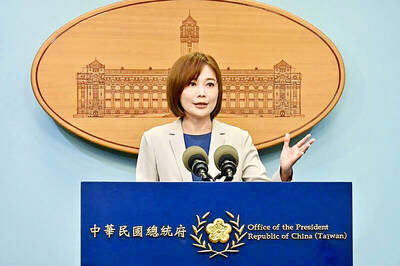
TIT-FOR-TAT: The US allegedly revoked the visa of a Chinese national working at Xinhua News Agency in the US in response to Beijing’s expulsion of Vivian Wang The Presidential Office yesterday condemned China for expelling a New York Times correspondent from Beijing following the newspaper’s interview with President William Lai (賴清德), saying the move highlighted Beijing’s suppression of press freedom and its threat to international news media. Taiwan has noted a series of recent incidents in which Beijing used similar tactics to “threaten and pressure international media outlets and journalists,” Presidential Office spokeswoman Karen Kuo (郭雅慧) said in a statement. “This concerns not only press freedom and freedom of expression, but also the safety of journalists, and Taiwan and relevant partners are paying close attention to the situation,” she


 RSS
RSS