


Democratic Progressive Party (DPP) Kaohsiung City Councilor Lee Chiao-ju (李喬如) came under fire — from inside and outside the party — yesterday for her proposal to evaluate public servants on their marital status and parenthood, as well as banning those who are older than 30 years of age from running for public office if they are unmarried and childless.
According to the councilor’s proposal, a public servant older than 30 who is unmarried and childless would receive a “C” on his or her annual performance evaluation, someone with two children would receive a “B”, while those with three children would be given an “A.”
In addition, she suggested that single men or women older than 30 should be banned from running for public office.

Photo: Chang Chung-yi, Taipei Times
Lee made the suggestion to Kaohsiung Mayor Chen Chu (陳菊) during a city council meeting on Thursday, saying that her proposal would help to raise the birth rate and she asked Chen to refer her suggestion to the central government.
Fertility, the measure of the average number of children per female during her lifetime, dropped to 0.895 in 2010. That figure rebounded to 1.06 last year, but still fell well below the global average of 2.5.
Chen, a long-time human rights activist and a founding member of the DPP, who is unmarried, rejected Lee’s suggestion immediately.
“As mayor, it is my responsibility to encourage marriage and childbirth, but everyone has the right to decide what they want to do with their life,” Chen said. “There’s no country in the world that can tell people what to do [on marriage and parenthood] — everyone’s rights must be respected.”
“As mayor, I have no right to ask my employees to get married at a certain age, either,” she added.
Speaking to the press later yesterday, Lee insisted her proposal was appropriate.
“Those with such selfish ideas as not wanting to get married and not wanting to have children should shoulder some social responsibility,” she said. “A low birth rate could lead to slower economic development, an outflow of job opportunities and it could have a huge impact on many industries.”
Lee’s proposal was not only rejected by Chen, it drew criticism from legislators across party lines.
“I don’t know whether to laugh or cry,” said 37-year-old DPP Legislator Chen Ting-fei (陳亭妃), who is unmarried. “Please stop this nonsense, this is not what you do to encourage people to have children.”
Chinese Nationalist Party (KMT) Legislator Lo Shu-lei (羅淑蕾), 59, who is also unmarried, said Lee’s proposal was ridiculous.
“This is ridiculous,” Lo said. “Should a government employee who sits around doing nothing get an ‘A’ in their annual performance evaluation just because they have three children?”
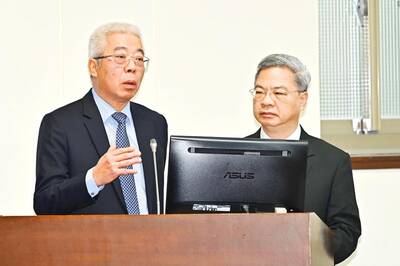
Taiwan has arranged for about 8 million barrels of crude oil, or about one-third of its monthly needs, to be shipped from the Red Sea this month to bypass the Strait of Hormuz and ease domestic supply pressures, CPC Corp, Taiwan (CPC, 台灣中油) said yesterday. The state-run oil company has worked with Middle Eastern suppliers to secure routes other than the Strait of Hormuz, through which about 20 percent of the world’s oil and liquefied natural gas typically passes, CPC chairman Fang Jeng-zen (方振仁) said at a meeting of the legislature’s Economics Committee in Taipei. Suppliers in Saudi Arabia have indicated they

South Korea has adjusted its electronic arrival card system to no longer list Taiwan as a part of China, a move that the Ministry of Foreign Affairs said would help facilitate exchanges between the two sides. South Korea previously listed “Taiwan” as “Taiwan (China)” in the drop-down menus of its online arrival card system, where people had to fill out where they came from and their next destination. The ministry had requested South Korea make a revision and said it would change South Korea’s name on Taiwan’s online immigration system from “Republic of Korea” to “Korea (South),” should the issue not be
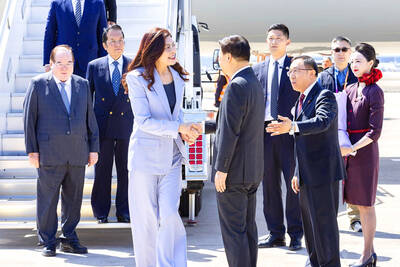
CCP ‘PAWN’? Beijing could use the KMT chairwoman’s visit to signal to the world that many people in Taiwan support the ‘one China’ principle, an academic said Chinese Nationalist Party (KMT) Chairwoman Cheng Li-wun (鄭麗文) yesterday arrived in China for a “peace” mission and potential meeting with Chinese President Xi Jinping (習近平), while a Taiwanese minister detailed the number of Chinese warships currently deployed around the nation. Cheng is visiting at a time of increased Chinese military pressure on Taiwan, as the opposition-dominated Legislative Yuan stalls a government plan for US$40 billion in extra defense spending. Speaking to reporters before going to the airport, Cheng said she was going on a “historic journey for peace,” but added that some people felt uneasy about her trip. “If you truly love Taiwan,
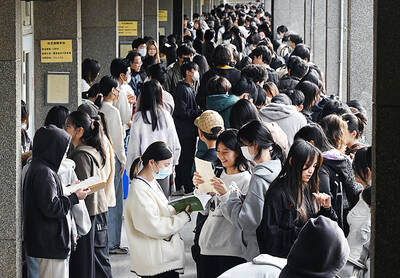
A global survey showed that 60 percent of Taiwanese had attained higher education, second only to Canada, the Ministry of the Interior said. Taiwan easily surpassed the global average of 43 percent and ranked ahead of major economies, including Japan, South Korea and the US, data from the Organisation for Economic Co-operation and Development (OECD) for 2024 showed. Taiwan has a high literacy rate, data released by the ministry showed. As of the end of last year, Taiwan had 20.617 million people aged 15 or older, accounting for 88.5 percent of the total population, with a literacy rate of 99.4 percent, the data


 RSS
RSS