


In a dramatic change of policy, the White House is giving “serious consideration” to selling F-16C/D jets to Taiwan. Washington insiders said the move was totally unexpected and that it could trigger a new crisis in US-China relations.
After refusing for years to sell the fighters to Taipei, the White House said on Friday that Taiwan had “a legitimate need” and that the administration of US President Barack Obama would decide in the “near term” how to address the nation’s fighter gap. The announcement comes as blind Chinese activist Chen Guangcheng (陳光誠) has fled house arrest and is believed to be seeking asylum in the US embassy in Beijing and as US Secretary of State Hillary Rodham Clinton and US Treasury Secretary Tim Geithner are preparing to visit China on May 3 and 4 for a fourth round of the US-China Economic and Security Dialogue.
“This is good news for Taiwan, it is very good news,” US-Taiwan Business Council president Rupert Hammond-Chambers told the Taipei Times, adding: “This is -forward movement, it is a big step forward.”
However, together with the Chen situation and the Bo Xilai (薄熙來) scandal, it will likely cause enormous upheaval within the Beijing leadership.
The White House news broke when US Senator John Cornyn released a letter he had received from Robert Nabors, an assistant to Obama and director of the Office of Legislative Affairs. The letter spells out a deal made between Cornyn and the White House in return for Cornyn releasing his hold on the confirmation of Mark Lippert to become the top Pentagon official for Asia. Lippert was confirmed on Thursday night.
Cornyn put Lippert’s nomination on hold in October and said that he would not allow it to pass until the White House dealt with Taiwan’s request to buy 66 of the fighters, which are made in Cornyn’s district. Last year, Obama agreed to update and retrofit Taiwan’s existing and aging F-16A/Bs, but refused to address the urgent request for new F-16C/Ds.
While the White House has denied it, insiders insist that the sale has not been approved to date largely as a result of vehement objections from China. Now it would seem that Obama is taking a much tougher line with -Beijing. At least in part, this could be a tactic to enhance his image as the US presidential campaign gets under way and presumptive Republican presidential candidate Mitt Romney steps up anti-Chinese rhetoric.
The letter from Nabors at the White House says: “We understand your desire to see Taiwan’s air force modernized with the addition of new F-16C/Ds.”
It says that “given the growing military threat to Taiwan,” the administration will give the sale of the fighters “serious consideration as we move forward in our planning discussions with the Taiwan military. We are committed to duly evaluating its merits as deliberations continue over -Taiwan’s long-term defense -priorities and requirements.”
According to the letter, the Pentagon will review Taiwan’s long-term defense strategy and resourcing plan and Taiwan’s “efforts to respond to the threat from the Chinese military.”
“We recognize that China has 2,300 operational combat aircraft, while our democratic partner Taiwan has only 490,” the letter adds. “We are committed to assisting Taiwan in addressing the disparity in numbers of aircraft through our work with Taiwan’s defense ministry on its development of a comprehensive defense strategy vis-a-vis China.”
“The Assistant Secretary [Lippert] in consultation with the inter-agency and the Congress, will play a lead role as the administration decides on a near-term course of action on how to address Taiwan’s fighter gap, including through the sale to Taiwan of an undetermined number of new US-made fighter aircraft,” the letter ends.
“I commend the administration for recognizing that our friend and ally Taiwan’s air force is woefully undersized and outgunned by Communist China, and their inability to adequately defend themselves poses a threat not just to their own security but to that of the United States,” Cornyn said.
The F-16s are manufactured in Cornyn’s home state of Texas and assembled by Lockheed Martin of Fort Worth. Foreign policy specialist Josh Roginwriting said on Foreign Policy magazine’s Web site that the White House position on the F-16C/Ds could “spark a new crisis” with China.
“The White House does not explicitly promise to sell Taiwan new F-16 fighter jets, as Cornyn wants, promising only to give the matter ‘serious consideration,’” he said.
“The decision to consider the move sets up a potential political clash with China, which has cut military contacts with the US in the past over American arms sales to Taiwan,” Bloomberg news said.
In a printed statement, Hammond-Chambers said that the language in the new White House letter was significantly different from a Feb. 15 letter in which the Pentagon said: “We believe the F-16A/B upgrade effectively meets Taiwan’s current needs.”
Hammond-Chambers urged the administration to quickly announce the sale of F-16C/Ds to Taiwan and added: “At a time when America needs every job it can generate, such a sale would mean more than US$17 billion to the US economy and it would be protecting more than 87,000 jobs. It would also serve to protect peace and stability in the Taiwan Strait, which is a core strategic interest of the United States.”
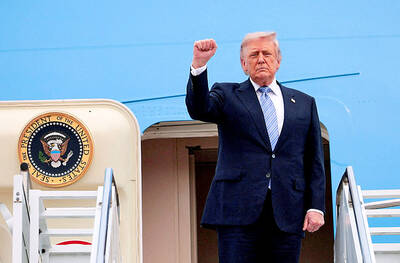
US-CHINA SUMMIT: MOFA welcomed US reassurance of no change in its Taiwan policy; Trump said he did not comment when Xi talked of opposing independence US President Donald Trump yesterday said he has not made a decision on whether to move forward with a major arms package for Taiwan after hearing concerns about it from Chinese President Xi Jinping (習近平). Trump’s comments on Taiwan came as he flew back to Washington after wrapping up critical talks in which both leaders said important progress was made in stabilizing US-China relations even as deep differences persist between the world’s two biggest powers on Iran and Taiwan. “I will make a determination,” Trump said, adding: “I’ll be making decisions. But, you know, I think the last thing we need right
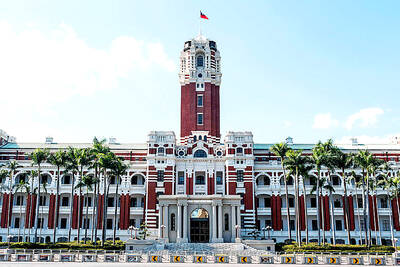
SECURITY: Taipei presses the US for arms supplies, saying the arms sales are not only a reflection of the US security commitment to Taiwan but also serve as a mutual deterrent against regional threats Taiwan is committed to preserving the cross-strait “status quo” and contributing to regional peace and stability, the Presidential Office said yesterday. “It is an undeniable fact that the Republic of China is a sovereign and independent democratic nation,” Presidential Office spokeswoman Karen Kuo (郭雅慧) reiterated, adding that Beijing has no right to claim sovereignty over Taiwan. The statements came after US President Donald Trump warned against Taiwanese independence. Trump wrapped up a state visit to Beijing on Friday, during which Chinese President Xi Jinping (習近平) had pressed him not to support Taiwan. Taiwan depends heavily on US security backing to deter China from carrying
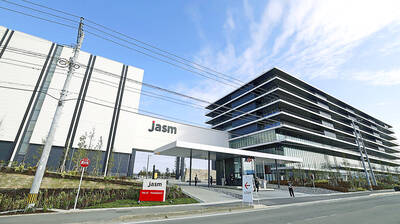
The subsidiary of Taiwan Semiconductor Manufacturing Co (TSMC, 台積電) in Kumamoto, Japan, turned a profit in the first quarter of this year, marking the first time the first fab of the unit has become profitable since mass production started at the end of 2024. According to the contract chipmaker’s financial statement released on Friday, Japan Advanced Semiconductor Manufacturing Inc (JASM), a joint venture running the fab in Kumamoto, posted NT$951 million (US$30.19 million) in profit in the January-to-March period, compared with a loss of NT$1.39 billion in the previous quarter, and a loss of NT$3.25 billion in the first quarter of
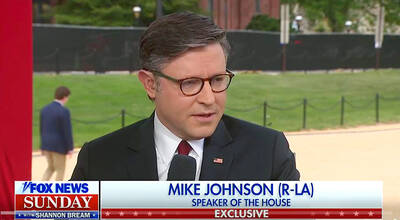
RESOLUTE BACKING: Two Republican senators are planning to introduce legislation that would impose immediate sanctions on China if it attempts to invade Taiwan US House of Representatives Speaker Mike Johnson on Sunday reaffirmed US congressional support for Taiwan, saying the US and “all freedom-loving people” have a stake in preventing China from seizing Taiwan by force. Johnson made the remarks in an interview with Fox News Sunday on US President Donald Trump’s summit with Chinese President Xi Jinping (習近平) last week. In an interview that aired on Friday on Fox News, just as Trump wrapped up a high-stakes visit to China, he said he has yet to green-light a new US$14 billion arms package to Taiwan and that it “depends on China.” “It’s a very good


 RSS
RSS