


Following a day of clashes between protesters and police, Minister of the Interior Lee Hong-yuan (李鴻源) yesterday said there were “elements of injustice” involved in the dispute over the city’s urban renewal project.
The project in Taipei’s Shilin District (士林), under which a construction firm plans to turn an old residential complex for 38 households into a 15-story high-rise apartment complex, was stalled for three years because of opposition from a family surnamed Wang (王), who had lived in the area for decades. The Wangs were evicted on Wednesday and their two stand-alone homes demolished.
“There were some elements of injustice involved in the urban renewal project, and some rethinking of the urban renewal mechanism may be needed,” Lee said. “I’m worried that what happened to the Wangs may become an obstacle to urban renewal, and that would not be a good thing for the country.”
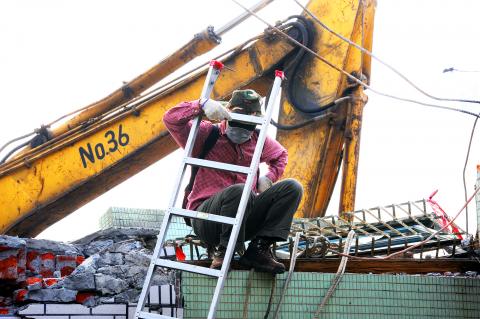
Photo: Lo Pei-der, Taipei Times
Lee made the remarks during a meeting at the legislature’s Internal Administration Committee meeting, as he and Construction and Planning Agency Director-General Yeh Shi-wen (葉世文) were bombarded by questions by lawmakers across party lines who were upset over the eviction of the Wangs and the large number of police sent by the Taipei City Government.
The Wangs were the only family left who had refused to take part in the urban renewal project. However, the Urban Renewal Act (都市更新條例) stipulates that, as long as the construction firm has obtained the consent of 75 percent of the land owners on a project site, it can ask the government to demolish the rest of the buildings by force.
On Wednesday, a demolition squad escorted by more than 1,000 police officers arrived at the site. More than 300 protesters who came out in support of the Wangs were removed by force, and the Wangs’ homes were demolished.
“The Wangs never said yes to the project, but the city government took their non-response as a yes,” Democratic Progressive Party (DPP) Legislator Tuan Yi-kang (段宜康) told Lee and Yeh. “How is this consent legitimate if the stakeholder never said ‘yes’ to it?”
Tuan asked why the agency did not try to intervene, since it has said the alleys around the project site might not be wide enough and could pose a fire hazard, or propose that the project be carried out without including the Wangs’ property.
“We did suggest that the Wangs’ property be excluded following a negotiation meeting in February, but the city government said it could not make changes since the project has already been approved,” Yeh said. “As for the fire hazard issue, the city government said it would take care of it and that it wouldn’t be a problem.”
Yeh said no actual on-site inspections had been conducted; instead, everything was done via written documents, since it is the local government that has the final say in the project.
“I wouldn’t say the city government has violated the law, but I believe it could have been done more cautiously,” Yeh said.
Several other DPP lawmakers, as well as Chinese Nationalist Party (KMT) legislators Wu Yu-sheng (吳育昇) and Chi Kuo-tung (紀國棟) also expressed doubts about the urban renewal mechanism.
National Police Agency Director-General Wang Cho-chiun (王卓鈞) apologized for the actions of some police officers, who allegedly tried to block the media from filming by shining their flashlights at their cameras.
“It’s certainly an inappropriate act, because the media should enjoy full freedom in covering the news,” Wang said. “I’ve asked all police agencies to prohibit such acts.”
At another setting, Premier Sean Chen (陳冲) declined to comment on the case, saying he was not familiar with the eviction and demolition process from start to finish, and so he did not have a full understanding of the case.
He said he favored a thorough review of the Urban Renewal Act and the Administrative Procedure Act (行政程序法) to address biases in the rules and adapt to changes in the legal environment.
Some biases in the urban renewal legal system may have emerged because the act, enacted in 1998, has undergone at least eight revisions, Chen said.
It also contains language that ordinary people might find difficult to understand, resulting in the problem of “asymmetry of knowledge” between ordinary citizens and developers, Chen said.
Saying the Urban Renewal Act was unconstitutional because it failed to uphold equality and people’s right to own property, DPP lawmakers said they would ask for a constitutional interpretation
DPP legislators Chen Chi-mai (陳其邁), Cheng Li-chiun (鄭麗君) and Hsiao Bi-khim (蕭美琴) said they would also propose that the act be amended.
Wednesday’s forceful demolition of the Wangs’ homes and the way the police treated protesters also prompted criticism from netizens.
“This is one big step backward for democracy,” a Facebook user named Marco Wang said.
“Democracy no longer exists in this country, the people’s only weapon is their bodies,” another Facebook user said.
A photo in which Taipei Mayor Hau Lung-bin (郝龍斌) was dubbed “All Mighty King of House Destruction” was posted by many netizens on social networking sites, including Facebook and Plurk.
Additional reporting by Shih Hsiu-chuan and Chris Wang

‘NO SECURITY RISK’: The Railway Bureau reassured the public that the technicians’ activities were limited to technical guidance and did not involve sensitive systems The Railway Bureau yesterday said it had invited eight Chinese technicians to assist with an airport MRT construction project. The bureau issued the confirmation after an Internet user said Chinese nationals had entered the construction zone of Taiwan Taoyuan International Airport’s Terminal 3 project. They asked why “individuals from an enemy state” were allowed access to such a major national infrastructure project, which raised serious concerns over Taiwan’s industrial safety, sensitive systems and information security. The bureau’s Northern Region Engineering Branch Office said subcontractor Taiwan Handle Industrial Co (台灣手把工業) of the Taoyuan airport MRT’s “Contract No. CU05 Project A14 Station Civil, MEP &

A US uncrewed surface vessel (USV) encountered multiple Chinese warships during an autonomous transit of the Taiwan Strait, US defense company Seasats said in a statement on Wednesday. Seasats announced that a Lightfish USV had completed the first autonomous transit of the Taiwan Strait. Over five days, the USV traversed the entire length of the Strait while constantly monitoring surface vessel traffic, the company said. The Lightfish encountered multiple Chinese warships, one of which was a Chinese People’s Liberation Army Navy (PLAN) Type 056 corvette, it said. The Chinese vessels were operating “well within Taiwan’s exclusive economic zone without transmitting their identity via the
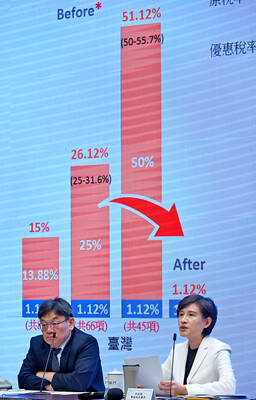
GREATER REACH? Auto parts and wood products would face tariffs of up to 15%, matching those targeting the EU, Japan and South Korea, Vice Premier said The US has announced that preferential tariff treatment for Taiwan’s non-semiconductor Section 232 goods would take effect retroactively from May 1, the Executive Yuan said yesterday. The US government yesterday posted a notice on the Federal Register’s public inspection Web site previewing tariff concessions for Taiwan under a memorandum of understanding (MOU) on Taiwan-US investment after two months of negotiations. The MOU signed on Jan. 15 stipulated three major preferential tariff arrangements: a 15 percent “reciprocal” tariff rate for Taiwan without stacking most-favored nation (MFN) rates; preferential Section 232 treatment for semiconductors and related products; and preferential Section 232 treatment for non-semiconductor

The National Chungshan Institute of Science and Technology yesterday showcased its locally developed variants of the Vision 60 robotic patrol dog, which it plans to deploy on the nation’s outlying territories in the South China Sea. The variants were produced under the Joint Lab project — created by the institute and domestic companies — and assembled with domestically produced motors, lenses and artificial intelligence (AI) systems alongside licensed tech from the US, Missile and Rocket Systems Research Division deputy director Jen Kuo-kang (任國光) told the media event at a military base in Taipei’s Dazhi (大直) area. Taiwan has built up its strengths


 RSS
RSS