


Tens of thousands of piggy banks were returned to the Democratic Progressive Party (DPP) yesterday during a large “homecoming day” rally in Taipei, as DPP presidential candidate Tsai Ing-wen (蔡英文) described the fundraising gimmick as a social movement that could defeat a unfair and monstrous government.
The DPP said about 50,000 people gathered on Ketagalan Boulevard in front of the Presidential Office to returning piggy banks distributed by the DPP over the past month.
“This is such a magnificent view!” Tsai told supporters, who braved the cold and rain — with temperatures as low as 11oC — as they chanted “Taiwan’s first female president” while shaking piggy banks in their hands.
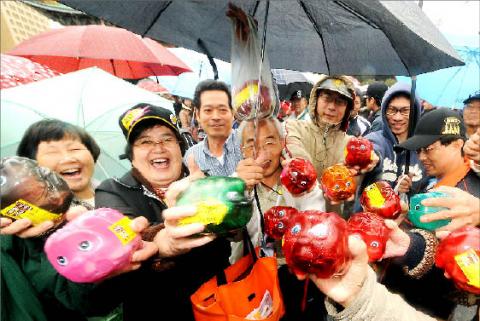
Photo: Liu Hsin-de, Taipei Times
The DPP launched its “three little pigs” campaign after the Control Yuan said in October that it would look into the party’s acceptance of three piggy banks donated by three children, warning that accepting the money from people too young to vote would be in violation of the Political Donations Act (政治獻金法).
Since then the DPP has distributed more than 200,000 piggy banks nationwide, with yesterday designated as their “homecoming day.”
“The campaign has now become a trend and a social movement that represents Taiwan society’s wish to take the opportunity to defeat a unfair and monstrous government that lives on the leftovers of an authoritative legacy,” said Tsai, who wore a pink scarf in recognition of the pink piggy banks.
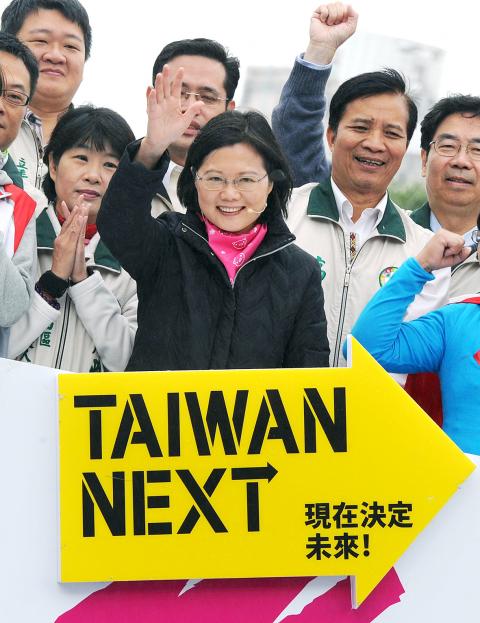
Photo: AFP
Twelve booths were set up in a large tent where DPP staffers collected piggy banks and gave each donor a campaign scarf as a souvenir. The scarves, available in pink, yellow, green and gray, have a logo in the shape of the head of a cartoon pig.
No words could describe the DPP’s gratitude to the Taiwanese, who have always stood on the same side with the party, Tsai said, adding that was why the DPP would cherish the lessons learned during its previous administration and stand firm on the side of the people, she said.
Tsai then turned to a more serious topic — the Chinese Nationalist Party’s (KMT) accusations that she profited from a government investment project in a biotechnology start-up — the so-called “Yu Chang case.”
“The monster has now shown its true face, because it could not care less about pretending to be nice” with the presidential election on the line, Tsai said.
She reminded supporters that yesterday was World Human Rights Day as well as the 32th anniversary of the Kaohsiung Incident, and she condemned the KMT’s smear campaign. She said the KMT was collaborating with the media and using the judiciary system as a campaign tool to distort the facts and using “character assassination” to attack opponents.
“This is a dirty trick. And this is the backsliding of Taiwan’s democracy,” she said.
The rally was scheduled to run from 10am to 12pm, but that was not enough time to process all the returned piggy banks, so the -details of donors of the rest were taken down and the banks piled up before being shipped out to the party’s national campaign headquarters in Banciao District (板橋), New Taipei City (新北市).
Tsai left the rally for other campaign activities before making a surprise return to Ketagalan -Boulevard about 11:40am and making another brief speech, prompting a cheerful reaction from the crowd, who chanted “Hello President Tsai.”
“I believe the Taiwanese people would make their choice with wisdom on January 14. And I believe I can win. From that day on, let us work together to make Taiwan a better democracy and a better country,” Tsai said.
The DPP sponsored similar homecoming rallies to collect the piggy banks in cities and counties across the nation yesterday.

‘NO SECURITY RISK’: The Railway Bureau reassured the public that the technicians’ activities were limited to technical guidance and did not involve sensitive systems The Railway Bureau yesterday said it had invited eight Chinese technicians to assist with an airport MRT construction project. The bureau issued the confirmation after an Internet user said Chinese nationals had entered the construction zone of Taiwan Taoyuan International Airport’s Terminal 3 project. They asked why “individuals from an enemy state” were allowed access to such a major national infrastructure project, which raised serious concerns over Taiwan’s industrial safety, sensitive systems and information security. The bureau’s Northern Region Engineering Branch Office said subcontractor Taiwan Handle Industrial Co (台灣手把工業) of the Taoyuan airport MRT’s “Contract No. CU05 Project A14 Station Civil, MEP &

The National Chungshan Institute of Science and Technology yesterday showcased its locally developed variants of the Vision 60 robotic patrol dog, which it plans to deploy on the nation’s outlying territories in the South China Sea. The variants were produced under the Joint Lab project — created by the institute and domestic companies — and assembled with domestically produced motors, lenses and artificial intelligence (AI) systems alongside licensed tech from the US, Missile and Rocket Systems Research Division deputy director Jen Kuo-kang (任國光) told the media event at a military base in Taipei’s Dazhi (大直) area. Taiwan has built up its strengths

NOT IMMEDIATE: Taiwan has a chance to appeal the proposed 10 percent tariff before it starts, while other countries face a 12.5 percent tariff from the trade office Taiwan is among 60 economies determined by the US to have failed to impose or enforce a ban on the importation of goods produced with forced labor, according to a notice released on Tuesday by the Office of the US Trade Representative (USTR), which proposed imposing an additional 10 percent or more tariff on them. The USTR in a statement said that following an investigation, it had determined under Section 301 of the Trade Act of 1974 that the failure of the 60 economies to impose and effectively enforce a prohibition on the importation of goods produced with forced labor is

TIT-FOR-TAT: The US allegedly revoked the visa of a Chinese national working at Xinhua News Agency in the US in response to Beijing’s expulsion of Vivian Wang The Presidential Office yesterday condemned China for expelling a New York Times correspondent from Beijing following the newspaper’s interview with President William Lai (賴清德), saying the move highlighted Beijing’s suppression of press freedom and its threat to international news media. Taiwan has noted a series of recent incidents in which Beijing used similar tactics to “threaten and pressure international media outlets and journalists,” Presidential Office spokeswoman Karen Kuo (郭雅慧) said in a statement. “This concerns not only press freedom and freedom of expression, but also the safety of journalists, and Taiwan and relevant partners are paying close attention to the situation,” she


 RSS
RSS