


The Sports Affairs Council (SAC) yesterday said the government never wavered in its support for Taiwanese taekwondo athlete Yang Shu-chun (楊淑君), adding that Yang and the Chinese Taipei Taekwondo Association (CTTA) had different opinions regarding an appeal to the Court of Arbitration for Sport (CAS) of her disqualification at the Asian Games last year.
Yang said last month she had decided to withdraw her appeal to the CAS so she could focus on training for next year’s Summer Games in London.
However, former CTTA chairman Chen Chien-ping (陳建平) said in an article in the Chinese-language Liberty Times (the Taipei Times’ sister newspaper) yesterday that Yang was forced to drop the appeal and sign a proxy enabling the CTTA to handle the lawsuit on her behalf under threat from association officials.
Joining the attacks, the Democratic Progressive Party (DPP) accused President Ma Ying-jeou’s (馬英九) administration and CTTA chairman Angus Hsu (許安進) of negligence and intimidation.
DPP spokesman Chen Chi-mai (陳其邁) said the DPP had evidence proving that Hsu had pressured Yang to withdraw her appeal.
Hsu visited Seoul in April to negotiate with the World Taekwondo Federation about the case and reported to SAC Minister Tai Hsia-ling (戴遐齡) on May 17, Chen said, adding that Yang made more than a dozen phone calls to SAC Deputy Minister Steven Chen (陳士魁) for help after her June 6 meeting with Hsu.
To compel Yang to withdraw her appeal, Hsu threatened Yang by saying that her place on the Olympic taekwondo team, the position of her boyfriend and coach Liu Tsung-ta (劉聰達), as well as training expenses, would all be at stake, Chen Chi-mai said.
Hsu played a key role in the withdrawal decision, Chen Chi-mai said, because “Yang never mentioned it before Hsu’s visit to South Korea.”
Steven Chen told a press conference yesterday morning that Yang had informed the council of her meeting with Hsu and other CTTA officials on June 6, but the deputy minister said Yang and CTTA officials had differing views on the appeal.
“In the meeting, Hsu tried to talk Yang into withdrawing the appeal, but Yang was unwilling to do so for various reasons,” Steven Chen said. “Each side stood their ground. Yang felt that she would not be able to leave the meeting if she did not sign the proxy, which she eventually signed.”
Steven Chen said the council did not recognize the proxy and wanted to hear from Yang herself. He said the council had been in contact with Yang between that time and the day she announced her decision to withdraw the appeal.
“I spoke to her on the phone before the press conference and told her not to take it,” Steven Chen said, adding that the council also told Hsu it could not force her to drop the appeal.
In a press conference yesterday afternoon, Chen Chien-ping stood by his statement.
“If you were told that you may not be able to represent your country to compete in the Olympics next year and your boyfriend [Liu] may not be recruited as a coach for the Olympics, could this not seen a threat?” Chen Chien-ping said. “Why did she cry if she was not under threat?”
Chen Chien-ping said CTTA officials had held more than one meeting with Yang, adding that each meeting lasted about six to seven hours.
“She finally could not take it anymore and asked SAC officials to stand with her so that the CTTA would not make her sign it, but the SAC officials said it was beyond their jurisdiction to do so,” Chen Chien-ping said.
The former CTTA chairman said he was not afraid of being sued because one of the participants in the meeting had recorded the conversations.
Hsu said last night he would sue Chen Chien-ping over his statements, which he said had damaged his reputation. Hsu denied the CTTA had forced Yang to drop the lawsuit.
Hsu said Yang entrusted the CTTA with the lawsuit so that she could concentrate on her training. Because of the proxy signed by Yang, Hsu said that he was able to ask for opinions from the 225 representatives of taekwondo associations nationwide — 207 of which said in written statements that the association should withdraw the appeal.
“We dropped the appeal after receiving an official apology from the Asian Taekwondo Union,” Hsu said. “I am the CTTA chairman and I cannot take the chance of scuttling our right to participate in [future] competitions.”
Additional reporting by Chris Wang

‘NO SECURITY RISK’: The Railway Bureau reassured the public that the technicians’ activities were limited to technical guidance and did not involve sensitive systems The Railway Bureau yesterday said it had invited eight Chinese technicians to assist with an airport MRT construction project. The bureau issued the confirmation after an Internet user said Chinese nationals had entered the construction zone of Taiwan Taoyuan International Airport’s Terminal 3 project. They asked why “individuals from an enemy state” were allowed access to such a major national infrastructure project, which raised serious concerns over Taiwan’s industrial safety, sensitive systems and information security. The bureau’s Northern Region Engineering Branch Office said subcontractor Taiwan Handle Industrial Co (台灣手把工業) of the Taoyuan airport MRT’s “Contract No. CU05 Project A14 Station Civil, MEP &

A US uncrewed surface vessel (USV) encountered multiple Chinese warships during an autonomous transit of the Taiwan Strait, US defense company Seasats said in a statement on Wednesday. Seasats announced that a Lightfish USV had completed the first autonomous transit of the Taiwan Strait. Over five days, the USV traversed the entire length of the Strait while constantly monitoring surface vessel traffic, the company said. The Lightfish encountered multiple Chinese warships, one of which was a Chinese People’s Liberation Army Navy (PLAN) Type 056 corvette, it said. The Chinese vessels were operating “well within Taiwan’s exclusive economic zone without transmitting their identity via the

Taiwan is still in the process of assessing the possibility of recruiting workers from Eswatini, the Ministry of Foreign Affairs said yesterday, adding that its goal is to help Eswatini upgrade its vocational training centers. If there are plans to recruit workers from Eswatini, safeguarding national security, protecting public health and ensuring the employment rights of Taiwanese would be prerequisites, Department of West Asian and African Affairs Director-General Yen Chia-liang (顏嘉良) told a news conference. Key considerations would also include filling labor shortages in specific industries, and fostering bilateral professional and technical exchanges, he said. Yen was asked about the progress of labor
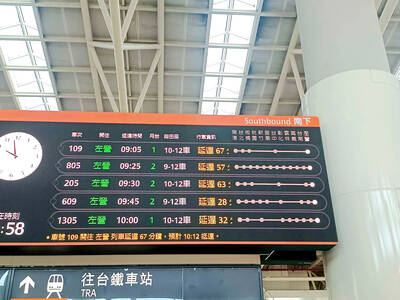
The nation’s usually punctual high-speed rail system yesterday was hit by major disruptions after all scheduled services were canceled and replaced with three hourly trains offering only non-reserved seating, affecting more than 200,000 passengers. Preliminary findings indicate the disruption was caused by a faulty power module in a track switch control cabinet, Taiwan High-Speed Rail Corp (THSRC) said, adding that as a full system inspection could only be conducted after operations end for the day, a decision on whether normal service would resume today would be announced before the first train departs. During a routine inspection early yesterday, a switch signal abnormality


 RSS
RSS