


Despite repeated warnings by the Ministry of National Defense to curb their visits to China, retired senior military personnel are continuing to make such trips — and sometimes as part of a group, a top official has said.
The official, who requested anonymity, said a delegation of generals led by retired general and former director of the General Political Warfare Department Hsu Li-nung (許歷農) visited Beijing over the weekend to attend the Huangpu seminar organized by the Beijing government.
Hsu’s “Chung Shang Huangpu Cross-Strait Ties” seminar launched its first activities in Taiwan last year, with Beijing mobilizing the families or descendants of Huangpu military school graduates to come to Taiwan, the official said.
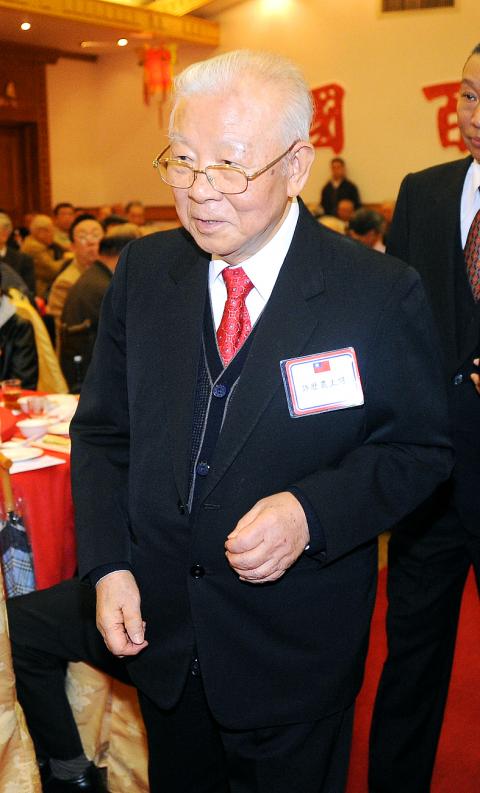
Photo: Taipei Times
CONCERN
The number of retired Taiwanese military personnel who participated in last year’s event was between 40 and 50 people, enough to cause concern within the administration of President Ma Ying-jeou (馬英九), the official said.
Prior to last year’s seminar, Hsu led a delegation of 18 retired military officers, including eight retired generals, on a visit to Beijing and held direct talks with officials from the Central Military Commission (CMC) under the title of director of the “New -Tongmenghui,” the official said.
As Hsu’s delegation received the royal treatment from the CMC last year, the possibility that his meeting over the weekend with CMC officials included an exchange of views on cross-strait matters could not be excluded, the official said.
According to other sources, another 10 retired military personnel visited Sichuan Province between May 31 and yesterday for a golf party with retired People’s Liberation Army officers, and some retired Taiwanese officers were flown directly to Beijing to attend the seminar after the golf trip.
In contrast with meetings two years ago, when the Chinese units in charge would publish press releases and pictures to promote the fact that cross-strait military exchanges were taking place, this year’s golf party and seminar was “abnormally low profile,” the official said.
ELECTION EFFECT
Whether this is because Taiwan has entered its election season or other election-related aspects requires further observation, the official said.
Former Political Warfare Bureau deputy director and executive officer Chen Hsing-kuo (陳興國), the main coordinator for the seminar in Taiwan last year, said the seminar was held in Beijing this year because the numbers of retired officers from Taiwan participating in the event would not be as high as last year.
Chen also confirmed that some of the retired officers attending the golf party in Sichuan were directly flown to Beijing to attend the seminar, but said he could not say how many participated.
Chen also confirmed that Hsu was flown directly to Beijing from Hubei Province.
A senior manager at the Huang Fu-hsing branch of the Chinese Nationalist Party (KMT) said they had received invitations to the golf party and the seminar, but after due consideration felt that it was best not to attend.
If anyone in the Huang Fu--hsing branch attended an event in China, they would do so through the KMT and Chinese Communist Party channels, the manager said, adding they would not go as independent tourist groups.
If some of the retired officers wished to attend the golf party or any seminars, the manager said that as long as they did not say they were acting on the behalf of the Huang Fu-hsing branch, it could not interfere.
Translated By Jake Chung, Staff Writer

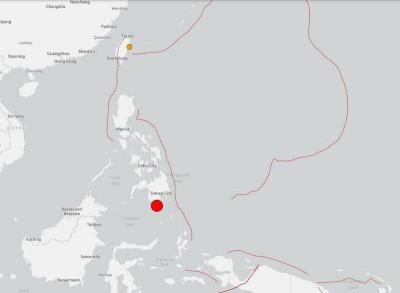
A magnitude 7.8 earthquake struck off the southern coast of Mindanao in the Philippines at 7:38am today, prompting the US Tsunami Warning System to issue an alert for neighboring countries, including Taiwan. The system issued a purple alert indicating a "tsunami threat." The potential threat zone includes Taiwan, the Philippines, Papua New Guinea, Yap and Palau. Philippine authorities were assessing the damage from the quake, with the office of civil defense seeking to verifying initial reports that 15 people had been killed and 129 injured in the region, mostly from falling debris. Arlene Hollero, disaster chief of Maasim town in the Philippines' Sarangani Province,
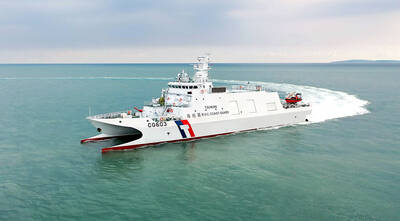
‘GRAY ZONE’ PRESSURE: Beijing’s activities are intended to create the deceitful impression that China has jurisdiction over the area around Taiwan, the CGA said Taiwan’s rights over its territorial waters and exclusive economic zone must not be violated by any country, the Mainland Affairs Council said yesterday, adding that it will not accept any unprovoked actions. The council issued the remarks in response to the China Coast Guard conducting maritime enforcement drills near eastern Taiwan and claiming to fully exercise China’s maritime administrative law enforcement authority. The Coast Guard Administration (CGA) has been closely monitoring the situation and is taking concrete steps to defend the nation’s sovereignty and secure its waters, the council said. China has no sovereign rights over the waters off eastern
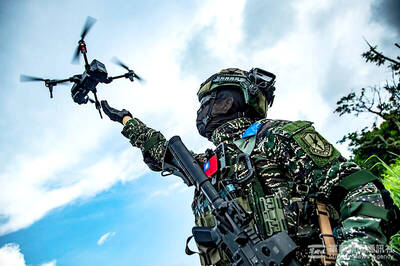
RESILIENCE: Taiwan plays a key role in semiconductors, energy, information infrastructure and advanced manufacturing, AIT Director Raymond Greene said Taiwan’s continued investment in deterrence and resilience remains vital, especially in uncrewed systems and other emerging technologies, American Institute in Taiwan (AIT) Director Raymond Greene said yesterday. Greene made the remarks at the annual National Strategic Summit on Supply Chain Resilience held by the Research Institute for Democracy, Society and Emerging Technology (DSET), a government-backed think tank. As Taiwan last year became the US’ fourth-largest trading partner and supply chain security is becoming more important, cooperation in emerging technologies continues to deepen between the two countries, he said. The US is committed to accelerating innovation, building key infrastructure, strengthening cooperation

The National Chungshan Institute of Science and Technology yesterday showcased its locally developed variants of the Vision 60 robotic patrol dog, which it plans to deploy on the nation’s outlying territories in the South China Sea. The variants were produced under the Joint Lab project — created by the institute and domestic companies — and assembled with domestically produced motors, lenses and artificial intelligence (AI) systems alongside licensed tech from the US, Missile and Rocket Systems Research Division deputy director Jen Kuo-kang (任國光) told the media event at a military base in Taipei’s Dazhi (大直) area. Taiwan has built up its strengths


 RSS
RSS