


Health authorities have begun investigating whether a third manufacturer may be guilty of using illegal food additives after di-n--butyl phthalate, or DBP, was found in a health supplement under the brand name Zoeyen, which is distributed by CPC Biotechnology (中油生技), a subsidiary of the state-run petroleum refiner CPC Corp, Taiwan (CPC, 台灣中油).
The manufacturer, Vitalife BioMed Co (優活醫藥生技有限公司), which is based in Taipei, tested the product and immediately informed Taipei City’s Bureau of Health that it was contaminated, officials said on Tuesday.
In the past two weeks, health authorities and prosecutors have tracked down two companies — Yu Shen Chemical Co (昱伸香料有限公司) and Pin Han Perfumery Co (賓漢香料公司) — who allegedly used di(2-ethylhexyl) phthalate, or DEHP, and di-isononyl phthalate, or DINP, respectively, in food additives that are supplied to food and beverage manufacturers.
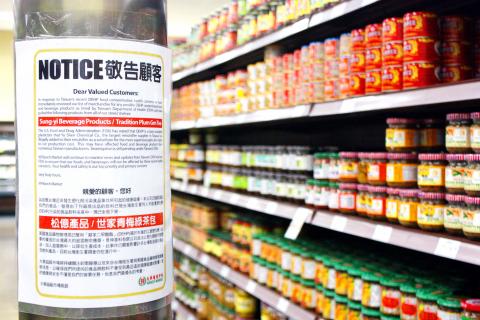
Photo: CNA
This was the first discovery in consumable products of the chemical DBP, which is an industrial-use plasticizer that should not be added to foods.
The Department of Health said that while DBP has not been proven to be a cancer--causing agent, exposure to the chemical above legal limits could cause feminization in boys and premature development of sexual organs in girls.
Hsu Ming-neng (許銘能), deputy director-general of the department’s Food and Drug Administration, said yesterday that after the discovery, health authorities suspected that a third company producing food additives laced with industrial chemicals has yet to be found.
Health officials said that initial investigations point to possible contamination of jujube powder, which is an ingredient used in the Zoeyen capsules.
Health authorities are tracking down which of CPC’s suppliers, whether domestic or foreign, produced the problematic material that went into the Zoeyen capsules. The capsules tested positive for DBP at 19 to 24 parts per million, Hsu said.
As of May 31, the department has required that companies producing five categories of consumable products — sports drinks, juices, tea drinks, fruit jams or syrups, and tablets or powders — provide proof that their products are free of DEHP, DINP, DBP, di-n-octyl phthalate (DNOP), diisodecyl phthalate (DIDP) and butylbenzyl phthalate (BBP).
Companies that fail to produce certification will have their products removed from the market or face fines of up to NT$300,000 for violating the Act Governing Food Sanitation (食品衛生管理法).

South Korea has adjusted its electronic arrival card system to no longer list Taiwan as a part of China, a move that the Ministry of Foreign Affairs said would help facilitate exchanges between the two sides. South Korea previously listed “Taiwan” as “Taiwan (China)” in the drop-down menus of its online arrival card system, where people had to fill out where they came from and their next destination. The ministry had requested South Korea make a revision and said it would change South Korea’s name on Taiwan’s online immigration system from “Republic of Korea” to “Korea (South),” should the issue not be

Tainan, Taipei and New Taipei City recorded the highest fines nationwide for illegal accommodations in the first quarter of this year, with fines issued in the three cities each exceeding NT$7 million (US$220,639), Tourism Administration data showed. Among them, Taipei had the highest number of illegal short-term rental units, with 410. There were 3,280 legally registered hotels nationwide in the first quarter, down by 14 properties, or 0.43 percent, from a year earlier, likely indicating operators exiting the market, the agency said. However, the number of unregistered properties rose to 1,174, including 314 illegal hotels and 860 illegal short-term rental
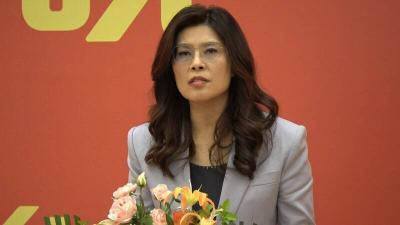
Both sides of the Taiwan Strait share a political foundation based on the “1992 consensus” and opposition to Taiwanese independence, Chinese Nationalist Party (KMT) Chairwoman Cheng Li-wun (鄭麗文) today said during her meeting with Chinese President Xi Jinping (習近平). Both sides of the Strait should plan and build institutionalized and sustainable mechanisms for dialogue and cooperation based on that foundation to make peaceful development across the Strait irreversible, she said. Peace is a shared moral value across the Strait, and both sides should move beyond political confrontation to seek institutionalized solutions to prevent war, she said. Mutually beneficial cross-strait relations are what the
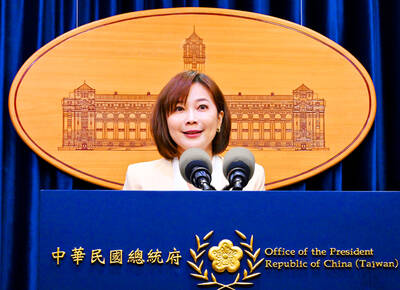
ECONOMIC COERCION: Such actions are often inconsistently applied, sometimes resumed, and sometimes just halted, the Presidential Office spokeswoman said The government backs healthy and orderly cross-strait exchanges, but such arrangements should not be made with political conditions attached and never be used as leverage for political maneuvering or partisan agendas, Presidential Office spokeswoman Karen Kuo (郭雅慧) said yesterday. Kuo made the remarks after China earlier in the day announced 10 new “incentive measures” for Taiwan, following a landmark meeting between Chinese President Xi Jinping (習近平) and Chinese Nationalist Party (KMT) Chairwoman Cheng Li-wun (鄭麗文) in Beijing on Friday. The measures, unveiled by China’s Xinhua news agency, include plans to resume individual travel by residents of Shanghai and China’s Fujian


 RSS
RSS