

President Ma Ying-jeou (馬英九) said yesterday that the WHO should not have two sets of standards, and he requested the help of the European Parliament to demand the use of “Chinese Taipei” as the name for Taiwan.
Ma asked Charles Tannock, head of the European Parliament-Taiwan Friendship Group, to help ensure Taiwan is referred to properly at the WHO.
Ma said that Taiwan has taken part at the World Health Assembly as an observer under the name “Chinese Taipei” since 2009, unlike in the past, when Taiwan was only invited to technical meetings.
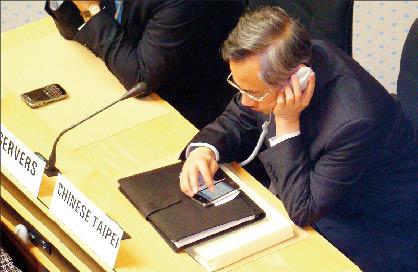
Photo: CNA
He only learned recently about the WHO memo asking recipients to address Taiwan as a “province of China.”
“Upon learning the news, I myself and our health minister currently at the Geneva meeting lodged a strong protest,” Ma said, adding that as an organization with such high stature, the WHO should not have different sets of standards.
Ma said Taiwan has requested that the WHO respect its name of “Chinese Taipei” for the past three years, which he said was a name that was confirmed after an exchange of notes.
“The WHO should address us as ‘Chinese Taipei’ instead of ‘Taiwan, China.’ We hope you can help us ... in this regard, “ Ma told Tannock and his 10-member delegation.
Department of Health (DOH) Minister Chiu Wen-ta (邱文達), head of Taiwan’s delegation at the 64th session of the WHA that opened on Monday in Geneva, Switzerland, presented a letter to Gian Luca Burci, the WHO’s legal counsel, at 11:30am on Monday.
Burci accepted the letter and promised to immediately pass it on to WHO Secretary-General Margaret Chan (陳馮富珍).
In the protest letter, which the DOH made public in Taipei yesterday, Taiwan expressed “utmost dissatisfaction” with the internal memo and its implications regarding the implementation of International Health Regulations (IHR) in Taiwan, demanding that the WHO redress the mistake which is “absolutely unacceptable to us.”
Chiu said in the letter to the WHO that he was writing on behalf of the nation, to “file a formal protest over improper procedure and erroneous terminology of political nature laid out” in the application of the IHR with respect to “Taiwan, province of China.”
According to the WHO memo, the terminology used in WHO publications and documents, either electronic or in hard copy, must be “Taiwan, province of China” and information related to Taiwan “must be listed or shown as falling under China and not separately” as if it referred to a separate state.
It showed that all communications between the WHO’s technical units and the “point of contact of Taiwan Province” would be channeled through the WHO contact point.
The WHO contact point, as necessary, would coordinate with the secretariat focal point concerning the implementation of the 2005 memorandum of understanding between China and the WHO that brings certain interactions with Taiwan under the WHO into China’s jurisdiction.
The memo cast into doubt the statement by the government that Taiwan’s participation in the IHR was made in the capacity of a “point of contact in Taipei” and that the inclusion of Taiwan in the IHR allows direct communication between the nation and the WHO.
“They have unwarranted political implications that are not only inconsistent with the reality, but also hinder the implementation of the IHR,” Chiu said in the letter.
Documents attached to the letter were a letter dated Jan. 2, 2009, sent by Bernard Kean that designated Taiwan as the “point of contact in Taipei” and the nation’s response to the letter dated Jan. 22 of that year by then-Centers for Disease Control director-general Steve Kuo (郭旭崧).
Chiu said Taiwan’s designation was “altered without our consent and knowledge in the WHO’s internal memo is most regrettable.”
“I hereby request that you immediately look into this grave matter and redress such a mistake that is unacceptable to us,” Chiu said.
Chiu concluded the letter by expressing gratitude to Chan for inviting him to attend the WHA session and also assured her that Taiwan’s delegation would continue to make substantial contributions to the work of the WHO.
The Ministry of Foreign Affairs yesterday said that representatives of several of the nation’s allies — Gambia, Nauru, Nicaragua and Swaziland — were present when Chiu met with Burci, while the representatives of Palau and Panama also met with Chiu later to express their support.
Asked for comment, Deputy Minister of Foreign Affairs Shen Lyu-shun (沈呂巡) denied that the wording of the letter had not been strong enough, saying the criticism of the tone used in the letter were lost in translation.
“It was actually a strongly-worded protest if you read the English version. If you also look at [former US president Franklin] Roosevelt’s declaration of war against Japan [on Dec. 8, 1941], the Day of Infamy Speech, you would see that the tone of his speech was quite gentle,” Shen said.
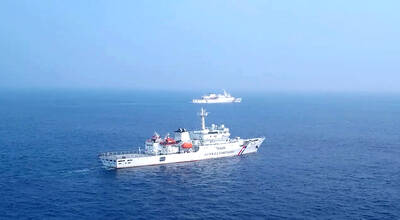
PATROL PARTNERS: The ‘Chiayi’ and the ‘Penghu’ departed for a two-day joint patrol of Palau’s exclusive economic zone, the CGA’s second diplomatic visit to the country The Coast Guard Administration (CGA) set a record for its southernmost deployment of a coast guard vessel as the vessels Chiayi and the Penghu reached Palau’s Pulo Anna Island on Saturday in a cooperative exercise between the two countries. The island, about 217 nautical miles (401km) southwest of Koror in the Palauan state of Sonsorol and 1,220 nautical miles from Taiwan’s southernmost point, Oluanpi (鵝鑾鼻), is the furthest south a CGA vessel has sailed. The two vessels are in Palau for the coast guard’s second diplomatic visit to the country. They docked at Malakal Harbor on Tuesday last week. The coast guard
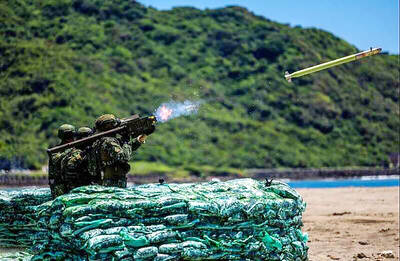
BATCH 1: The military has plans to assign the weapons to the army to defend Taiwan proper, as well as outlying islands and the navy for the Marine Corps, the official said Taiwan is to receive 500 Stinger missiles and 178 launchers from the US by the end of the year, the first batch under a planned two-stage acquisition totaling 2,621 missiles and 763 launchers, a defense official said yesterday on condition of anonymity. The portable missiles would play a vital role in the nation’s air defense capabilities, the source said. The army plans to deploy 2,235 missiles and 657 launchers to defend Taiwan proper and outlying islands, they said, citing military documents. The navy is allotted 295 missiles and 85 launchers to arm the Marine Corps and some surface vessels that lack air defense
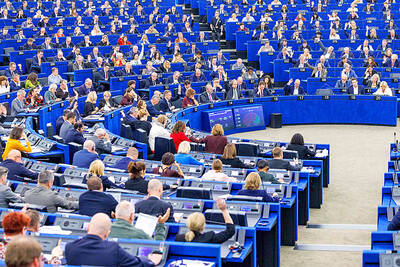
The European Parliament on Wednesday adopted a recommendation on EU-China political relations that rejected China’s efforts to restrict Taiwan’s participation in international organizations and exchanges. The recommendation, addressed to the European Council, the European Commission and EU High Representative for Foreign Affairs and Security Policy Kaja Kallas, includes several references to EU-Taiwan relations and expresses support for closer ties, saying they would bring positive benefits and have strategic importance. Describing Taiwan as a valuable partner in trade and technology, the European Parliament said it “rejects China’s attempts to coerce international organizations, third countries and other actors into restricting Taiwan’s international participation and
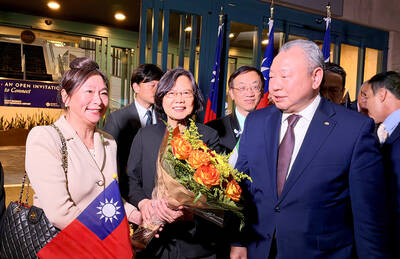
Former president Tsai Ing-wen (蔡英文) on Monday arrived in San Francisco, receiving a warm welcome from hundreds of overseas Taiwanese as she launched a week-long visit. Accompanied by Representative to the US Alexander Yui (俞大?), and head of Taiwan’s San Francisco office Wu Chih-hsiang (伍志翔), Tsai arrived at her hotel, waving, smiling and giving high-fives to Taiwanese compatriots amid cheers of “Taiwan’s democracy involves you and me” to welcome her to the San Francisco Bay Area. It is Tsai’s first visit to the US since she left office in May 2024 after serving two four-year terms as president. Tsai is today to deliver


 RSS
RSS