

President Ma Ying-jeou (馬英九) yesterday visited the family of Chiang Kuo-ching (江國慶), who was wrongfully executed by the military 14 years ago for the rape and murder of a five-year-old girl, and promised to clear Chiang’s name in a speedy manner.
Ma apologized to Chiang and his family on Monday through Presidential Office spokesman Lo Chih-chiang (羅智強), as well as a posting on his Facebook page.
After visiting the family, Ma told reporters that Chiang’s mother and uncle said they cared more about clearing his name than receiving compensation.

Photo: Reuters
“I have instructed the Ministry of National Defense and Ministry of Justice to fully assist the family so Chiang can be declared innocent and his family obtain compensation,” Ma said. “Minister of National Defense Kao Hua-chu (高華柱), who is also here today, will also do his best to help the family get its wish.”
Ma said his visit and apology demonstrated his administration’s willingness to help the family see its requests fulfilled.
“The public must realize that my visit today clearly indicates that Chiang is innocent,” Ma said. “This fact has been confirmed by the investigations of the Control Yuan and Taipei District Court.”
The family’s wish that Chiang’s conviction and death penalty be revoked has to proceed in accordance with the law, but he promised the process would not take five or 10 years, Ma said.
“A retrial is probably the least time-consuming, but we will do our best to shorten the process,” he said.
However, he declined to specify how long it would take, saying he would ask the justice ministry to provide an estimate.
He also dismissed speculation that Chiang could not be declared innocent until another suspect, Hsu Jung-chou (許榮洲), has been proven guilty.
Taipei prosecutors arrested Hsu, who has a record of sexual offenses, as a suspect in the case on Friday.
Ma said the new evidence discovered could be used against Hsu at a retrial and clearing Chiang’s name should be dealt with separately from proving Hsu guilty.
Chiang was executed on Aug. 13, 1997, but his family continued to fight to clear his name.
A Control Yuan report on its investigation said that in notes Chiang wrote in prison, he recounted being threatened with an electric baton, exposed to strong light and forced to undergo physical activity all night during his interrogations.
In letters Chiang sent to his family while in prison, he wrote that investigators told him “the chief [then-head of air force command Chen Chao-min (陳肇敏)] is coming to see you. When he arrives, remember to kneel before him and ask for help. The chief will save you.”
About 30 military officials involved in Chiang’s arrest, trial and execution are facing criminal and administrative investigations, including Chen.
While Chen also served as minister of national defense under Ma, the president said he was in no position to say whether Chen or other military personnel involved in Chiang’s case had been guilty of negligence or should be held legally responsible for his wrongful conviction and execution.
Chiang’s case has prompted Ma’s long-time friend C.V. Chen (陳長文), the president of Taiwan’s Red Cross Society, to urge the government to consider abolishing the death penalty.
Ma said his administration was willing to gradually try for abolition because the public remains polarized on the issue.
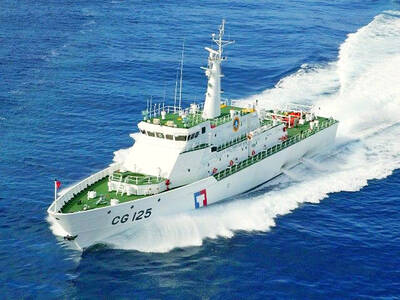
GEOPOLITICAL SIGNIFICANCE: The CGA’s nonmilitary role makes it a tool to avert diplomatic issues, an official said, while confirming the donation of a ship to Manila Coast Guard Administration (CGA) ships are scheduled to sail to the Philippines bearing the words “Taiwan Coast Guard” in a high-profile visit in October next year, the first such visit by a Taiwanese maritime law enforcement vessel to the Southeast Asian nation, the agency said yesterday. The CGA also confirmed that it had donated one of its decommissioned patrol vessels to the Philippines in a rare transfer of a retired ship to a nondiplomatic ally. The Republic of China (ROC) Navy last made such a visit in 1974, shortly before the Philippines switched diplomatic recognition to the People’s Republic of China in

‘GLOBAL WARNING’: The infiltration is not just a local problem, as Beijing has been deploying the same tactics worldwide against Western democracies, a report said Between 50,000 and 100,000 Chinese spies are operating in Taiwan, far more than the National Security Bureau’s previous estimate of 5,000, German journalist and author Jurgen Kremb said on Monday. Kremb presented his research, titled “The War of Spies: How China’s Intelligence Services Are Infiltrating Taiwan — and What Europe Must Learn from It,” at a joint event held by the Taiwan offices of the Friedrich Naumann Foundation and the European Values Center for Security Policy. The report was published in June in the Ministry of Justice Investigation Bureau’s Prospect & Exploration Monthly (展望與探索月刊). By spies, he said he was referring to informants,
CALL FOR CHANGE: They urged the UN to facilitate Taiwan’s involvement in the body, recognize its peace efforts and to work with members in preventing military conflict Representatives to the UN from five of Taiwan’s diplomatic allies sent a joint letter to UN Secretary-General Antonio Guterres on Friday, calling for the country’s inclusion in the body. Allies in the letter sent ahead of the 81st session of the UN General Assembly General Debate made three demands in support of Taiwan: inclusion, recognition and camaraderie. They implored the UN to seek an appropriate way to facilitate Taiwan’s meaningful involvement in the world governing body, saying that UN Resolution 2758, which accepted the People’s Republic of China (PRC) as a member of the UN, does not exclude Taiwan. Beijing claims that the
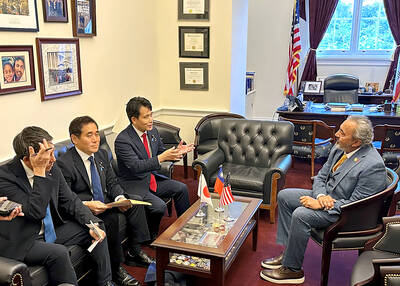
WASHINGTON MEETING: Japan’s Hirofumi Takinami said participants rejected the idea that the US should limit its defensive perimeter to the Second Island Chain US and Japanese lawmakers agree that the US must defend the First Island Chain, including Taiwan, and should not fall back to the Second Island Chain, while “a Taiwan contingency is a Japan contingency and therefore a US-Japan alliance contingency,” media reported after a meeting between officials of the two nations in Washington on Tuesday. A delegation of Japanese lawmakers from the Liberal Democratic Party met with US Senator Thom Tillis, co-chair of the Senate Taiwan Caucus, and US Representative Ami Bera, co-chair of the US Congressional Taiwan caucus, to discuss issues concerning East Asia and the Taiwan Strait. The Japanese and


 RSS
RSS