


A US lawmaker was in critical condition yesterday after being shot in the head when a gunman opened fire at a public event, killing six people in an attack that shocked the nation.
US Representative Gabrielle Giffords, 40, a member of US President Barack Obama’s Democratic Party, was meeting constituents at a supermarket in Tucson, Arizona, when the assailant unleashed a volley of automatic fire. A nine-year-old girl and a US federal judge were among those killed, and 12 others were wounded.
Obama called the attack a “tragedy for our entire country.” The US House of Representatives, which opened under new Republican leadership just three days earlier, called off proceedings for this week.

PHOTO: AFP
Bystanders tackled the gunman, identified as 22-year-old local resident Jared Lee Loughner. News reports said he had filled the Internet with angry and largely incoherent condemnations of the government, while the army said he had tried to enlist but was rejected.
A Loughner profile posted on YouTube listed Karl Marx and Friedrich Engels’ The Communist Manifesto and Adolf Hitler’s Mein Kampf among his favorite books.
“There’s some reason to believe that he came to this location with another individual,” Pima County Sheriff Clarence Dupnik told reporters, saying the gunman “has kind of a troubled past, and we’re not convinced that he acted alone.”
Doctors said a bullet passed through Giffords’ brain. Despite initial media reports she had died, local television networks said late on Saturday she was awake in her hospital bed and recognized her husband, NASA astronaut Mark Kelly.
“She is in critical condition [but] I’m optimistic about recovery,” University Medical Center trauma chief Peter Rhee said. “We cannot tell what kind of recovery, but I’m about as optimistic as you can get.”
At a later briefing, however, Giffords family friend and former US surgeon-general Richard Carmona was more cautious, saying: “With guarded optimism, I hope that she will survive, but this is a very devastating wound.”
Giffords was hosting an event dubbed “Congress on Your Corner” at a Safeway supermarket in a strip mall off a major intersection in Tucson, a city of rolling desert and cactus trees in the fast-growing southwestern state.
Giffords, like most rank-and-file US legislators, traveled without any security detail, according to witnesses.
The incident came amid heightened security after packages ignited in a post office in Washington on Friday and two government buildings in neighboring Maryland on Thursday.
Dupnik noted two incidents involving Giffords during the recent election campaign — one when at a meeting “someone in the audience dropped a gun out of their pants,” while in another windows were broken at her offices.
Denouncing “vitriol” notably by some media outlets, he added that a suspicious package had been found at her headquarters since the shooting, which was being investigated.
Giffords, the first Jewish woman to be elected to US Congress from Arizona, barely survived a bruising re-election bid last year to a Republican rival from the right-wing “Tea Party” movement.
Giffords is a centrist and a member of the so-called Blue Dog Coalition of Democrats who support fiscal conservative, pro-business policies.
Obama condemned the attack as an “unspeakable tragedy” adding: “Such a senseless and terrible act of violence has no place in a free society.”
Arizona US Senator and former US presidential candidate John McCain said: “Whoever did this; whatever their reason, they are a disgrace to Arizona, this country and the human race.”
While the US has witnessed a stream of shootings, assassination bids against elected officials are rare. The last major incident was in 1981 when then-US president Ronald Reagan was shot and injured at a Washington hotel.
The only member of Congress ever to die in the line of duty was Leo Ryan, a California Democrat killed in 1978 in Guyana, as he investigated a cult that later carried out a notorious mass suicide.
Conservative standard-bearer Sarah Palin had controversially placed Giffords on a political hit list, putting her under an image of a gun’s crosshairs for her support of Obama’s healthcare overhaul.
Palin offered condolences for the victims, writing on her Facebook page: “We all pray for the victims and their families, and for peace and justice.”

PROVOCATIVE: Chinese Deputy Ambassador to the UN Sun Lei accused Japan of sending military vessels to deliberately provoke tensions in the Taiwan Strait China denounced remarks by Japan and the EU about the South China Sea at a UN Security Council meeting on Monday, and accused Tokyo of provocative behavior in the Taiwan Strait and planning military expansion. Ayano Kunimitsu, a Japanese vice foreign minister, told the Council meeting on maritime security that Tokyo was seriously concerned about the situation in the East China and South China seas, and reiterated Japan’s opposition to any attempt to change the “status quo” by force, and obstruction of freedom of navigation and overflight. Stavros Lambrinidis, head of the EU delegation to the UN, also highlighted South China Sea

SILENCING CRITICS: In addition to blocking Taiwan, China aimed to prevent rights activists from speaking out against authoritarian states, a Cabinet department said The Ministry of Foreign Affairs (MOFA) yesterday condemned transnational repression by Beijing after RightsCon, a major digital human rights conference scheduled to be held in Zambia this week, was abruptly canceled due to Chinese pressure over Taiwanese participation. This year’s RightsCon, the world’s largest conference discussing issues “at the intersection of human rights and technology,” was scheduled to take place from tomorrow to Friday in Lusaka, and expected to draw 2,600 in-person attendees from 150 countries, along with 1,100 online participants. However, organizers were forced to cancel the event due to behind-the-scenes pressure from China, the ministry said, expressing its “strongest condemnation”

Taiwan Semiconductor Manufacturing Co (TSMC, 台積電), the world’s largest contract chipmaker, said it expects its 2-nanometer (2nm) chip capacity to grow at a compound annual rate of 70 percent from this year to 2028. The projection comes as five fabs begin volume production of 2-nanometer chips this year — two in Hsinchu and three in Kaohsiung — TSMC senior vice president and deputy cochief operating officer Cliff Hou (侯永清) said at the company’s annual technology symposium in Silicon Valley, California, last week. Output in the first year of 2-nanometer production, which began in the fourth quarter of last year, is expected to
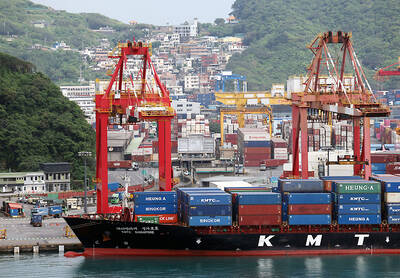
Taiwan’s economy grew far faster than expected in the first quarter, as booming demand for artificial intelligence (AI) applications drove a surge in exports, spilling over into investment and consumption, the Directorate-General of Budget, Accounting and Statistics (DGBAS) said yesterday. GDP growth was 13.69 percent year-on-year during the January-to-March period, beating the DGBAS’ February forecast by 2.23 percentage points and marking the most robust growth in nearly four decades, DGBAS senior official Chiang Hsin-yi (江心怡) told a news conference in Taipei. The result was powered by exports, which remain the backbone of Taiwan’s economy, Chiang said. Outbound shipments jumped 51.12 percent year-on-year to


 RSS
RSS