


Sean Lien (連勝文), a son of former vice president Lien Chan (連戰), was in stable condition in National Taiwan University Hospital’s intensive care unit (ICU) yesterday, recovering from a gunshot wound to the face.
Sean Lien was shot while stumping for a Taipei County councilor candidate at a campaign rally on Friday night. He was initially treated at a hospital in Yonghe City (永和), before being rushed to the university hospital in Taipei, where he underwent more than three-and-a-half hours of surgery.
The bullet entered the left side of his face and exited near his right temple, causing partial fractures to his cheek bones and two open wounds, hospital spokeswoman Tan Ching-ting (譚慶鼎) said.
The operation, which began at 9:53pm on Friday and lasted until 1:30am yesterday, was jointly conducted by craniofacial surgeons and ear, nose and throat doctors, Tan said.
He was then sent to the ICU for further evaluation, Tan said.
Although the doctors said the surgery was successful, they were monitoring Sean Lien’s responses to determine whether a second operation would be needed. They also said the wounds were unlikely to leave obvious scars on his face and it was unlikely his appearance would be significantly altered.
According to the university hospital, Sean Lien said a few words to ICU staff after waking up yesterday morning, a preliminary indication that his vision and language abilities were not impaired.
Sean Lien resigned from his post as chairman of Taipei EasyCard Co early this year for health reasons. He is a member of the Chinese Nationalist Party’s (KMT) Central Committee and works for Taipei City’s Economic Development Commission.
A second man, 29-year-old Huang Yun-sheng (黃運聖), was also hit in the shooting and died before reaching hospital.
The alleged gunman was arrested at the scene and police recovered a 9mm handgun.
Police said the suspect, -identified as Lin Cheng-wei (林正偉), was reportedly a member of a gang in Yonghe.
Police said the suspect claimed he mistook Sean Lien for Taipei County Deputy Council Speaker Chen Hung-yuan (陳鴻源), a candidate for the Sinbei City municipal council, who he said was his intended target.
However, William Hsu (徐弘庭), Sean Lien’s assistant, said his boss regained consciousness after the surgery and said the gunman had shouted his name as he ran toward him on the rally stage.
Family members, including his wife, Patty Tsai (蔡依珊), and Lien Chan visited him at the hospital before casting their votes for the Taipei mayoral election.
Lien Chan said the bullet may have hit his son, but the whole family felt the pain.
He also called for calm and the development of a stable and healthy Taiwan.
“Taiwan’s democratic politics must not walk the path of blood and violence, and I hope Sean Lien’s blood was not spilled in vain,” he said.
Meanwhile, politicians across party lines unanimously condemned the shooting, offered their best wishes to the victims and their families and urged the police to solve the case as soon as possible.
Democratic Progressive Party (DPP) Chairperson Tsai Ing-wen (蔡英文) said the KMT should take responsibility for poor public safety, while Premier Wu Den-yih (吳敦義) said: “Public security was at its worst when Su Tseng-chang (蘇貞昌) was premier and Tsai vice premier.”
“When your knee-jerk reaction is to point a finger at someone else and shirk responsibility, the other four fingers are always pointing at yourself,” Wu said.
ADDITIONAL REPORTING BY SHIH HSIU-CHUAN,
FLORA WANG AND SHELLEY HUANG

‘NO SECURITY RISK’: The Railway Bureau reassured the public that the technicians’ activities were limited to technical guidance and did not involve sensitive systems The Railway Bureau yesterday said it had invited eight Chinese technicians to assist with an airport MRT construction project. The bureau issued the confirmation after an Internet user said Chinese nationals had entered the construction zone of Taiwan Taoyuan International Airport’s Terminal 3 project. They asked why “individuals from an enemy state” were allowed access to such a major national infrastructure project, which raised serious concerns over Taiwan’s industrial safety, sensitive systems and information security. The bureau’s Northern Region Engineering Branch Office said subcontractor Taiwan Handle Industrial Co (台灣手把工業) of the Taoyuan airport MRT’s “Contract No. CU05 Project A14 Station Civil, MEP &

A US uncrewed surface vessel (USV) encountered multiple Chinese warships during an autonomous transit of the Taiwan Strait, US defense company Seasats said in a statement on Wednesday. Seasats announced that a Lightfish USV had completed the first autonomous transit of the Taiwan Strait. Over five days, the USV traversed the entire length of the Strait while constantly monitoring surface vessel traffic, the company said. The Lightfish encountered multiple Chinese warships, one of which was a Chinese People’s Liberation Army Navy (PLAN) Type 056 corvette, it said. The Chinese vessels were operating “well within Taiwan’s exclusive economic zone without transmitting their identity via the

Taiwan is still in the process of assessing the possibility of recruiting workers from Eswatini, the Ministry of Foreign Affairs said yesterday, adding that its goal is to help Eswatini upgrade its vocational training centers. If there are plans to recruit workers from Eswatini, safeguarding national security, protecting public health and ensuring the employment rights of Taiwanese would be prerequisites, Department of West Asian and African Affairs Director-General Yen Chia-liang (顏嘉良) told a news conference. Key considerations would also include filling labor shortages in specific industries, and fostering bilateral professional and technical exchanges, he said. Yen was asked about the progress of labor
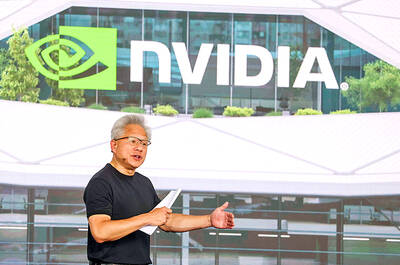
‘BOOMING’: ’ The number of partners we have here is incredible. You can see from their stock prices. They’re doing so well, they’re so happy,’ Jensen Huang said Nvidia Corp’s spending in Taiwan has ballooned to about US$150 billion a year, 10 times the US$10 billion to US$15 billion the company spent five years ago, Nvidia chief executive officer Jensen Huang (黃仁勳) said yesterday, suggesting Taiwan’s strategic importance in the global artificial intelligence (AI) supply chain. “Taiwan is the epicenter of the AI revolution. This is where the chips come, packaging comes. This is where the systems are made. This is where AI supercomputers were created,” Huang said at a meeting for the company’s employees in Beitou-Shilin Technology Park (北投士林科技園區) in Taipei, the planned site of Nvidia’s Taipei headquarters. “Taiwan


 RSS
RSS