


Want Want Group (旺旺集團), the conglomerate with businesses from broadcasting to food, said it’s leading an investment group that agreed to buy cable TV operator China Network Systems Co (中嘉網路) from MBK Partners Ltd.
Chao Yu-pei, special assistant to Want Want’s president, said the group signed the agreement on Monday, but declined to provide financial details.
The investors agreed to buy closely held China Network’s stock for about US$1.4 billion and assume US$1 billion of debt, a person familiar with the matter said, asking not to be identified because the accord is confidential.
The purchase would allow Want Want chairman Tsai Eng-meng (蔡衍明) to expand his media assets in a market where almost 80 percent of homes tune in to cable TV. For MBK, the sale would help the private equity fund, founded by former Carlyle Group executives, collect more than double the US$600 million it spent buying China Network’s stock more than three years ago.
“If Want Want has media outlets covering the entire Greater China, companies who want to buy advertisements can do it cost effectively,” said Monika Yang, who helps oversee almost US$2 billion at Hamon Asset Management Ltd in Hong Kong. “They are already very successful in the consumer front.”
Want Want outbid Permira Advisers LLP, which teamed up with Ruentex Group (潤泰集團), Macquarie Group Ltd and Bain Capital LLC, the person said. Choosing a Taiwanese buyer will help obtain regulatory approval, the person said.
The sale comes as Daniel Tsai (蔡明忠) and Richard Tsai (蔡明興) — no relation to Tsai Eng-meng — seek to approval to buy Kbro Co (凱擘), the nation’s top cable TV operator, from Carlyle Group.
The National Communications Commission (NCC) said on Oct. 6 it would seek public and expert opinion before deciding whether to approve the purchase of Kbro.
MBK, which bought China Network with the Koo family, effectively controls the cable TV operator through a preference-share arrangement with the local partner, people familiar with the plan said in August.
China Network had 1.05 million subscribers at the end of last year, giving it a 21 percent market share of Taiwan’s cable TV market, while Kbro had a 22 percent share with 1.11 million customers, the NCC said in a July report.
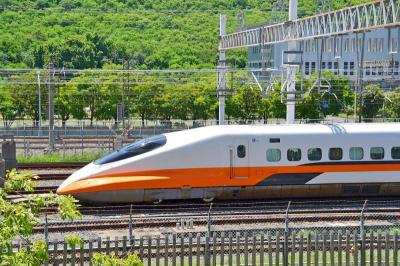
A signaling system malfunction disrupted high-speed rail (HSR) services beginning at 8am today, with trains temporarily reduced to three northbound and three southbound trains per hour as authorities conduct inspections. The malfunction occurred on a section of track in Miaoli County during pre-operation checks early this morning, forcing northbound and southbound trains to use a single track, the HSR operator said. The regular schedule has been replaced with three hourly trains offering only nonreserved seating in each direction, stopping at every station, it said, adding that business class cars would still have reserved seating. Departures from terminal stations are scheduled at the top

DRONE CENTRAL: Taiwan aims to become Asia’s democratic hub for drones, with most exports focused on high-quality military-grade models, an official said Taiwan’s drone industry is expected to expand significantly by 2030, producing 100,000 units per month and exporting half of them, the Ministry of Economic Affairs said yesterday. Current drone production capacity is about 15,000 units per month, but the industry can quickly scale up as demand increases, Industrial Development Administration Director-General Chiou Chyou-huey (邱求慧) told a news conference in Taipei. Taiwan’s drone output grew 2.5-fold last year to NT$12.9 billion (US$408.3 million) under a government program to develop the uncrewed vehicle sector, he said. The Executive Yuan in October last year approved plans to invest NT$44.2 billion into domestic production of uncrewed aerial

VERBOSE VESSELS: A CGA cutter and a China Coast Guard exchanged verbal barbs for more than a day in Taiwanese-controlled waters before the Chinese vessel left The Taiwanese and Chinese coast guards had a standoff near the strategically located Pratas Islands (Dongsha Islands, 東沙群島) in the north of the South China Sea, the Coast Guard Administration (CGA) said yesterday. The two sides engaged in intense radio exchanges over sovereignty claims during the 33-hour standoff. China Coast Guard vessel 3501 eventually left the restricted waters, 26.6 nautical miles (49.2km) west of the Pratas Islands, at 5pm yesterday, the CGA said. Lying approximately between southern Taiwan and Hong Kong, the Taiwan-controlled Pratas are seen by some security experts as vulnerable to Chinese attack due to their distance — more than
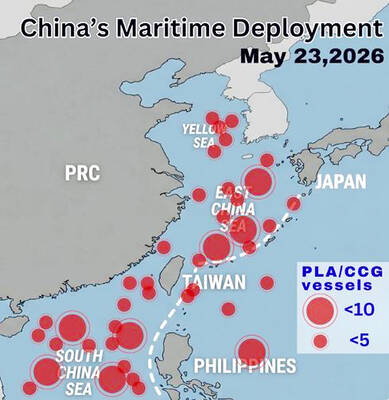
WARNING: China should stop engaging in actions that undermine regional peace and stability, as it would only build resentment among people across the Strait, the CGA said China has deployed more than 100 navy, coast guard and other vessels in waters from the Yellow Sea to the South China Sea and the western Pacific since US President Donald Trump and Chinese President Xi Jinping (習近平) met in Beijing, National Security Council Secretary-General Joseph Wu (吳釗燮) said yesterday. “In this part of the world, #China is the one & only PROBLEM wrecking the #StatusQuo & threatening regional peace & stability,” Wu wrote on X. In a separate post, he said Beijing was coercing Taiwan’s maritime domain, calling it illegal and provocative, after the Coast Guard Administration (CGA) expelled a


 RSS
RSS