

The Taipei District Prosecutors’ Office yesterday began probing the purchase plans for the Xinsheng Overpass reconstruction project, charging five people with corruption after searching more than 20 sites.
Prosecutors yesterday morning led agents from the Ministry of Justice’s Investigation Bureau to search a total of 27 locations, including the New Construction Department, Join Engineering Consultants (昭凌顧問工程公司), Kung Sing Engineering Corp (工信工程公司), Evergreen Construction Corp (長鴻營造公司), Hwang Chang Builds (皇昌營造公司) and residences of officials associated with the construction companies.
Investigators questioned 16 people, including former New Construction Department director Huang Hsi-hsun (黃錫薰), New Construction Department Vice Director Lin Ching-fan (林慶釩), former New Construction Department chief engineer Chang Li-yan (章立言) and officials of the construction companies.
The interrogations were still proceeding at press time last night. Of the 16 people, Huang, Lin, Chang Li-yan, former New Construction Department section chief Chen Chih-sheng (陳智盛) and Join Engineering Consultants employee Lee Mei (李媺) are standing as defendants, while the rest are witnesses.
The Xinsheng Overpass scandal is part of prosecutors’ investigation into the exorbitant prices paid by the city government for flowers to be planted under the highway.
The investigation also follows a complaint by a group of Democratic Progressive Party (DPP) Taipei City councilors alleging possible negligence of duty and possible acts of bribery by Taipei Mayor Hau Lung-bin (郝龍斌) in handling the overpriced project.
The city government also formed a task force to look into the project and last week sent project contractor Join Engineering Consultants and the three former officials with the department to prosecutors for further investigation.
Soon after the prosecutors searched the department, Hau visited to show his support to department workers and accused the opposition party of politicizing the project and the flora expo to defeat him in November’s Taipei mayoral election.
“We should face all the challenges and criticism over the mistakes we made. However, I am sorry that city workers in the city government, especially at the department, have to be placed under so much pressure because of the election,” he said.
Hau said he expected the prosecutors to complete their investigation as soon as possible, adding that he believed the civil servants in the case were innocent.
While Hau promised to face the disputes surrounding the overpass project and expo, Taipei City’s Public Works Bureau proposed a new regulation on Monday night to ban media and city councilors from entering expo sites without making an appointment.
The proposed regulation required reporters and city councilors to make reservations with the expo’s organizing committee before entering exhibition sites. The reservation would take about three to 10 days for approval.
The proposal was drafted amid a string of DPP accusations and criticism against the expo. Since the scandal of the overpriced flowers broke last month, DPP Taipei City councilors have made frequent trips to different expo sites around the city to inspect the construction projects.
The city government’s latest move irritated the DPP Taipei City Council caucus, with Taipei City councilors Chien Yu-yen (簡余晏) and Lee Ching-feng (李慶鋒) accusing the city government of violating councilors’ rights to oversee municipal projects.
“The proposed regulation is clearly drafted to avoid city councilors’ on-site inspection of the expo construction and overall supervision of the expo. It’s a serious violation and disrespects our rights,” Chien said.
Hau said the bureau drafted the regulation because the construction projects would be completed soon and banning irrelevant personnel from entering the sites was to protect their safety at the construction sites.
The draft will be sent to the Taipei City Council for discussion today.
Also See: Hau loss could hurt Ma: Jaw Shaw-kong

Taiwan, which accounts for more than half of the global outsourced semiconductor assembly and testing market, is well-positioned to develop copackaged optics (CPO) and manufacture precision silicon photonics chips, the Ministry of Economic Affairs said yesterday. Silicon photonics are emerging as a mainstream optical communications technology and is seen as key to overcoming bottlenecks in AI computing power. The technology is a key project under the government’s New 10 Major AI Infrastructure Projects, with industry, government, academia and research institutions working to overcome critical technological hurdles and build a self-reliant silicon photonics supply chain, the ministry said. Nvidia Corp in March invested US$4
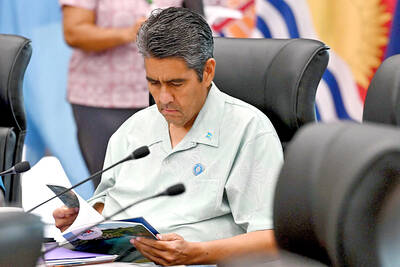
Palau’s president yesterday called for a “unified” Pacific response to a missile test by China in July, while Taiwan and its Pacific allies a day earlier at the Pacific Islands Forum (PIF) reaffirmed their commitment to peace, stability and prosperity. China gave only a handful of nations short notice before test-firing an intercontinental ballistic missile in July, sparking condemnation from several Pacific leaders. The 18-member PIF being held in Palau was expected to release a communique after press time last night, with a formal response to the test possibly included. Palau, which invited Taiwan to attend sideline events as an aid partner, urged
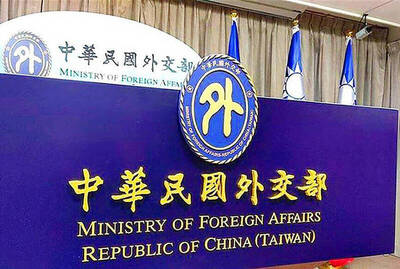
China’s continued efforts to inject geopolitical rivalry into the region and disrupt Pacific nations’ discussions of regional issues warrant greater international attention, a foreign affairs official said yesterday. Minister of Foreign Affairs Lin Chia-lung (林佳龍) last week led a delegation to diplomatic ally Palau to attend events related to the 55th Pacific Islands Forum (PIF) summit. However, the absence of some member-state leaders has been interpreted by some people as a sign of fracturing in Pacific unity. Thirteen PIF members were represented by their heads of state or government, while Fiji, New Caledonia, Vanuatu and Samoa sent ministerial-level representatives, a diplomatic official

STATE DEPARTMENT: A US official said that Washington would provide more than US$150m for Pacific island nations, with Minister Lin Chia-lung welcoming the plans The US Department of State has announced partnerships with Taiwan on two Palau projects after Washington pledged more than US$150 million for Pacific island nations. Following the opening of the 55th Pacific Islands Forum (PIF) Leaders Meeting in Palau on Sunday, the department on Tuesday issued a statement titled “Promoting Pacific Prosperity: US Engagement at the Pacific Islands Forum,” which said that the US’ commitment to the security and prosperity of Pacific island nations “is steadfast and enduring, and remains a core pillar of its ‘America first’ foreign policy.” Meanwhile, US Deputy Secretary of State Christopher Landau announced at the PIF Partners


 RSS
RSS