


A recent investigation into allegations of bribery against the Democratic Progressive Party’s (DPP) Taichung mayoral candidate, Su Jia-chyuan (蘇嘉全), has DPP officials questioning whether it was politically motivated.
“This issue doesn’t look like it has anything to do with bribery — yet they are [wasting] the resources of police and prosecutors,” DPP Chairperson Tsai Ing-wen (蔡英文) said yesterday, referring to the event in which Su, while meeting with the coach and players from Shi Yuan Senior High School hours before they left for the World Junior Baseball Championships in the US last month, gave the group a NT$20,000 donation and promised them a dinner when they came back.
“They shouldn’t act rashly on this, as it could have important implications for the upcoming elections,” Tsai said.
Team coach Huang Wu-hsiung (黃武雄) was questioned by prosecutors last week for accepting Su’s donation on behalf of the team.
Su, a former minister of the interior, said he only wanted to encourage the players and give them some financial support before they left. The check came from a group of team supporters who had asked Su to present it on its behalf, he said.
“All I did was … represent this group of supporters to encourage our aspiring national athletes, but if the prosecutors should be questioning anybody, it should be me and not the coach,” Su said.
He also asked why his support for the team before their departure was questioned, but it was fine when his opponent, Taichung Mayor Jason Hu (胡志強) of the Chinese Nationalist Party (KMT), treated the entire team to a lavish dinner after they won the title.
“It almost seems like it’s okay when they try ‘to add flowers to the brocade,’ but I have problems when I try ‘to give a gift of charcoal in snowy weather,’” Su said.
Ministry of Justice regulations on election bribery state that gifts by candidates should be kept under NT$30. However, in revisions published last September, the ministry said cash or gifts given for activities, including temple events, weddings and other “cultural events,” should be exempted.
Lin Feng-jeng (林峰正), executive director at the Judicial Reform Foundation, said since Su was not an official candidate yet — registration for the elections begins later this month — the regulations shouldn’t applys.
“Based on this fact alone, the investigation is completely groundless,” he said. “Besides, when we talk about bribery, it’s clearly aimed at money that influences voting behavior — something that is missing from the picture when we consider that the players are high school students.”
“What’s next? Are we going to start investigating politicians who give donations at temples or red envelopes at weddings?” he said.
According to the Taichung District Prosecutors Office, the investigation started after it received a public complaint about the gift.
At a separate setting, when asked for comment yesterday, Hu said there was nothing wrong about him in his capacity as the city mayor treating the team to a meal to celebrate its victory.
ADDITIONAL REPORTING BY STAFF WRITER
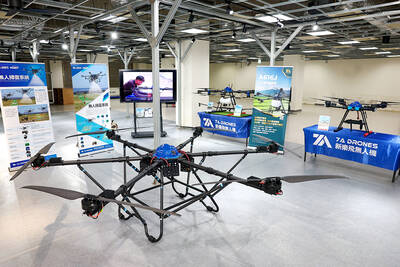
DRONE CENTRAL: Taiwan aims to become Asia’s democratic hub for drones, with most exports focused on high-quality military-grade models, an official said Taiwan’s drone industry is expected to expand significantly by 2030, producing 100,000 units per month and exporting half of them, the Ministry of Economic Affairs said yesterday. Current drone production capacity is about 15,000 units per month, but the industry can quickly scale up as demand increases, Industrial Development Administration Director-General Chiou Chyou-huey (邱求慧) told a news conference in Taipei. Taiwan’s drone output grew 2.5-fold last year to NT$12.9 billion (US$408.3 million) under a government program to develop the uncrewed vehicle sector, he said. The Executive Yuan in October last year approved plans to invest NT$44.2 billion into domestic production of uncrewed aerial
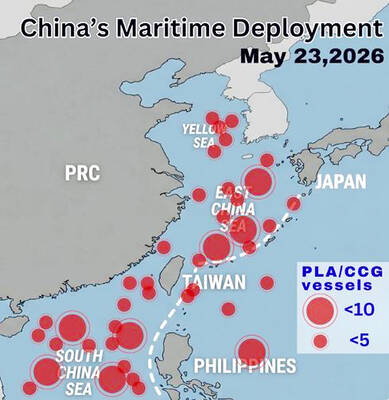
WARNING: China should stop engaging in actions that undermine regional peace and stability, as it would only build resentment among people across the Strait, the CGA said China has deployed more than 100 navy, coast guard and other vessels in waters from the Yellow Sea to the South China Sea and the western Pacific since US President Donald Trump and Chinese President Xi Jinping (習近平) met in Beijing, National Security Council Secretary-General Joseph Wu (吳釗燮) said yesterday. “In this part of the world, #China is the one & only PROBLEM wrecking the #StatusQuo & threatening regional peace & stability,” Wu wrote on X. In a separate post, he said Beijing was coercing Taiwan’s maritime domain, calling it illegal and provocative, after the Coast Guard Administration (CGA) expelled a

VERBOSE VESSELS: A CGA cutter and a China Coast Guard exchanged verbal barbs for more than a day in Taiwanese-controlled waters before the Chinese vessel left The Taiwanese and Chinese coast guards had a standoff near the strategically located Pratas Islands (Dongsha Islands, 東沙群島) in the north of the South China Sea, the Coast Guard Administration (CGA) said yesterday. The two sides engaged in intense radio exchanges over sovereignty claims during the 33-hour standoff. China Coast Guard vessel 3501 eventually left the restricted waters, 26.6 nautical miles (49.2km) west of the Pratas Islands, at 5pm yesterday, the CGA said. Lying approximately between southern Taiwan and Hong Kong, the Taiwan-controlled Pratas are seen by some security experts as vulnerable to Chinese attack due to their distance — more than
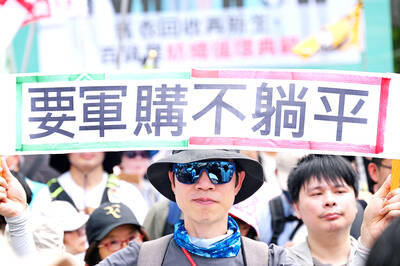
More than 8,000 people took part in a rally in Taipei yesterday to express support for more defense spending, after the opposition slashed the Cabinet’s proposed NT$1.25 trillion (US$39.6 billion) special defense budget and capped it at NT$780 billion. The demonstrators urged the Cabinet to propose another bill. Taiwan Economic Democracy Union convener Lai Chung-chiang (賴中強) said the main problem of the passed budget plan is the removal of funding for critical items, not just that the total amount is smaller. Critical budget items included purchasing or developing uncrewed vehicles, Strong Bow (強弓) missile systems, additional ammunition, artificial intelligence-powered combat systems and Taiwan-US


 RSS
RSS