


Six Democratic Progressive Party (DPP) Taipei City councilors yesterday filed a lawsuit against Taipei Mayor Hau Lung-bin (郝龍斌), accusing him of negligence after a city contractor was found to have been paid about 30 times the market price for roadside flowers.
Documents obtained from the New Construction Department at the city’s Bureau of Public Works show a contractor working on an overpass beautification project billed the city millions of dollars above market prices routinely paid by government agencies to buy plants and flowers.
In one case, Join Engineering Consultants (昭凌工程顧問), billed the city more than NT$120,000 (US$3,748) for planting 400 Wedelia underneath the Xinsheng Overpass. The tiny yellow flower normally retails for NT$9.
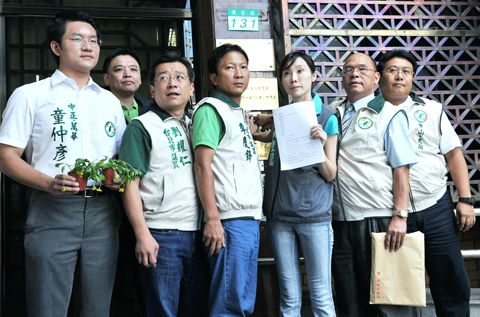
PHOTO: CNA
The company also billed the city government more than NT$425 each for bulbs of an evergreen vine for which the city’s parks department normally pays about NT$100.
A small seashore ardisia bulb that routinely sells for NT$38 was billed for NT$580.
The price differential has left DPP councilors wondering whether the contract involved kickbacks to city officials or if the officials in charge of screening the costs simply failed to take a close look.
“The Taipei City Government is either very good at spending money or simply careless in how it chooses to spread it. Regardless, it’s a sloppy waste of taxpayers’ money,” Taipei City Councilor Yen Sheng-kuan (顏聖冠) said.
The city councilors also accused Hau of illegally giving the contractor special benefits.
The entire sum under question is just under NT$24 million, part of a NT$262 million contract to beautify the Xinsheng Overpass.
The cost of the flowers has also raised questions over their relationship to the Taipei International Flora Exposition because the overpass runs alongside the main site.
Yen said the beautification contract, while not counted in the expo budget, should still be seen as a flora expo project, adding that there could be other cases of excess inside the expo budget.
Taipei City Government spokesperson Chao Shin-pin (趙心屏) said the Join Engineering Consultants contract was part of the Xinsheng Overpass reconstruction project.
The overpass underwent a renovation in 2008 at a cost of NT$1.3 billion and was reopened last year, she said, adding that the flowers and plants were used to decorate the bridge.
“The project has nothing to do with the flora expo, we will not allow anyone to criticize the expo using information that is incorrect. We will exercise our legal rights against politicians, talk show guests or media outlets that spread rumors about the expo,” she said.
The city urged the city councilors to apologize both to Hau and for wasting judicial resources.
Taipei Deputy Mayor Lee Yong-ping (李永萍) said the overpass project was handled by the New Construction Department and supervised by the Bureau of Public Works. Join Engineering Consultants should also be held responsible, she said.
“DPP councilors know that we have divisions of labor in the city government and that the budget and the implementation of the project was handled by the [New Construction] department. How would Mayor Hau know details of the project?” Lee asked a press conference, slamming the DPP councilors for politicizing the issue by suing Hau.
Meanwhile, the bureau held a disciplinary committee meeting yesterday morning and announced that it would be reprimanding New Construction Department chief engineer Chang Li-yen (章立言) and section chief Chen Chih-sheng (陳智盛) for their poor supervision.
The city’s Department of Ethics said it has also reported Join Engineering Consultants to prosecutors for investigation into whether corruption had been involved.
A spokesperson for the company told the Taipei Times they had not received any information on the city’s investigation.
Speaking on condition of anonymity due to a privacy clause in the contract, the spokesperson denied over-billing the city for flowers and was considering a lawsuit.

PROVOCATIVE: Chinese Deputy Ambassador to the UN Sun Lei accused Japan of sending military vessels to deliberately provoke tensions in the Taiwan Strait China denounced remarks by Japan and the EU about the South China Sea at a UN Security Council meeting on Monday, and accused Tokyo of provocative behavior in the Taiwan Strait and planning military expansion. Ayano Kunimitsu, a Japanese vice foreign minister, told the Council meeting on maritime security that Tokyo was seriously concerned about the situation in the East China and South China seas, and reiterated Japan’s opposition to any attempt to change the “status quo” by force, and obstruction of freedom of navigation and overflight. Stavros Lambrinidis, head of the EU delegation to the UN, also highlighted South China Sea

SILENCING CRITICS: In addition to blocking Taiwan, China aimed to prevent rights activists from speaking out against authoritarian states, a Cabinet department said The Ministry of Foreign Affairs (MOFA) yesterday condemned transnational repression by Beijing after RightsCon, a major digital human rights conference scheduled to be held in Zambia this week, was abruptly canceled due to Chinese pressure over Taiwanese participation. This year’s RightsCon, the world’s largest conference discussing issues “at the intersection of human rights and technology,” was scheduled to take place from tomorrow to Friday in Lusaka, and expected to draw 2,600 in-person attendees from 150 countries, along with 1,100 online participants. However, organizers were forced to cancel the event due to behind-the-scenes pressure from China, the ministry said, expressing its “strongest condemnation”
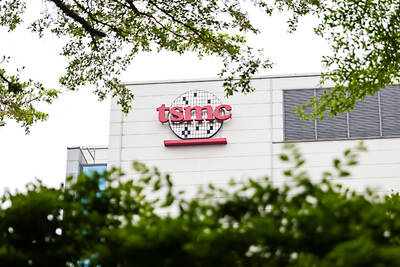
Taiwan Semiconductor Manufacturing Co (TSMC, 台積電), the world’s largest contract chipmaker, said it expects its 2-nanometer (2nm) chip capacity to grow at a compound annual rate of 70 percent from this year to 2028. The projection comes as five fabs begin volume production of 2-nanometer chips this year — two in Hsinchu and three in Kaohsiung — TSMC senior vice president and deputy cochief operating officer Cliff Hou (侯永清) said at the company’s annual technology symposium in Silicon Valley, California, last week. Output in the first year of 2-nanometer production, which began in the fourth quarter of last year, is expected to
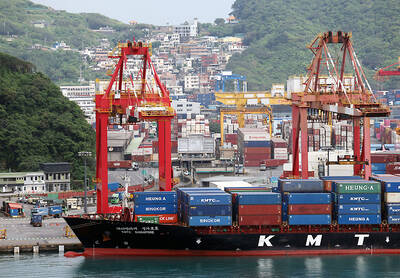
Taiwan’s economy grew far faster than expected in the first quarter, as booming demand for artificial intelligence (AI) applications drove a surge in exports, spilling over into investment and consumption, the Directorate-General of Budget, Accounting and Statistics (DGBAS) said yesterday. GDP growth was 13.69 percent year-on-year during the January-to-March period, beating the DGBAS’ February forecast by 2.23 percentage points and marking the most robust growth in nearly four decades, DGBAS senior official Chiang Hsin-yi (江心怡) told a news conference in Taipei. The result was powered by exports, which remain the backbone of Taiwan’s economy, Chiang said. Outbound shipments jumped 51.12 percent year-on-year to


 RSS
RSS